
A star delta starter limits the starting current of a large induction motor by starting the windings in star, which applies about 58% (1/√3) of line voltage and cuts starting current to roughly one-third, then switching to delta for full-voltage running. The trade-off is lower starting torque and a switching surge risk.
Imagine a 25 HP induction motor in perfect condition, on a normal supply. Yet every time you start it, the whole feeder trips. Direct-on-line starting works well for small motors, so why does it fail for a larger one?

The answer is starting current, and it is why large motors need a starter. This article explains the problem, how a star delta starter solves it, how its control circuit works, and where it falls short.
Why Does an Induction Motor Draw High Starting Current?
An induction motor draws high starting current because the rotor is stationary while the rotating magnetic field already turns at synchronous speed, so slip is at its maximum.

The moment supply is connected, the stator field rotates at full speed, but the rotor has not moved. That large speed gap is the slip, and a large slip means the motor draws a large current. As the rotor gains speed, slip falls and the current drops with it. How an induction motor works explains slip in more detail.
The starting current can be five to seven times the full-load current. The major induction motor drawbacks article covers this problem in more depth.
What Problems Does High Starting Current Cause?
High starting current overloads the motor insulation, wiring, and protection, and it disturbs other equipment on the same supply.
Take a worked example. A motor is rated 1,000 kW at 6.6 kV, with 95% efficiency and a full-load power factor of 0.88.
Full-load current: about 105 A.
Wiring and protection: selected around that current, say 150 A cables and matching protection.
Starting current at 6x: about 630 A.
Apparent power drawn at start: about 7.2 MVA, mostly reactive because the power factor at standstill is very low.
The motor insulation and the wiring were never designed for 630 A. Sensitive equipment on the same line may trip as well. The surge lasts only a few seconds, falling as the rotor speeds up, but four to six seconds is enough to cause trouble.

It is like starting a car directly in third gear. You get a jerk, the vehicle is stressed, and the passengers suffer. The sensible approach is to start in first gear and move up gradually.
How Can You Limit the Starting Current of an Induction Motor?
You can limit starting current by reducing the voltage applied to the motor during starting, because lower voltage means lower current.
You cannot change the motor or the incoming factory supply, but you can change what the motor receives locally. One way is to connect the windings in star. In a star connection, the phase voltage is 1/√3 of the line voltage. For a 6.6 kV motor, that means the windings see about 3.81 kV. The starting current falls from 630 A to roughly 210 A, and the apparent power falls with it.

That is a big improvement, but it cannot last. At 3.81 kV the motor cannot deliver full load performance. So after the motor has accelerated, usually after about 5 to 10 seconds depending on the motor and load, the windings must be switched to delta, where the motor gets the full 6.6 kV and runs normally.
What is a Star Delta Starter?
A star delta starter is a motor starter that connects the windings in star during starting to limit current, then automatically switches them to delta for running.

Doing this by hand is not practical. A manual switchover risks an inconsistent transition period, so the changeover is automated with contactors and a timer. The method is simple and inexpensive, which is why it is so widely used, though it has two drawbacks covered below.
How Does the Star Delta Control Circuit Work?

The star delta circuit has a power circuit that feeds the motor and a control circuit that operates the contactors in sequence.
The power circuit takes three-phase supply (L1, L2, L3) through fuses and an overload relay to the motor, which has six winding terminals (U1, V1, W1 and U2, V2, W2) so it can be wired either way. The control circuit uses a 24 V auxiliary supply.
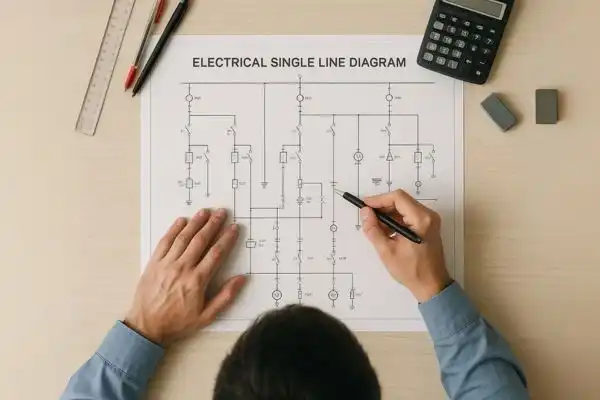
Reading a diagram like this follows the 5-step method for reading electrical schematics. The same method is the foundation of the Circuit Breaker Control Schematics Masterclass, which applies it to circuit breaker control circuits.
What Does Each Component Do?
Each label on the diagram has one job in the starting sequence.
Label | Component | Purpose |
L1, L2, L3 | Three-phase supply | Main power supply to the motor |
24 V / N | Control supply | Powers the relays, contactors, and timer |
Q1 | Switching / isolating device | Isolates the starter from the motor. Its auxiliary contacts are used in the control circuit |
F2 | Power fuses | Short-circuit protection for the motor circuit |
F3 | Control-circuit fuse | Protects the 24 V control circuit |
F1 | Motor overload relay | Protects against sustained overload. Its NC contact (95-96) opens the control circuit if it trips |
SH1 | START pushbutton (NO) | Energises the control circuit |
SH2 | STOP pushbutton (NC) | Interrupts the control circuit |
K1 | Control relay | Part of the START/STOP holding circuit. Its auxiliary contact keeps the circuit energised after START is released |
K2 | Main contactor | Connects supply to the motor. Closed in both star and delta |
K4 | Star contactor | Joins the three winding ends to form the star point during starting |
K3 | Delta contactor | Reconnects the windings in delta for running |
K5 | Star delta timer | Sets how long the motor runs in star, then starts the changeover |
K6 | Auxiliary / interposing relay | Extra control or permissive relay associated with F1. Specific to this circuit, not essential in every star delta starter |
U1, V1, W1 / U2, V2, W2 | Motor winding terminals | Winding ends, reconfigured by K4 (star) and K3 (delta) |
PE | Protective earth | Connects the motor frame to earth |
Contact numbers such as 11-12 (normally closed) and 13-14 (normally open) are auxiliary contact terminals. Normally closed contacts are mainly used for interlocking, for example so the star and delta contactors cannot be energised together. Normally open contacts are used for holding, status, or permissive functions.
What is the Starting and Running Sequence?
The sequence runs automatically after one push of the START button.
Start: SH1 is pressed and K1 energises and latches. K2 (main) and K4 (star) close, and timer K5 starts counting.
Motor starts in star: With K4 closed, the winding ends form a star point. Voltage across each winding falls, and so does the starting current.
Motor accelerates: It runs in star for the time set on K5, close to its normal speed.
Star contactor opens: After the preset time, K5 changes over and K4 opens. A short transition period follows before delta closes.
Delta contactor closes: K3 closes and reconnects the windings in delta. The motor receives full voltage and runs at rated speed, with K2 still closed.
Stop: SH2 is pressed, or F1 trips on overload. The control circuit is interrupted, the contactors open, and the motor is disconnected.
What Are the Drawbacks of a Star Delta Starter?
A star delta starter has two major drawbacks: reduced starting torque and a switching surge at the star-to-delta transition.

Limited starting torque. Lowering the voltage limits the current, and the starting torque falls with it. Applications that need high starting torque are not suited to this method. It also gives no speed control.
Switching surge. During the star-to-delta changeover, the motor is disconnected from supply for a brief moment but keeps turning from inertia and generates a residual voltage. When it reconnects in delta, that residual voltage may not match the supply, which can create a switching surge. For large motors, a switching surge study is recommended before using star delta starting.
What Are the Alternatives to a Star Delta Starter?
The alternatives are direct-on-line starters for small motors, closed-transition star delta, soft starters, and variable frequency drives.
Starting Method | Notes |
Direct-on-line | Good enough for smaller motors |
Star delta (open transition) | Simple and inexpensive, fixed speed, limited starting torque, switching surge risk |
Closed-transition star delta | Adds resistors and circuitry so the motor never disconnects, but is more complex and more expensive |
Soft starter | More advanced than star delta |
Variable frequency drive | More advanced than star delta, also gives speed control |
When Should You Use a Star Delta Starter?
Use a star delta starter for fixed-speed applications where the starting torque requirement is low and starting current must be limited.
If the load needs high starting torque or variable speed, a different method is the better fit. For small motors, direct-on-line starting is often enough. Starter selection should also follow the relevant standard.
FAQ
How much does a star delta starter reduce starting current?
In star, each winding sees about 58% of line voltage, and the starting current falls to roughly one-third of the direct-on-line value. In the 1,000 kW, 6.6 kV example, it drops from about 630 A to about 210 A.
How long does the motor run in star before switching to delta?
The timer sets it, typically about 5 to 8 seconds depending on the motor and load. The aim is to let the motor accelerate close to normal speed before the changeover.
Why is a star delta starter unsuitable for high-torque starts?
Reducing the voltage lowers the starting current, and the starting torque falls with it. Loads that need strong torque at start, or any speed control, need a different method such as a soft starter or drive.
Why must the star and delta contactors never be energised together?
An interlock using normally closed auxiliary contacts prevents K3 and K4 from being energised at the same time, so the windings are never connected in star and delta together.
What is the difference between open and closed transition star delta?
In open transition, the motor is briefly disconnected during changeover, which can cause a switching surge. Closed transition adds resistors and extra circuitry so the motor is never fully disconnected, but it is more complex and more expensive.
Conclusion
Large induction motors need a starter because the starting current can be several times the full-load current, which stresses the motor, the wiring, and the rest of the supply. A star delta starter solves this by starting the motor in star on reduced voltage, then switching automatically to delta for running.
It is simple and inexpensive, but its limited starting torque, fixed speed, and switching surge risk mean it suits only certain applications, and soft starters or drives are better for others.
To see the control circuit explained step by step, watch my complete video on the TheElectricalGuy YouTube channel.
Watch the Youtube Video

About Author
Gaurav Joshi
Gaurav started his career on the floor of the electrical industry — not in a classroom. Working across Siemens and Schneider Electric, he saw firsthand how wide the gap was between what colleges teach and what the industry actually needs.
So he did something about it.
Today, he's built a global community of 300,000+ engineers and professionals across YouTube and beyond — and TheElectricalGuy Academy is where that knowledge lives in its most structured, practical form.