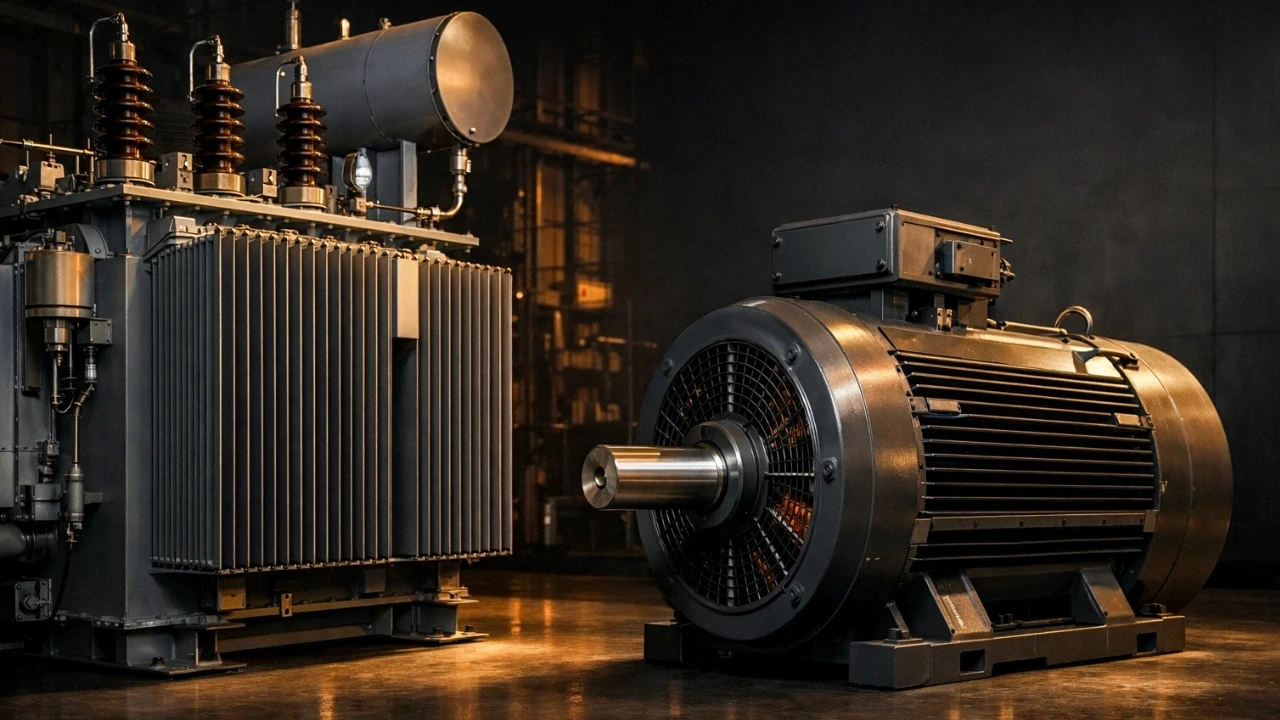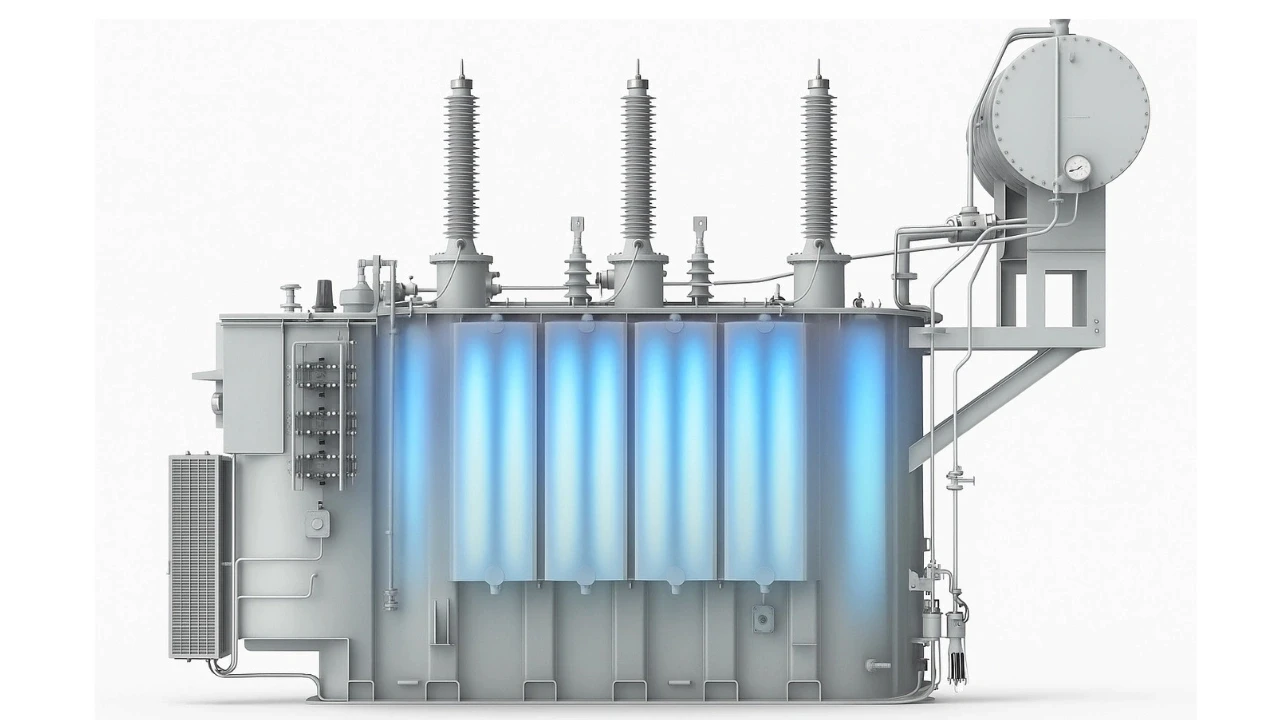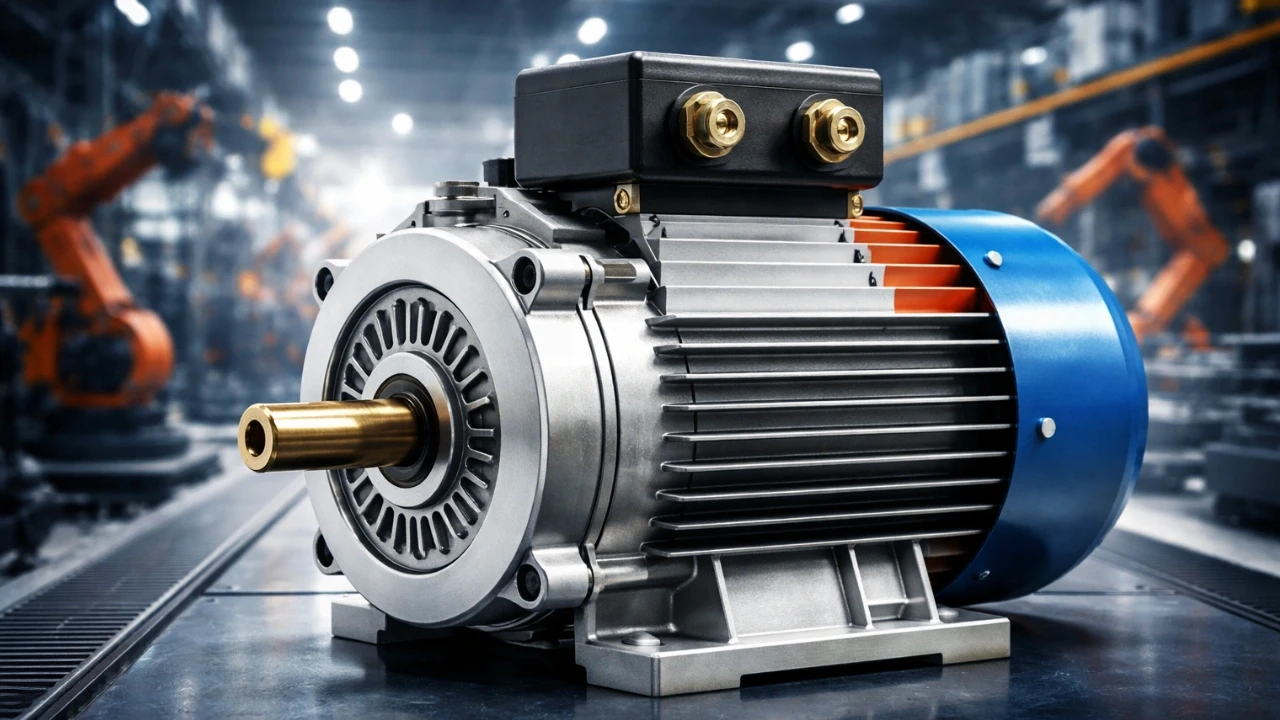

An induction motor works by using a rotating magnetic field, created by three phase AC supply in the stator, to induce voltage and current in the rotor through electromagnetic induction. That rotor current, combined with the Lorentz force, produces torque and turns the rotor. Because the rotor always runs slightly slower than the magnetic field (a gap called slip), induction motors are also known as asynchronous motors.
The induction motor is often called the workhorse of industry, and across the sites I have worked on I have rarely seen a plant that does not lean on it. It powers pumps, fans, compressors, conveyors, and countless industrial machines. What makes it interesting is that no direct electrical supply is given to the rotor, yet the rotor rotates and produces mechanical output.
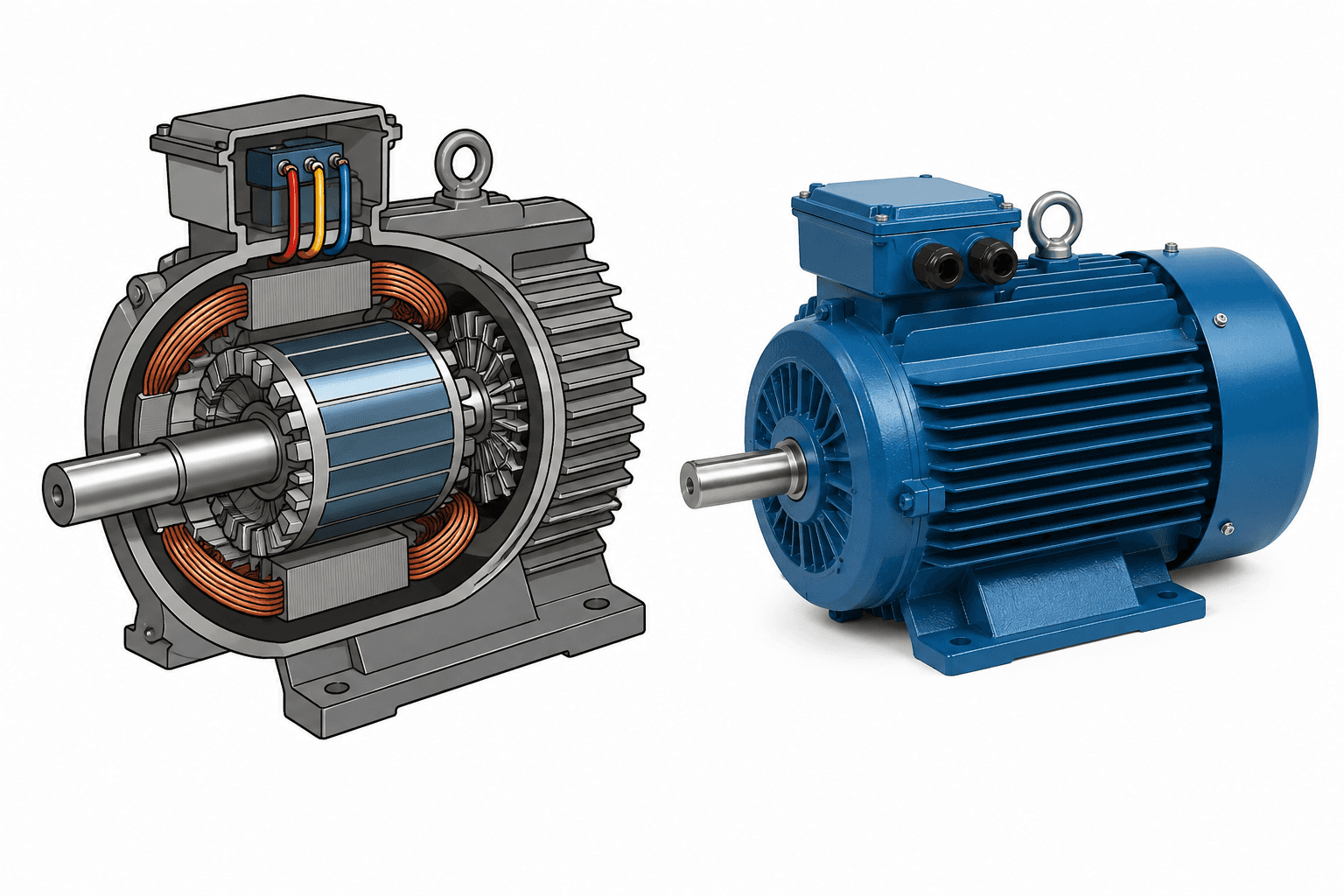
In a DC motor, current reaches the armature through brushes and a commutator. In a squirrel cage induction motor, there are no brushes, no commutator, and no direct electrical connection to the rotor. So where does the rotor current come from, and how is torque developed? The working principle of the induction motor answers both questions, starting with a basic electrical principle.
What is Faraday's Law of Electromagnetic Induction?
Faraday's Law states that induced voltage is directly proportional to the rate of change of magnetic flux, so increasing the speed of relative motion between a magnet and a conductor increases the induced voltage.
Imagine a permanent magnet placed near a copper conductor. The magnet produces a magnetic field around it. If the magnet is moved, the magnetic field linked with the conductor changes. Connect a voltmeter across the conductor and you will see a voltage appear, even though no direct supply is connected to it. This is Faraday's Law in action.
One important point: either the magnet can move or the conductor can move, the result is the same. What matters is the relative motion between the magnetic field and the conductor.
How Does Induced Voltage Become Mechanical Motion?
Induced voltage becomes mechanical motion when it drives current through a closed conductor loop sitting inside a magnetic field. The current carrying conductor then experiences a force and moves.
Take two conductors connected together by end rings, forming a closed electrical path. As the magnetic field moves:
Step 1: Voltage is induced in the conductors due to Faraday's Law.
Step 2: Since the conductors are short circuited, current starts flowing through them.
Step 3: The current carrying conductors are now placed inside a magnetic field.
Step 4: According to the Lorentz force, a current carrying conductor inside a magnetic field experiences a force.
Step 5: This force causes the conductor to move.
At this stage, electrical energy is being converted into mechanical motion. This is the basic motor action.
Why is a Rotating Magnetic Field Necessary?
A rotating magnetic field is necessary because the conductor moves only while the magnetic field is changing. For continuous rotation, that change has to be continuous too.
This is why induction motors use AC supply. A DC supply produces a constant magnetic field and does not naturally create a rotating field. A three phase AC supply, however, creates a continuously rotating magnetic field, the foundation of the induction motor's working principle.
How is a Practical Induction Motor Built?
A practical induction motor is built from two main parts: a stator that creates the rotating magnetic field, and a rotor that the field acts on.
What is the Stator?
The stator is the stationary part of the motor, built from a set of three phase windings inside a fixed frame. When three phase AC supply is connected to the stator windings, a rotating magnetic field is produced.
What is Synchronous Speed?
Synchronous speed is the speed of the rotating magnetic field itself, not the speed of the rotor. This distinction matters for everything that follows.
What is the Rotor?
The rotor is the rotating part of the motor: a set of conductors arranged in a circular structure, placed inside the stator and short circuited at both ends.
How is Torque Produced in an Induction Motor?
Torque is produced when the rotating magnetic field induces current in the rotor, and that current then interacts with the same magnetic field to generate a turning force.
Step 1: The stator creates a rotating magnetic field.
Step 2: The rotating magnetic field cuts the rotor conductors.
Step 3: Voltage is induced in the rotor conductors due to Faraday's Law.
Step 4: Because the rotor conductors are short circuited, current starts flowing.
Step 5: The current carrying rotor conductors experience the Lorentz force.
Step 6: The force creates torque.
Step 7: The rotor begins rotating in the same direction as the rotating magnetic field.
The rotor receives no direct electrical supply. Instead, rotor current is induced by electromagnetic induction. That is why it is called an induction motor.
Why is It Called an Induction Motor?
It is called an induction motor because rotor current is created entirely through electromagnetic induction, not a direct electrical connection.
Unlike many other motor types, current is not supplied directly to the rotor. The rotating magnetic field induces voltage in the rotor conductors, and that induced voltage produces rotor current. Hence, induction motor.
What Are Synchronous Speed and Slip?
Slip is the small, unavoidable speed difference between the rotor and the rotating magnetic field, and it is essential, because without it no torque can be produced.
Rotor current exists only because the rotating magnetic field cuts the rotor conductors. As the rotor gains speed, the relative speed between the rotor and the magnetic field reduces. If the rotor ever reached exactly synchronous speed:
No relative motion would exist
No flux cutting would occur
No voltage would be induced
No rotor current would flow
No torque would be produced
So the rotor can never reach synchronous speed. A small difference must always exist between synchronous speed and rotor speed. This difference is called slip, and because the rotor always runs below synchronous speed, an induction motor is also known as an asynchronous motor.
FAQ
What is the difference between synchronous speed and rotor speed?
Synchronous speed is the speed of the stator's rotating magnetic field. Rotor speed is always slightly slower. That difference is slip, and it is what allows current, and therefore torque, to keep being produced.
Why doesn't the rotor ever reach synchronous speed?
If the rotor reached synchronous speed, there would be no relative motion between the rotor and the magnetic field, so no voltage would be induced and no torque would be produced. The motor would simply coast down.
What is the Lorentz force's role in an induction motor?
Once current flows in the rotor conductors, the Lorentz force acts on those current carrying conductors sitting inside the magnetic field, producing the mechanical force that becomes torque.
Why is an induction motor also called an asynchronous motor?
Because the rotor always runs below synchronous speed rather than in step with it. "Asynchronous" describes that permanent speed gap, which is the same thing as slip.
Conclusion
The working principle of the induction motor rests on two fundamental laws of electromagnetism: Faraday's Law and the Lorentz force. The stator produces a rotating magnetic field, that field induces current in the rotor, and the interaction between rotor current and the magnetic field produces torque, causing the rotor to rotate. A small speed difference called slip always exists between the rotor and the rotating magnetic field, and it is what makes continuous operation possible.
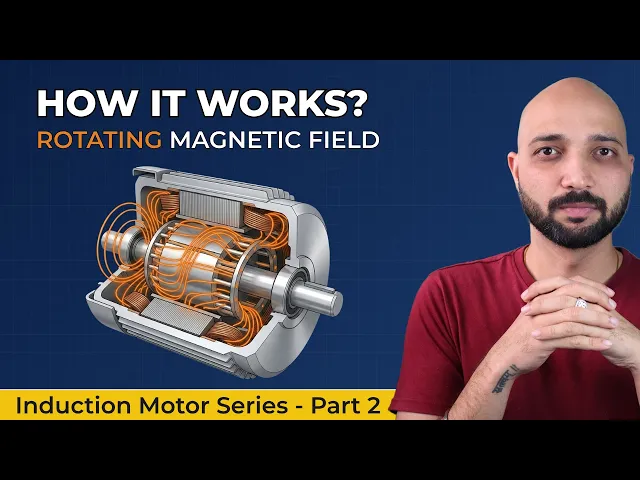
For the full walkthrough with diagrams, watch the detailed video below.
Watch the Youtube Video

About Author
Gaurav Joshi
Gaurav started his career on the floor of the electrical industry — not in a classroom. Working across Siemens and Schneider Electric, he saw firsthand how wide the gap was between what colleges teach and what the industry actually needs.
So he did something about it.
Today, he's built a global community of 300,000+ engineers and professionals across YouTube and beyond — and TheElectricalGuy Academy is where that knowledge lives in its most structured, practical form.