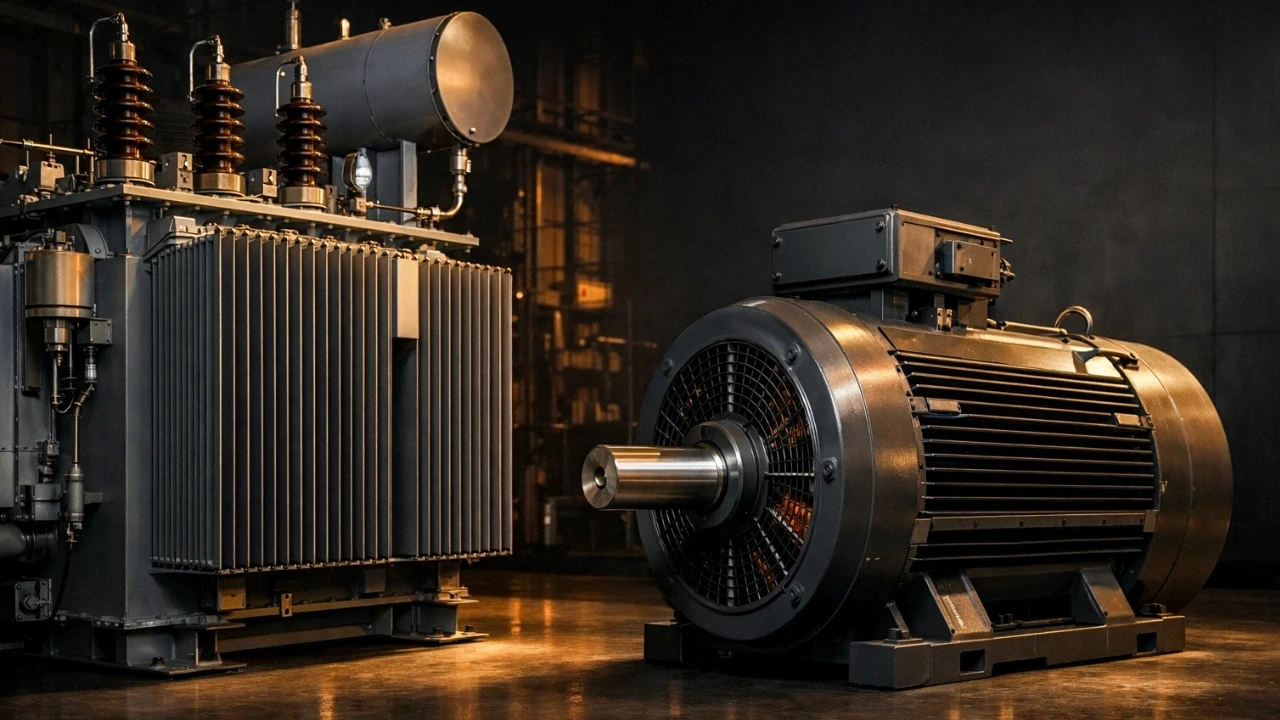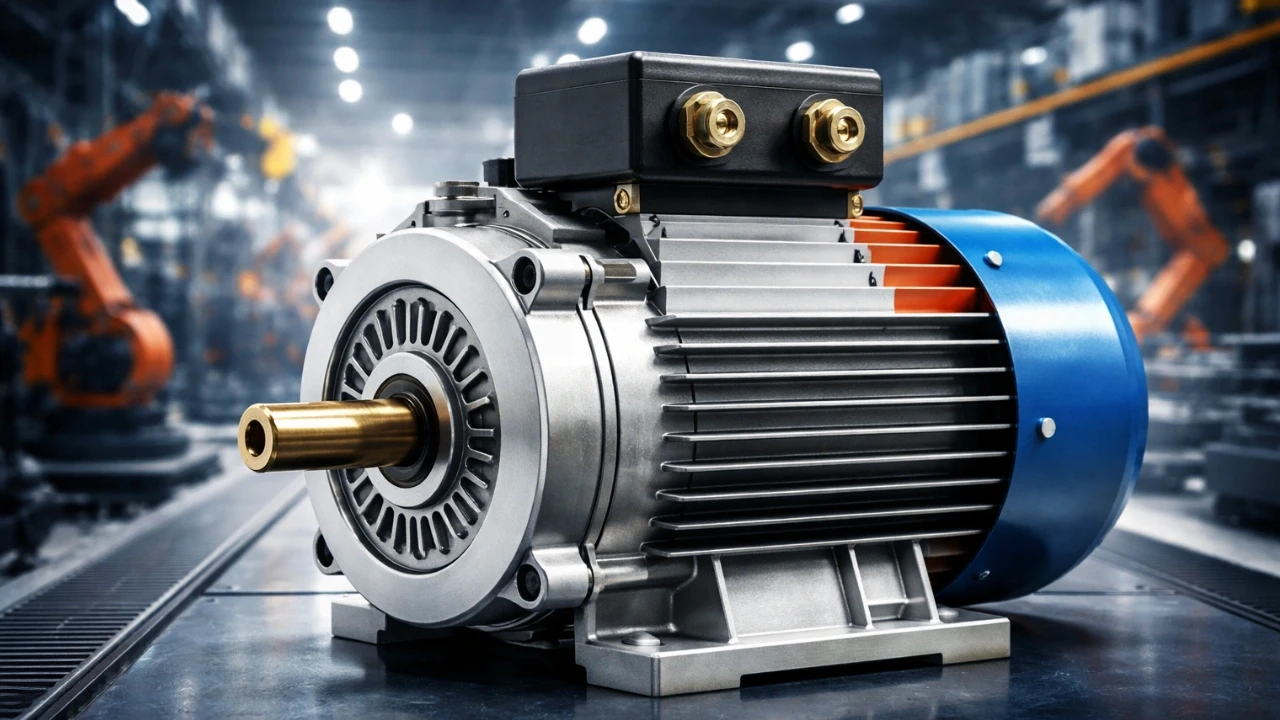
Induction motors dominate industrial and household equipment because they are reliable, low-maintenance, rugged, and cost-effective, and they run directly on standard three-phase AC supply. Their squirrel-cage rotor has no brushes or commutator, which keeps failure rates low and lifetime running costs predictable, the combination industries actually optimise for.
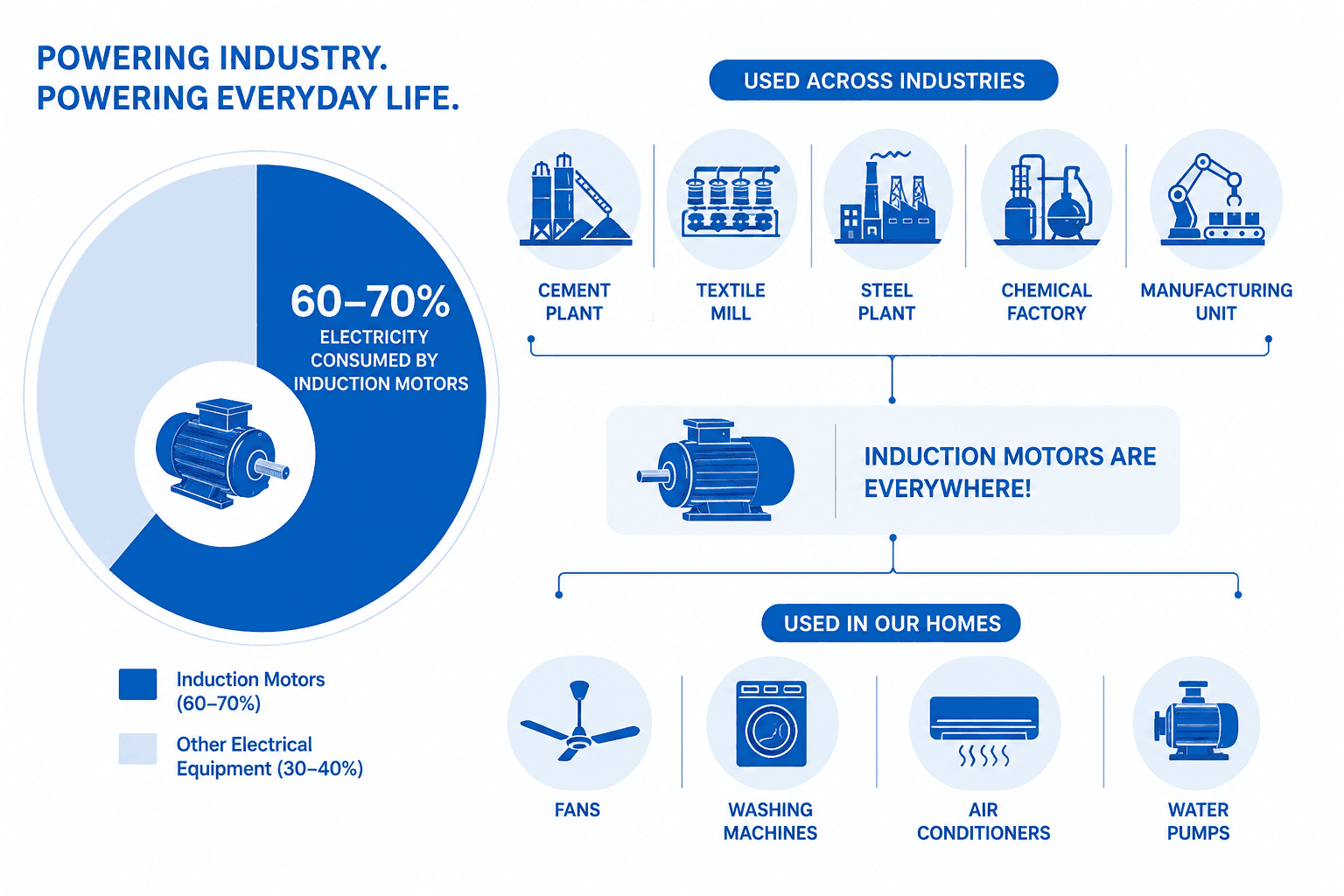
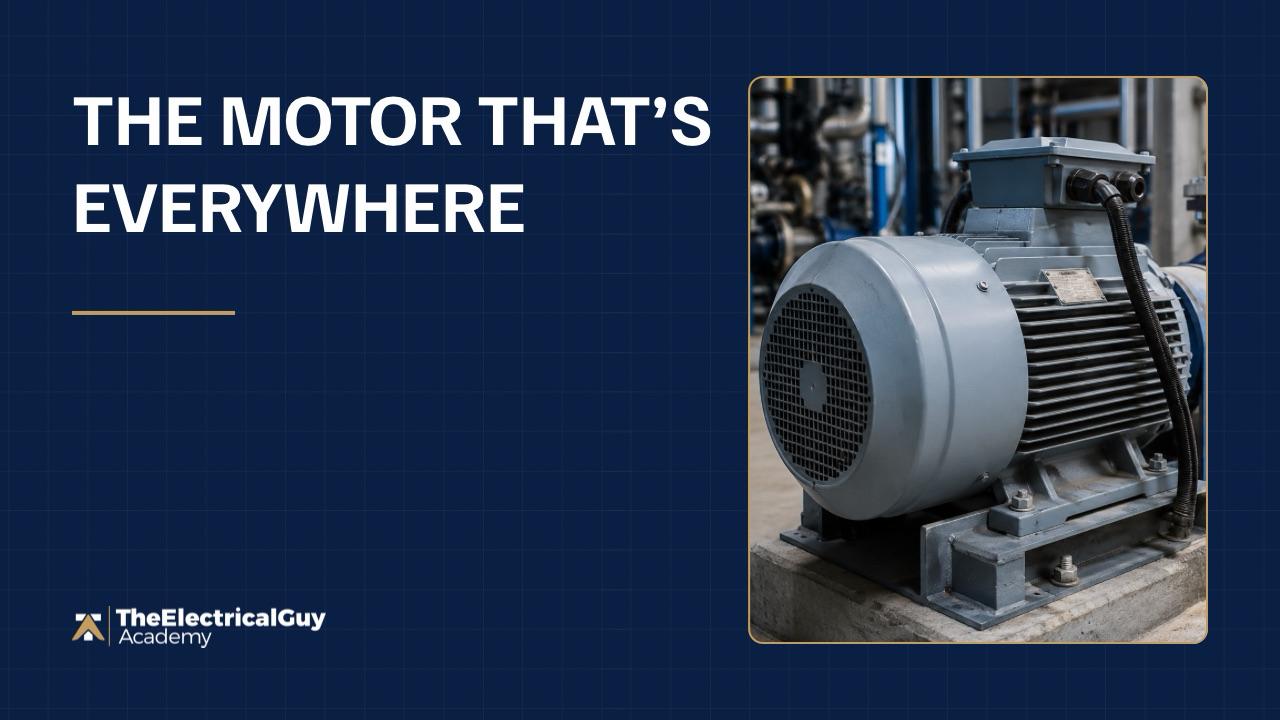
On a cement plant floor, a textile mill, or even inside a home water pump, the motor doing the work is almost always the same type: an induction motor. Cement plants, textile mills, steel plants, chemical factories, and general manufacturing units all lean on them and so do fans, washing machines, air conditioners, and water pumps in ordinary homes.
That raises the obvious question: why has one motor type become the default almost everywhere? The answer starts with what industries actually demand from a motor in the first place.
What Do Industries Actually Look For in a Motor?
Industrial plants weigh a motor against six practical requirements before it's ever installed.
1. Reliability
Motors need to run continuously often 8, 12, or 24 hours a day, stopping only for scheduled maintenance. A failed boiler feed pump or cooling water pump can halt an entire process, so continuous reliability isn't optional.
2. Low maintenance
A large plant may run hundreds or thousands of motors at once. Motors that need frequent inspection, brush replacement, or complex servicing overwhelm maintenance teams, so low-touch designs are preferred by default.
3. Rugged construction
Industrial environments routinely expose motors to dust, heat, moisture, vibration, voltage fluctuations, and mechanical load variation. A motor has to survive all of that without special protection.
4. Reasonable cost
Across hundreds of motors, purchase price, maintenance cost, and running cost all compound so cost-efficiency at scale matters more than it does for a single machine.
5. Simple operation
A motor should start and run without complex procedures, ideally working directly off the AC supply already available on site.
6. Good efficiency and availability
Motors consume a major share of industrial energy, so even small efficiency gains compound into real savings and wide availability of spares and familiar technicians matters just as much as the motor itself.
How Do Induction Motors Meet These Industrial Requirements?
Induction motors satisfy nearly every one of these six requirements by design, not by accident.
1. High reliability
An induction motor's rotor has no brushes, no commutator, and no direct electrical connection rotor current is induced electromagnetically rather than supplied directly. Fewer wearing parts means fewer failure points, which is why induction motors hold up well under continuous duty.
2. Low maintenance requirement
Without brushes or a commutator to service, a squirrel-cage induction motor needs far less routine attention than motor types that have them. Maintenance is still required bearings wear, insulation degrades, ventilation paths collect dust but the baseline workload stays low, which matters when a plant is managing hundreds of units.
3. Rugged construction
The simple rotor design lets induction motors withstand harsh conditions, which is why they show up across cement plants, steel plants, water pumping stations, manufacturing facilities, and HVAC systems.
4. Economical solution
Mass production and standardized manufacturing keep induction motors affordable to buy, and their simple design keeps repair costs down over the motor's life which is why they're favored by procurement teams and plant owners, not just maintenance crews.
5. Easy integration with AC systems
Induction motors run natively on the three-phase AC supply already present in most industrial systems, and they support multiple starting methods, DOL starters, star-delta starters, soft starters, and Variable Frequency Drives (VFDs) depending on the application.
6. Good efficiency and wide availability
Modern induction motors are available in high-efficiency classes, which matters because lifetime running cost usually exceeds purchase cost by a wide margin for a continuously operating motor. They also come in a wide range of ratings, speeds, frame sizes, mounting arrangements, and enclosure types, which keeps replacement and spares management simple and most technicians are already familiar with them.
Are Induction Motors Without Limitations?
No, induction motors have four well-known limitations that industries actively design around.
1. High starting current
A directly started induction motor can draw several times its full-load current, which can cause voltage dips and stress the electrical system. Industries manage this with star-delta starters, soft starters, auto-transformer starters, or VFDs.
2. Limited speed control on fixed-frequency supply
Without a VFD, motor speed depends on supply frequency and pole count, which limits speed flexibility under normal fixed-frequency operation.
3. Power factor challenges
Induction motors need magnetizing current to establish their magnetic field, so their power factor is typically below unity, especially at light load which is why capacitor banks and power factor correction are common in plants running many induction motors.
4. Starting torque limitations
Standard induction motors don't always deliver the very high starting torque some applications demand. In those cases, engineers turn to special rotor designs, slip-ring motors, or alternative motor technologies.
FAQ
What makes an induction motor different from other motor types?
An induction motor has no direct electrical connection to its rotor — rotor current is generated by electromagnetic induction from the stator's rotating magnetic field. This eliminates the brushes and commutator found in other motor designs, which is the root cause of its reliability and low maintenance needs.
Why do induction motors have a high starting current?
At startup, the rotor is stationary and the induced rotor current is at its highest, which draws several times the motor's full-load current from the supply. Star-delta starters, soft starters, and VFDs are used specifically to manage this inrush.
Can induction motor speed be controlled?
Yes, but not simply on a fixed-frequency AC supply, where speed depends mainly on frequency and pole count. A Variable Frequency Drive (VFD) allows flexible speed control by varying the supply frequency.
Why is power factor a concern with induction motors?
Induction motors draw magnetizing current to build their magnetic field, which pulls their power factor below unity especially at light load. Plants typically offset this with capacitor banks or power factor correction equipment.
Conclusion
Induction motors dominate industrial and household applications because their simple, brushless construction directly answers what industries actually need: reliability, low maintenance, ruggedness, cost-efficiency, and easy integration with standard AC supply. Their limitations, high starting current, restricted speed control without a VFD, and power factor drop are well understood and routinely engineered around.
Watch the Youtube Video

About Author
Gaurav Joshi
Gaurav started his career on the floor of the electrical industry — not in a classroom. Working across Siemens and Schneider Electric, he saw firsthand how wide the gap was between what colleges teach and what the industry actually needs.
So he did something about it.
Today, he's built a global community of 300,000+ engineers and professionals across YouTube and beyond — and TheElectricalGuy Academy is where that knowledge lives in its most structured, practical form.