Partial discharge is detected by measuring the energy it releases when a small insulation defect breaks down: electrical charge, electromagnetic waves, light, acoustic waves, gaseous and chemical byproducts, and ozone. No single sensor captures all of these, so detection uses a combination of devices, including HFCT sensors, TEV and UHF sensors, UV cameras, acoustic sensors, and dissolved gas analysis, with noise filtering to confirm the signal is real partial discharge.
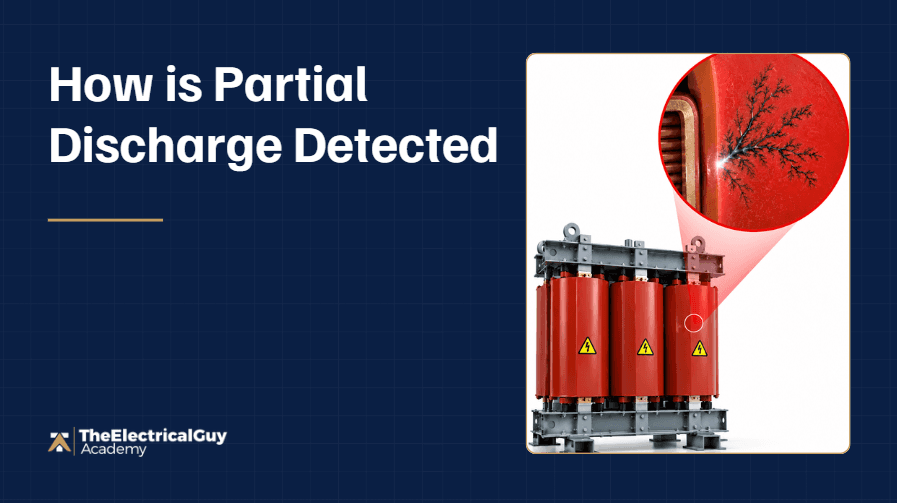
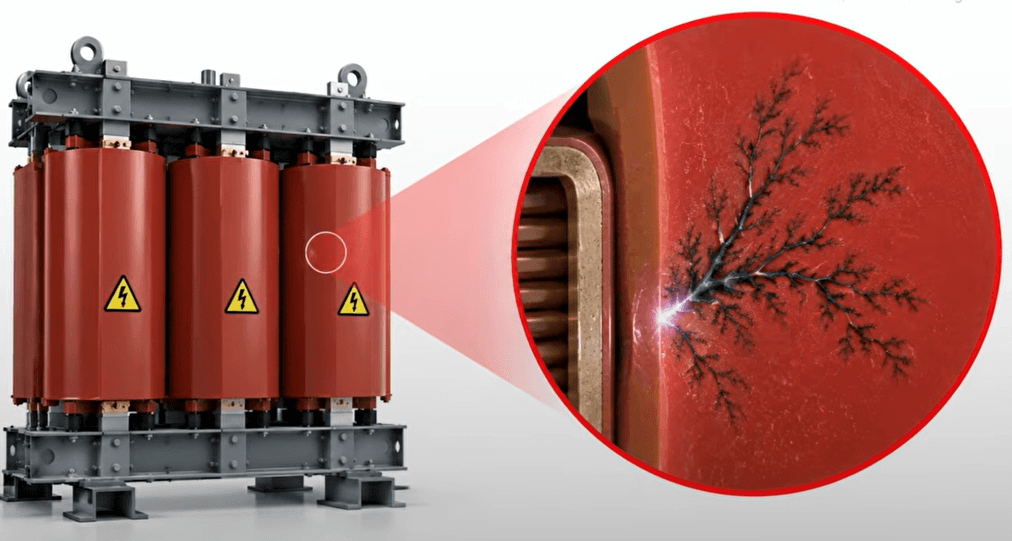
At a pharmaceutical plant, routine inspection of an 11 kV, 1.6 MVA dry-type transformer picked up abnormal acoustic signals. When the transformer was taken out of service, a tree-like structure had formed on its bushing. That was surface partial discharge, caught before it became a failure.
Many engineers use partial discharge instruments without understanding what those instruments actually measure. This article covers that foundation: what partial discharge is, what energy it releases, and which sensor detects which signal.
What Causes Partial Discharge?
Partial discharge occurs when a small defect or stress point in an insulation system breaks down locally, without bridging the full insulation gap.
What are the Internal Causes of Partial Discharge?
Internal partial discharge comes from defects inside the insulation itself:

Voids in solid insulation — air pockets or bubbles left behind during manufacturing.
Sharp or irregular conductor surfaces — for example, a poorly made cable joint with sharp edges.
Impurities in the insulation — which can grow into electrical trees over time.
What Are the External Causes of Partial Discharge?
External partial discharge comes from conditions outside the insulation material:

Floating metal near a conductor — such as a screwdriver left near a 24 kV conductor after maintenance.
Sharp objects at high voltage — causing corona discharge, most common on outdoor substation equipment.
Surface discharge on insulators — driven by pollution, humidity, or dust.
Why Does Partial Discharge Behave Like a Tiny Capacitor Breaking Down?
A void inside solid insulation acts as a tiny capacitor: electrical stress surrounds it, and weak air sits in the middle. When the air can't withstand that stress, it breaks down in a small spark.

That spark stays inside the void, which is why it's called partial discharge: it doesn't cross the entire insulation. But each breakdown releases energy, and that released energy is exactly what every detection sensor is built to track. Void and cavity discharge, surface discharge, and corona from sharp edges are all modeled the same way, as a small capacitor with an insulation gap that eventually fails.
Why is Partial Discharge Easy to Miss?
Partial discharge develops slowly and silently, often showing no obvious effect for one or two years, until the insulation finally fails.
It's like ageing: you don't notice it day to day, then one day the damage is already done.

Real examples include a 33 kV XLPE cable connector that failed because of voids from insufficient mastic material, surface discharge visible on the elbow connector of a 24 kV cable, and a faint violet glow on a 275 kV insulator string that's invisible to the naked eye.
What Types of Energy Does Partial Discharge Release?
Partial discharge releases electrical charge, electromagnetic waves, optical energy, acoustic waves, gaseous byproducts, chemical byproducts, and ozone.
Electrical charge — released when the void's "capacitor" breaks down; very fast, so ordinary current transformers can't capture it.
Electromagnetic waves — range from megahertz to gigahertz, well above the 50 Hz power frequency.
Optical energy — most visible in corona, sometimes seen by eye, often needing UV cameras.
Acoustic waves — produced by the electrical discharge itself.
Gaseous byproducts — especially in liquid insulation like transformer oil.
Chemical byproducts — such as white oxide deposits, seen on a dry-type cable termination.
Ozone — detectable by smell or by ozone detectors.
Which Sensors Detect Each Type of Energy?
Each energy type needs its own sensor, because no single device captures every signal partial discharge produces.
Energy Released | Detection Method |
Electrical charge | Capacitive or inductive measurement; HFCT (high-frequency current transformer) sensors |
Electromagnetic waves | TEV (transient earth voltage) sensors; UHF (ultra-high frequency) sensors |
Optical energy | Low-light cameras; UV cameras |
Acoustic waves | Contact sensors (on switchgear panels); airborne sensors |
Gaseous byproducts | Dissolved gas analysis (DGA), most common in transformers |
Chemical byproducts | Visual inspection |
Ozone | Smell; ozone detectors |
Why Can't One Sensor Detect Partial Discharge on Its Own?
No single sensor detects every symptom of partial discharge, just as one medical test can't diagnose every condition in the body, so detection relies on combining several measurements.
The reverse problem also exists: the energy a sensor picks up doesn't always come from partial discharge. A mobile tower's signal, for example, can generate electromagnetic waves that look like a PD signal. Engineers have to filter out this noise to confirm that a reading really is partial discharge.
FAQ
What is partial discharge in simple terms?
Partial discharge is a localized electrical breakdown inside or on the surface of insulation, such as in a void or at a sharp edge, that doesn't bridge the full insulation gap but gradually degrades it.
Why can't a regular current transformer detect partial discharge?
The electrical charge released by partial discharge is extremely fast, so detecting it needs specialized sensors, such as HFCT sensors, tuned to that signal.
What does a TEV sensor detect?
A TEV (transient earth voltage) sensor detects the electromagnetic waves partial discharge produces, particularly useful in switchgear testing.
Why do partial discharge readings need noise filtering?
Other sources, like mobile tower signals, can produce similar electromagnetic energy. Without filtering, a non-PD signal could be misread as partial discharge.
Is corona discharge a type of partial discharge?
Yes. Corona, caused by sharp objects at high voltage, is one form of partial discharge, most common on outdoor substation equipment.
Conclusion
Partial discharge detection comes down to one idea: every breakdown inside an insulation defect releases measurable energy. Electrical charge, electromagnetic waves, light, sound, gases, chemical residue, and ozone are all symptoms, and each needs its own sensor. Because no single device catches everything, and other sources can mimic PD signals, combining sensors and filtering out noise is what separates a real finding from a false alarm.
If you want to go deeper, the Partial Discharge Testing certification pathway is built with Monitra, a UK-based specialist in MV and HV asset monitoring. It has two levels, runs from fundamentals through to reading real PRP data and making maintenance decisions, is taught by working PD engineers, and is CPD accredited at both levels.
Watch the Youtube Video


About Author
Gaurav Joshi
Gaurav started his career on the floor of the electrical industry — not in a classroom. Working across Siemens and Schneider Electric, he saw firsthand how wide the gap was between what colleges teach and what the industry actually needs.
So he did something about it.
Today, he's built a global community of 300,000+ engineers and professionals across YouTube and beyond — and TheElectricalGuy Academy is where that knowledge lives in its most structured, practical form.