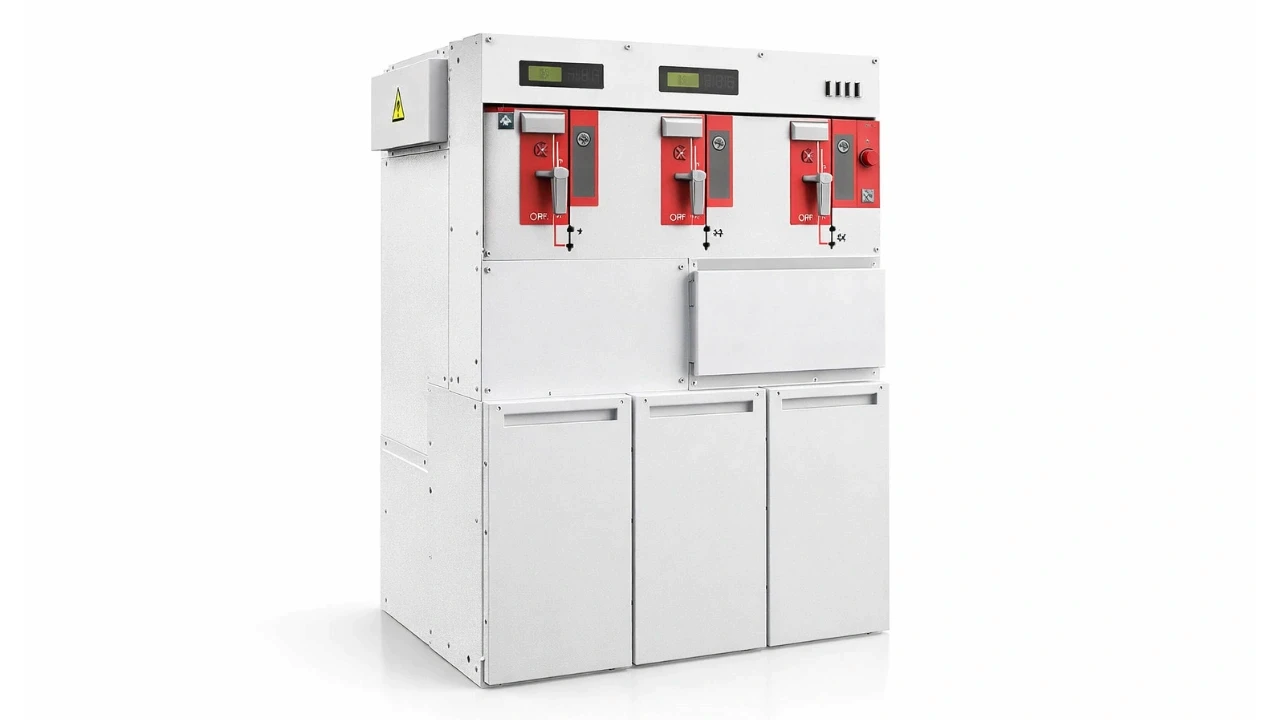

Before ordering a ring main unit (RMU), five decisions matter: insulation (SF6 or SF6-free), number of functions, extensibility, protection type (load break switch, load break switch with fuse, or circuit breaker), and how smart it needs to be. An RMU is sealed for 20 to 25 years, so each choice is effectively permanent.

Ordering an RMU seems straightforward until it lands at your substation. Then you find two problems. You cannot add another feeder next year, and your transformer rating exceeds the capability of the switch and fuse combination.
An RMU is sealed for its entire 20 to 25 year life, so every mistake in the technical specification is permanent. This article walks through the five decisions to lock down before you issue a purchase order. If you are new to the equipment, start with What is a Ring Main Unit (RMU)?.
Decision 1: Which Insulation Should an RMU Use?
Most RMUs are gas-insulated, using either SF6 gas or an SF6-free alternative.

There are three types:
Air-insulated: very rare, and nobody really uses them now.
SF6 gas-insulated: the most common choice. It is compact, needs no maintenance, and is reliable, which is why most outdoor RMUs are gas-insulated. Where space is tight and nobody is available for maintenance, it is the preferred choice.
SF6-free gas-insulated: uses alternatives to SF6, which manufacturers call names such as clean air, pure air, or synthetic air. These are mostly a mixture of oxygen and nitrogen. The gas is used only for insulation, while the switching still happens in vacuum bottles.
SF6-free units are more expensive than SF6 types, and regulations did not require them everywhere. In some regions, such as the European Union, SF6 is already restricted in some switchgear, so SF6-free is clearly the direction of travel. Both options perform well. The decision is SF6 or SF6-free. For the trade-offs in detail, see SF6-free RMUs.
Decision 2: How Many Functions Does the RMU Need?
The number of functions depends on how many feeders or supply sources you connect and whether the transformer needs protection.

A function is simply what a section of the RMU does. In a typical three-function RMU:
Function 1: the incoming cable, called the incomer.
Function 2: a load break switch that takes the outgoing cable to another RMU, called the feeder.
Function 3: a circuit breaker connected to the transformer, which is the protection function.
RMUs come with one, two, three, four, or five functions. The most common configuration is two load break switches with one circuit breaker. Manufacturers often name functions by the device used: load break switch, circuit breaker, or a direct incoming or outgoing function with only an earthing switch.
Two feeders or two supply sources: you will likely need a three-function RMU, with the third function protecting the transformer.
Only a transformer, with no incoming or outgoing feeder: a single-function RMU is enough.
Decision 3: Does the RMU Need to Be Extensible?
Extensibility means the RMU can be connected to additional switchgear or functional units in the future. If you expect growth, choose an extensible RMU.

Suppose you buy a three-function RMU and demand grows after a few years. You now need a fourth function, a load break switch to supply another RMU. With a non-extensible RMU, you must either buy a separate single-function RMU, or remove the existing one and install a four-function unit. Neither is ideal.
With an extensible RMU, you simply add a function to the existing unit and make it a four-function RMU. That is the modular design.
Non-extensible: the unit is locked. A three-function RMU stays three-function. Choose it when you know for sure no expansion is coming, because there is no point paying for extensibility you won’t use.
Extensible: choose it when future expansion is likely. Options are extension on the right side, the left side, or both sides.
Decision 4: Which Protection Does the RMU Need?
Protection comes in three levels: a load break switch, a load break switch with fuse, or a vacuum circuit breaker with a dedicated relay.
Protection Option | What It Does | Choose It When |
Load break switch | Switches normal current only. It does not protect, and it cannot break short-circuit current | You need simple switching and no protection |
Load break switch with fuse | Gives limited protection at a lower cost | The budget is tight and breaking currents are small, so a relay would not even sense them |
Vacuum circuit breaker with relay | Breaks fault currents, up to 20 kA or 25 kA depending on the configuration | You need proper protection for critical loads |
A load break switch with fuse only handles limited currents. Once the current rises above roughly 200 to 300 A, it may not be suitable, and a vacuum circuit breaker is the answer. For more on that device, see components of a vacuum circuit breaker.
Some functions have no switching device at all. They are a direct incoming or outgoing connection, perhaps with only an earthing switch or a voltage detection and indication system. The right choice depends on the load, how critical it is, and the budget.
Decision 5: Do You Need a Smart RMU?
A smart RMU, also called a digital RMU, combines normal switching and protection with sensors, electronic control devices, communication equipment, and, where required, motorised operating mechanisms.
It still does everything a standard RMU does, with extra capability:
Remote operation: without motorised mechanisms, you must visit the RMU and operate it manually.
SCADA connection: a smart RMU can be connected to a SCADA system, so you can see the whole system and track its data.
Self-healing grid: a self-healing distribution grid needs smart RMUs. Without them, you cannot have one.
Digitalisation comes in levels, such as level one, two, three, up to six or beyond. Motorised operation alone does not make an RMU digital. The level you choose changes the sensors inside the RMU, and with that, the cost. Local monitoring, remote monitoring, and a fully self-healing grid each need a different level. The RMU Blueprint course covers these levels in detail.
The 5 RMU Decisions at a Glance
Decision | Options | Key Question |
1. Insulation | SF6, SF6-free (air-insulated is rare) | SF6 or SF6-free? Both perform well |
2. Functions | Single, two, three, four, or five | How many feeders and supply sources, and is the transformer protected? |
3. Extensibility | Non-extensible, or extensible on the right, left, or both sides | Is any expansion coming? |
4. Protection | Load break switch, load break switch with fuse, vacuum circuit breaker | What load and criticality, and what budget? |
5. Smart features | Standard, or smart with a chosen level of digitalisation | Do you need remote operation, SCADA, or a self-healing grid? |
FAQ
Why are RMU specification mistakes permanent?
An RMU is sealed for its entire 20 to 25 year life. You can’t swap components later, so an incorrect function count, protection type, or extensibility choice stays with the unit.
What does “three-function RMU” mean?
It has three functions: an incoming cable, an outgoing load break switch to another RMU, and a circuit breaker that protects the transformer. It is the most common configuration.
When is a non-extensible RMU the right choice?
When you are sure no expansion is coming. A non-extensible RMU is locked to its function count, so there is no point paying for extensibility you won’t use.
When is a load break switch with fuse enough?
When breaking currents are small and the budget is tight. Above roughly 200 to 300 A, it may not be suitable, and a vacuum circuit breaker with a relay is the better choice.
Do I need a smart RMU?
Only if you want remote operation, SCADA connection, or a self-healing grid. Motorised operation alone is not digital, and the level of digitalisation you choose affects both the internal sensors and the cost.
Conclusion
Because an RMU is sealed for 20 to 25 years, its specification is effectively permanent. Five decisions shape it: the insulation, the number of functions, whether it is extensible, the protection type, and how smart it needs to be. Make those choices carefully against the project, the load, and the budget, and the unit will serve its application well for its full life.
If you want to learn the RMU from the ground up in a structured way, explore The RMU Blueprint: Master Ring Main Units.
Watch the Youtube Video

About Author
Gaurav Joshi
Gaurav started his career on the floor of the electrical industry — not in a classroom. Working across Siemens and Schneider Electric, he saw firsthand how wide the gap was between what colleges teach and what the industry actually needs.
So he did something about it.
Today, he's built a global community of 300,000+ engineers and professionals across YouTube and beyond — and TheElectricalGuy Academy is where that knowledge lives in its most structured, practical form.