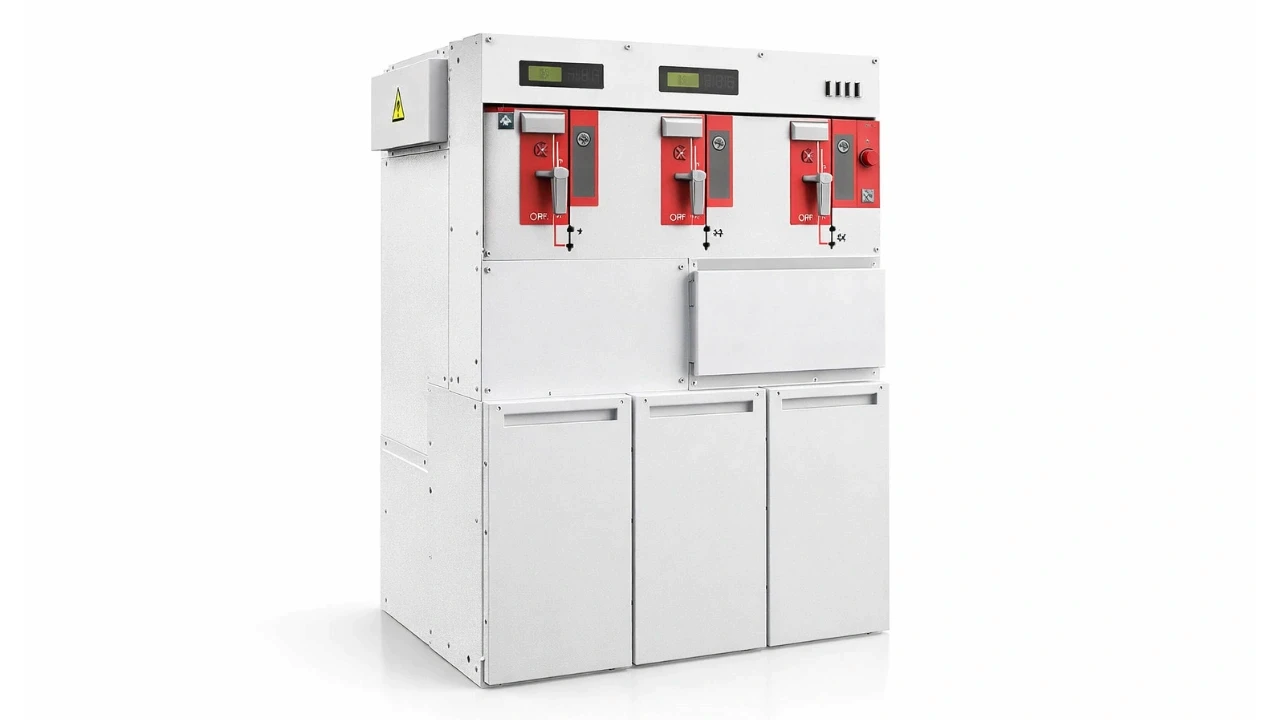

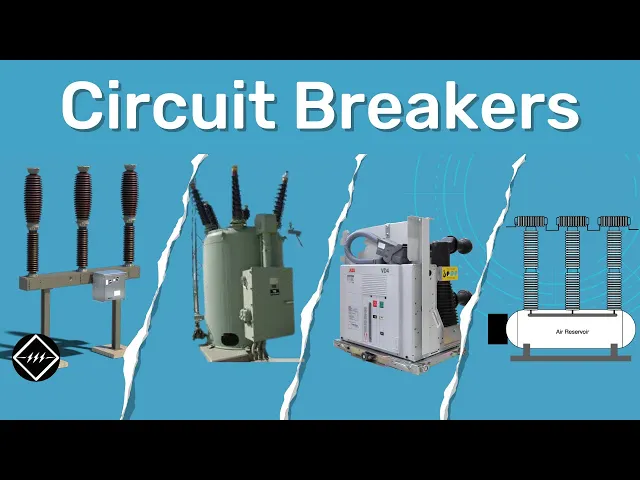
Circuit breakers are classified four ways: by voltage class (low or high voltage), installation (indoor or outdoor), external design (live tank or dead tank), and interrupting medium. Of the interrupting media, only SF6 and vacuum are in practical use today. Air magnetic, air blast, and oil breakers are obsolete.

The circuit breaker is one of the most important pieces of equipment in a substation. Over the years it has evolved a great deal, and it can be grouped in several ways. This article covers the definition first, then the four classifications, and finally which types are still in use today.
What is a Circuit Breaker?
A circuit breaker is a mechanical device that can make, carry, and break current under normal conditions, and can also make, carry for a set time, and break current under abnormal conditions such as a short circuit.
The definition looks long, but it becomes easy once you split it into two parts: normal conditions and abnormal conditions.
What Can a Circuit Breaker Do Under Normal Conditions?
Under normal conditions, a circuit breaker can make, carry, and break the rated normal current.
Making means the closing operation.
Carrying means conducting the current continuously.
Breaking means the opening operation.
Take a 145 kV system with a rated current of 3,150 A. The breaker can close onto 3,150 A, carry it continuously, and open it without any problem.
What Can a Circuit Breaker Do Under Abnormal Conditions?
Under abnormal conditions such as a short circuit, a circuit breaker can make the fault current, carry it for a limited time, and break it.
The nameplate shows a short-time current rating, for example 40 kA for 1 second or 40 kA for 3 seconds. That means the breaker can carry 40 kA of short-circuit current for that time. It can also break huge short-circuit currents, up to 40 kA, 50 kA, or even 63 kA, depending on the system fault rating and the voltage rating.
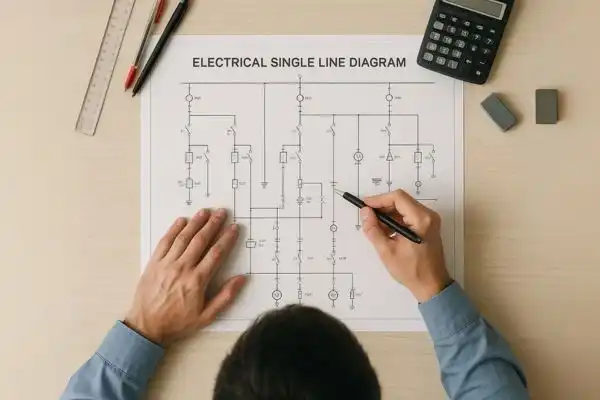
The control circuits that tell a breaker when to close and trip are covered in the Circuit Breaker Control Schematics Masterclass.
How Are Circuit Breakers Classified?
Circuit breakers are classified by voltage class, installation, external design, and interrupting medium.
Voltage class: low voltage or high voltage.
Installation: indoor or outdoor.
External design: live tank or dead tank.
Interrupting medium: air magnetic, air blast, oil, SF6, or vacuum.
The interrupting medium is the most important classification, so it gets the most space below.
What Are the Types of Circuit Breakers by Voltage Class?
By voltage class, circuit breakers are either low voltage or high voltage.

Low voltage: breakers that operate at 1,000 V or less.
High voltage: breakers for more than 1,000 V, up to 800 kV.
High voltage can be subdivided further. Around 36 kV is considered medium voltage, which is the distribution level, and anything above 36 kV up to 800 kV is considered high voltage, the transmission level.
What Are the Types of Circuit Breakers by Installation?
By installation, circuit breakers are either indoor or outdoor.

An indoor breaker is designed for use inside a building or in a controlled environment. An outdoor breaker is installed outside, and breakers of 72.5 kV and above are generally outdoor.
In practice, the only difference is the enclosure. The interrupting devices, the mechanism, and the other parts are the same, and both types have the same current carrying and breaking capacity.
What Are the Types of Circuit Breakers by External Design?
By external design, circuit breakers are either live tank or dead tank.

Aspect | Live Tank | Dead Tank |
Interrupter | At live potential (the top portion) | Inside a metal-enclosed tank at dead (earth) potential |
Connection | Directly to the interrupter | Through bushings |
Safety | Live parts exposed | Safe to touch, because the tank is at dead potential |
Size | Larger | Compact |
Cost | The cheapest | Higher |
Gas-insulated switchgear is a complete example of dead tank design. Each design has its own advantages and disadvantages, and a detailed comparison.
What Are the Types of Circuit Breakers by Interrupting Medium?
By interrupting medium, circuit breakers are air magnetic, air blast, oil, SF6, or vacuum, and the medium used has changed a great deal over time.

What Were the Earlier Types?
The earlier types used air or oil, and all of them are now obsolete.
Air magnetic: stretched the arc to increase its resistance. This was a basic technology with limited current carrying and breaking capacity, and it is now obsolete.
Air blast: stored air at very high pressure in a reservoir and blasted it onto the arc to clear it. It was available up to 420 kV, but it had many disadvantages, and it is no longer used.
Oil: used oil to interrupt the current and to cool the arc. It also had many drawbacks, and the SF6 breaker replaced it completely.
Why Do SF6 Breakers Dominate High Voltage?
SF6 breakers use SF6 gas as both the interrupting medium and the arc cooling medium, and the gas outperforms the earlier media.
At the time of the video, SF6 breakers completely dominated the market. They are available up to 800 kV, and above about 36 kV, practically every breaker in a switchyard today is SF6. See SF6 circuit breaker components for what is inside one.
The industry is now moving towards SF6-free switchgear, and many manufacturers have already developed solutions that do not need SF6 for current interruption.
Where Are Vacuum Breakers Used?
Vacuum breakers are used mainly at 36 kV and below, and most breakers in that range are vacuum.
In the video’s view, vacuum is superior to SF6, but it has traditionally been limited to 36 kV. Some manufacturers have already developed a 145 kV vacuum breaker. See components of a vacuum circuit breaker for more.
Which Types Are Used Today?
In practice, only two types are used today: SF6 and vacuum. Every other interrupting medium is obsolete.
Interrupting Medium | Status | Notes |
Air magnetic | Obsolete | Stretched the arc; limited current carrying and breaking capacity |
Air blast | Obsolete | High-pressure air blast, available up to 420 kV |
Oil | Obsolete | Replaced by SF6 |
SF6 | In use | Dominates high voltage, up to 800 kV |
Vacuum | In use | Mostly 36 kV and below; some 145 kV types developed |
Circuit Breaker Classifications at a Glance
Classification | Types | Key Point |
Voltage class | Low voltage (up to 1,000 V), high voltage (above 1,000 V up to 800 kV) | Around 36 kV is medium voltage |
Installation | Indoor, outdoor | Only the enclosure differs; ratings are the same |
External design | Live tank, dead tank | Live tank is cheapest; dead tank is compact but costlier |
Interrupting medium | Air magnetic, air blast, oil, SF6, vacuum | Only SF6 and vacuum are in use today |
FAQ
What does a circuit breaker do?
It can make, carry, and break current under normal conditions, and under abnormal conditions such as a short circuit it can make the fault current, carry it for a set time, and break it.
What is the difference between a live tank and a dead tank circuit breaker?
In a live tank breaker, the interrupter is at live potential. In a dead tank breaker, the interrupter sits inside an earthed metal tank, so the tank is safe to touch. Live tank is cheaper, and dead tank is more compact.
Is there a difference between an indoor and an outdoor circuit breaker?
Only the enclosure. The interrupting devices, mechanism, current carrying capacity, and breaking capacity are the same.
Which circuit breaker types are obsolete?
Air magnetic, air blast, and oil circuit breakers. Only SF6 and vacuum breakers are used in practice today.
Which breaker is used at which voltage level?
Vacuum breakers are mostly used at 36 kV and below. SF6 breakers dominate above that, up to 800 kV.
Conclusion
A circuit breaker can be classified by voltage class, installation, external design, and interrupting medium. The first three describe where and how it is used, and the interrupting medium describes how it works. That last one matters most: air magnetic, air blast, and oil breakers have all given way to SF6 and vacuum, and the industry is already moving towards SF6-free designs.
If you want to understand the control circuits that operate these breakers, explore the Circuit Breaker Control Schematics Masterclass.
Watch the Youtube Video

About Author
Gaurav Joshi
Gaurav started his career on the floor of the electrical industry — not in a classroom. Working across Siemens and Schneider Electric, he saw firsthand how wide the gap was between what colleges teach and what the industry actually needs.
So he did something about it.
Today, he's built a global community of 300,000+ engineers and professionals across YouTube and beyond — and TheElectricalGuy Academy is where that knowledge lives in its most structured, practical form.