
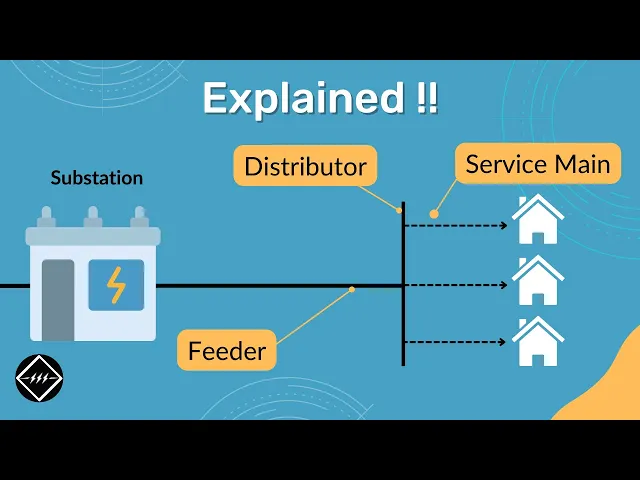
A service main is the cable that connects a house or factory to the distribution supply. A distributor is the conductor that powers many service mains through tappings. A feeder carries power from the distribution substation to the distributors, with no tappings along its length.
Look at the conductor coming into your house or factory. It runs from outside to a meter or an incoming panel. That conductor is only the last link in a chain, and each link has a name: service main, distributor, and feeder.

These three terms come up constantly in distribution work, and they are easy to mix up. This article explains what each one is, how they differ, and how they connect.
How Does Power Reach a House or Factory?
Power reaches a consumer through a chain: the distribution substation, then the feeder, then the distributor, then the service main.
Distribution substation: steps the supply down, for example from 36 kV to 11 kV.
Feeder: carries that power from the substation to the distributors.
Distributor: carries it along the street or area, with tappings for each consumer.
Service main: connects the consumer’s house or factory to the distributor.
The rest of this article follows that chain from the consumer back towards the substation.
What is a Service Main?
A service main is the conductor or cable that connects the supply to a house or factory, ending at a meter or an incoming panel.

It is the part you can see from your own building. If a cable runs from a distribution pole to your meter, that is your service main.
What are the Types of Service Main?
A service main is either overhead or underground.
Aspect | Overhead Service Main | Underground Service Main |
How it is taken | Directly from the overhead distribution lines | From an underground cable |
Where it is used | Generally rural areas | Populated urban areas |
Cost | The most common and cost-effective option | Costlier |
Safety and life | Not as good | More safety and longer life |
Appearance | Does not look as neat | Neat and clean |
Installation | Easy, and no skilled labour is needed | Skilled labour is required |
Phase conversion | Easy, for example single phase to three phase | Not covered here |
Fault finding | Easy | Cumbersome |
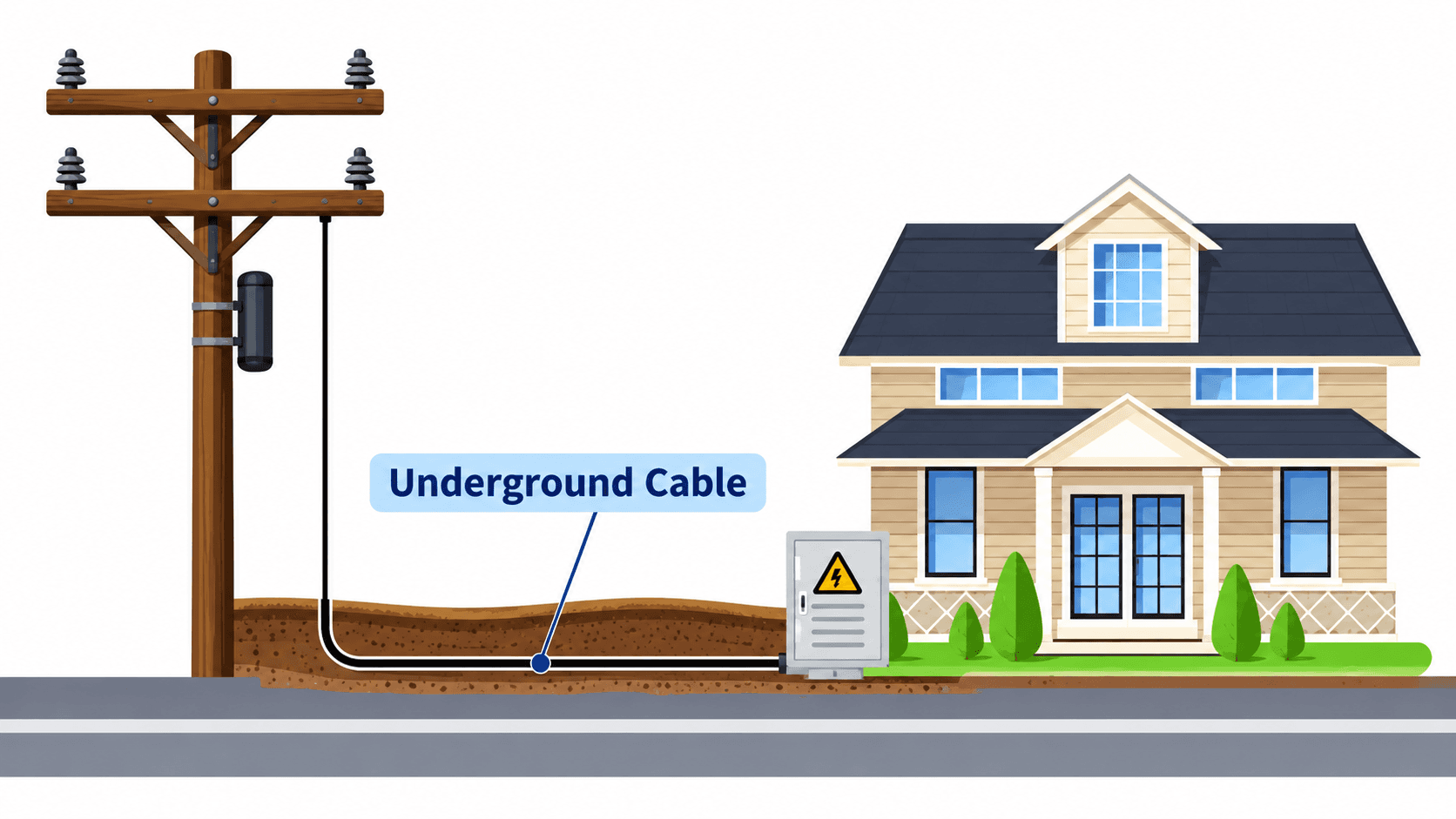
The choice is a trade-off between cost and ease on one side, and safety, life, and appearance on the other.
What is a Distributor?
A distributor is the conductor or cable that powers the service mains, with many tappings taken from it to supply individual consumers.
The overhead line you see near your house, the one your service main is taken from, is a distributor. It is an important link between the supply company and the consumer.
What Are Primary and Secondary Distributors?
Distributors are classified by voltage into primary and secondary.

Primary distributor: a high voltage distributor. It supplies customers who need power directly at a level such as 11 kV, for example a factory, a shopping mall, or a commercial building.
Secondary distributor: a low voltage distributor, for example 415 V.
What is a Feeder?
A feeder is the conductor or cable that powers the distributors. It runs from the distribution substation to the distributor, and no tappings are taken along its length.
Because a feeder has no tappings, the current at its receiving end is the same as the current at its sending end. That is why a feeder is selected based on its current-carrying capacity. In the example network, the feeder is also longer than the distributor.
How Do the Feeder, Distributor and Service Main Fit Together?
They fit together in sequence: the feeder carries power to the distributor, and the distributor supplies the service mains.

Take a 36/11 kV substation. It receives 36 kV and steps it down to 11 kV. The feeder carries that 11 kV supply out. It reaches a pole-mounted transformer, from which the distributor carries power onward. Several service mains are then connected along the distributor, and each one powers a separate load.
If you want to see how these cables are arranged in a network, the radial vs ring main distribution article compares the two layouts. The What is a Ring Main Unit (RMU)? article explains the equipment that makes the ring layout work. The pole-mounted transformer is a distribution transformer, covered in Power Transformer vs Distribution Transformer.
Feeder vs Distributor vs Service Main: Quick Comparison
Aspect | Feeder | Distributor | Service Main |
Role | Link between the distribution substation and the distributor | Link between the supply company and the consumer | Final connection to the house or factory |
Powered by | Distribution substation | Feeder | Distributor |
Powers | Distributors | Service mains | Meter or incoming panel |
Tappings | None | Many | Not applicable |
Types | Not covered here | Primary (high voltage) and secondary (low voltage) | Overhead and underground |
Key point | Current is the same at both ends, so it is sized by current-carrying capacity | The overhead line near your home is a distributor | Overhead is cheaper, underground is safer and longer-lived |
Where Can You Learn More About Distribution Networks?
The first module of The RMU Blueprint covers the structure of the power system, primary and secondary distribution, and the radial and ring methods, before moving into ring main units. See The RMU Blueprint: Master Ring Main Units.
FAQ
Is the overhead line near my house a feeder or a distributor?
It is a distributor. The service main to your house is taken from it, and many such tappings are taken along its length.
Why is a feeder selected on current-carrying capacity?
No tappings are taken on a feeder, so the current at the receiving end equals the current at the sending end. The current therefore stays constant along its length, and the cable must be able to carry it.
What is the difference between a primary and a secondary distributor?
A primary distributor is high voltage and supplies customers who need power directly at a level such as 11 kV. A secondary distributor is low voltage, for example 415 V.
Which service main is used in cities and which in villages?
Underground service mains are generally used in populated urban areas, and overhead ones in rural areas.
Why is an underground service main costlier than an overhead one?
It needs skilled labour for the connection and cable laying. In return it gives more safety, a longer life, and a neater appearance, although finding faults is harder.
Conclusion
Power reaches a house or factory in a chain. The feeder carries it from the distribution substation, the distributor supplies it along the route with many tappings, and the service main makes the final connection to the meter or incoming panel. Keeping the three apart is simple: a feeder has no tappings, a distributor has many, and a service main serves one consumer.
To see the three terms explained with the network diagram, watch my complete video on the TheElectricalGuy YouTube channel.
Watch the Youtube Video

About Author
Gaurav Joshi
Gaurav started his career on the floor of the electrical industry — not in a classroom. Working across Siemens and Schneider Electric, he saw firsthand how wide the gap was between what colleges teach and what the industry actually needs.
So he did something about it.
Today, he's built a global community of 300,000+ engineers and professionals across YouTube and beyond — and TheElectricalGuy Academy is where that knowledge lives in its most structured, practical form.