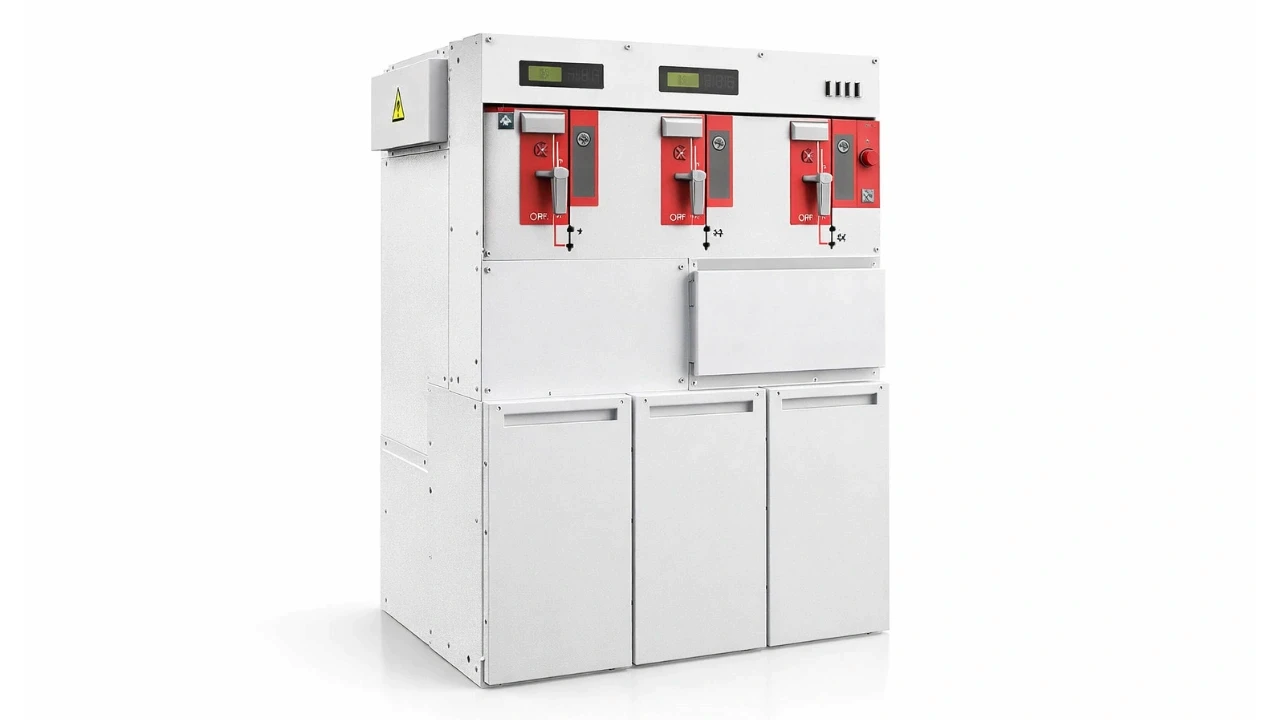

A ring main unit (RMU) is a factory-assembled, metal-enclosed switchgear that combines two switches and a transformer protection device, a circuit breaker or a fused load break switch, in one unit. It sits at the load point of a ring main network, keeping supply running through a feeder fault and protecting the transformer.

Walk around any city neighbourhood and there is a good chance a ring main unit is installed near you. It was first introduced in the United Kingdom and is now used in many countries. This article covers what an RMU is, how it keeps supply running, its parts, its advantages, and where it is used.
What Terms Should You Know Before Learning About an RMU?
Three terms describe the cables that carry power to a consumer: the service main, the distributor, and the feeder.
Service main: the cable that connects a house to the distribution supply, for example from a distribution pole to your meter.
Distributor: the cable that powers the service mains. Tappings are taken from it to supply individual loads.
Feeder: the cable that powers the distributors, running from the distribution substation.
Why Do Ring Main Networks Need an RMU?
A ring main network needs an RMU because a loop of feeders alone cannot isolate a faulty section or protect the transformer.
In a radial network, one main feeder powers every load, so a fault on that feeder cuts power to everything downstream. The radial vs ring main distribution article compares the two in full.

A ring main network fixes this by taking two feeders from the substation, or from two different substations, and joining them in a loop. Each load can then be supplied from two directions. If feeder 1 fails, load can still be fed through feeder 2.

A plain loop is still not enough. With no switches, there is no way to disconnect a faulty feeder. The transformer, one of the most expensive pieces of equipment, has no protection either. The fix is to install switches and a circuit breaker at each load point.
What is a Ring Main Unit?
A ring main unit is a switchgear that combines those switches and the transformer protection device into one metal-enclosed unit.
At each load point you install two switches (switch 1 and switch 2) and a circuit breaker that protects the transformer. Combined into a single unit, that is a ring main unit. The appearance varies between manufacturers, but the three-part arrangement stays the same.
How Does an RMU Keep Supply Running During a Feeder Fault?
An RMU keeps supply running by letting you isolate the faulted feeder and feed the load from the other direction around the ring.

Normal operation: load 1 is supplied through feeder 1, RMU 1, and the transformer. The switch towards the second feeder stays open.
Fault on feeder 1: the faulted section is disconnected by opening the switch on the RMU.
Rerouting: the open switch in the ring is closed. Power now flows from feeder 2 through RMU 3 and RMU 2 to RMU 1, the transformer, and the load.
The result is continuity of supply, which is why the RMU is so valuable in cable-based distribution networks.
What Are the Parts of a Ring Main Unit?
A typical three-function RMU has two switch branches and one circuit breaker branch, all inside one metal cubicle.

Branch | Equipment | Function |
Branch 1 | Three-position switch | Switches the supply. Positions: closed, neutral (open), and earthing |
Branch 2 | Three-position switch | Same as branch 1, towards the next RMU or feeder |
Branch 3 | Circuit breaker, disconnector, earthing switch, and current transformer | Protects the transformer. The current transformer feeds the circuit breaker so it trips on a fault |
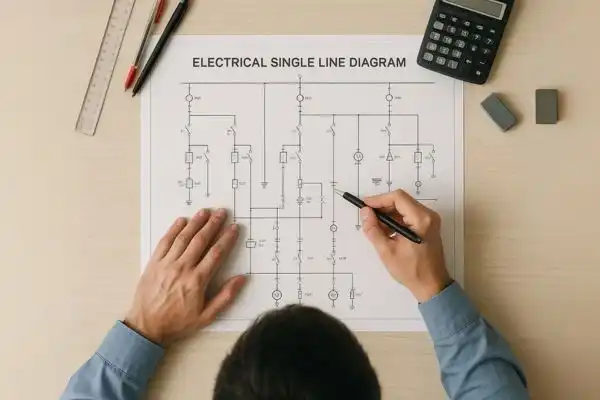
An RMU can also include voltage transformers, relays that sense voltage conditions, and voltage sensors. These parts are shown on a single line diagram. To read diagrams like this with confidence, see the Single Line Diagram (SLD) Masterclass, which teaches how to read and interpret real substation SLDs.
What is a Three-Function RMU?
A three-function RMU has three switching functions: switch 1, switch 2, and the circuit breaker. Not every RMU has all three. One that only provides the transformer protection function is called a single-function RMU.
How is the Transformer Protected Inside an RMU?
The transformer is protected either by a circuit breaker or by a load break switch with a fuse.
Protection Option | Cost | Reliability | After a Fault |
Circuit breaker | Higher | More reliable | Nothing to replace |
Load break switch with fuse | Lower | Less reliable | Fuses must be replaced |
For more on the switch itself, see What is a Load Break Switch (LBS)?
What Are the Key Features of an RMU?
An RMU is factory-assembled, metal-enclosed, and used at the load point of a ring main network.
Factory-assembled and metal-enclosed: it is delivered fully assembled, so no modification is needed on site. Place it on the foundation, install it, and connect the cables.
Used at the load point: it is installed where the transformer connects to a ring main network. You will rarely find it in radial networks, which is why it appears in urban areas more than in rural ones.
Indoor or outdoor: both versions are available.
Several functions in one unit: switching and transformer protection together.
What Are the Advantages of an RMU?
An RMU is safer, needs less maintenance, takes less space, and installs more easily than separate switchgear.
Safer and more secure: everything sits in a closed metal cubicle. The insulating medium can be SF6 gas, or an SF6-free option using environmentally friendly gases. See SF6 circuit breaker components for related reading.
Better performance, less maintenance: a metal-enclosed unit does not need frequent maintenance.
Compact: the size varies with voltage rating, but RMUs are compact in general.
Suited to different conditions: it handles monsoon, summer, and snow, with a dedicated IP rating protecting the equipment inside.
Easy installation: because it is factory-assembled, installation is quick.
Is There a Disadvantage to Using an RMU?
The main disadvantage is cost. An RMU costs more than the simple two-pole structures used in a radial (tree) network. Considering the advantages, I think the cost is worth it.
Where Are RMUs Used?
RMUs are mainly used in secondary power distribution, in buildings and infrastructure of many kinds.
Hospitals
Malls and commercial buildings
Residential buildings
Solar and wind power plants, where generation happens at lower voltages
Airports
Railway stations
If you want to go from these basics to reading a real RMU specification sheet, the RMU Blueprint: Master Ring Main Units course covers components, functional units, IEC standards, and testing in one structured path.
FAQ
What does a ring main unit do in a distribution network?
It combines switches and transformer protection in one unit. When a feeder faults, it lets you isolate that feeder and supply the load from the other direction around the ring.
Why is it called a three-function RMU?
Because it provides three functions: switch 1, switch 2, and the circuit breaker for transformer protection. An RMU with only the protection function is a single-function RMU.
Can an RMU be used in a radial network?
It is generally not found in radial networks. An RMU is designed for the load point of a ring main network, which is why it is more common in dense urban areas than in rural ones.
Should I choose a circuit breaker or a fuse for transformer protection?
A circuit breaker is more reliable and needs no replacement after a fault. A load break switch with fuse is cheaper but less reliable, and the fuses must be replaced after every fault.
Does an RMU have to use SF6 gas?
No. SF6 is one insulating medium, and SF6-free options that use environmentally friendly gases are available.
Conclusion
A ring main unit makes a ring main network practical. It combines two switches and a transformer protection device in one factory-assembled, metal-enclosed unit, so a feeder fault can be isolated and the load fed from the other direction around the ring.
The result is safer, lower-maintenance, compact switchgear that installs quickly. It costs more than a radial network’s simple structures, but for supply security in cable-based distribution, it is worth it.
To see the RMU explained with the single line diagram and power flow, watch my complete video on the TheElectricalGuy YouTube channel.
Watch the Youtube Video

About Author
Gaurav Joshi
Gaurav started his career on the floor of the electrical industry — not in a classroom. Working across Siemens and Schneider Electric, he saw firsthand how wide the gap was between what colleges teach and what the industry actually needs.
So he did something about it.
Today, he's built a global community of 300,000+ engineers and professionals across YouTube and beyond — and TheElectricalGuy Academy is where that knowledge lives in its most structured, practical form.