
Radial distribution is the simplest and cheapest primary distribution method, but suffers from poor reliability and voltage drop at the far end of the feeder. Ring main distribution solves both problems by connecting two feeders in a loop so every load can draw power from either side, at a significantly higher cost. Neither is universally better; the right choice depends on load density and how critical supply continuity is for that area.
Radial distribution and ring main distribution are the two most commonly used primary distribution systems. Understanding the difference starts with where distribution fits into the broader power system, and what primary distribution actually means.
What is a Distribution System?
A distribution system is the network that connects bulk incoming power to end consumers, the final stage after generation and transmission.
Distribution receives its input from the sub-transmission network, typically rated at 145 kV or 72.5 kV, and subdivides into two parts: primary distribution and secondary distribution.
What's the Difference Between Primary and Secondary Distribution?
Primary distribution steps power down to around 36 kV, 11 kV, 6.6 kV, or 3.3 kV and serves high voltage consumers directly, including industries, while secondary distribution steps it down further, typically to 440V, for residential and low voltage consumers.

An industry needing direct 11 kV supply, for example, can be fed straight from the primary distribution substation.
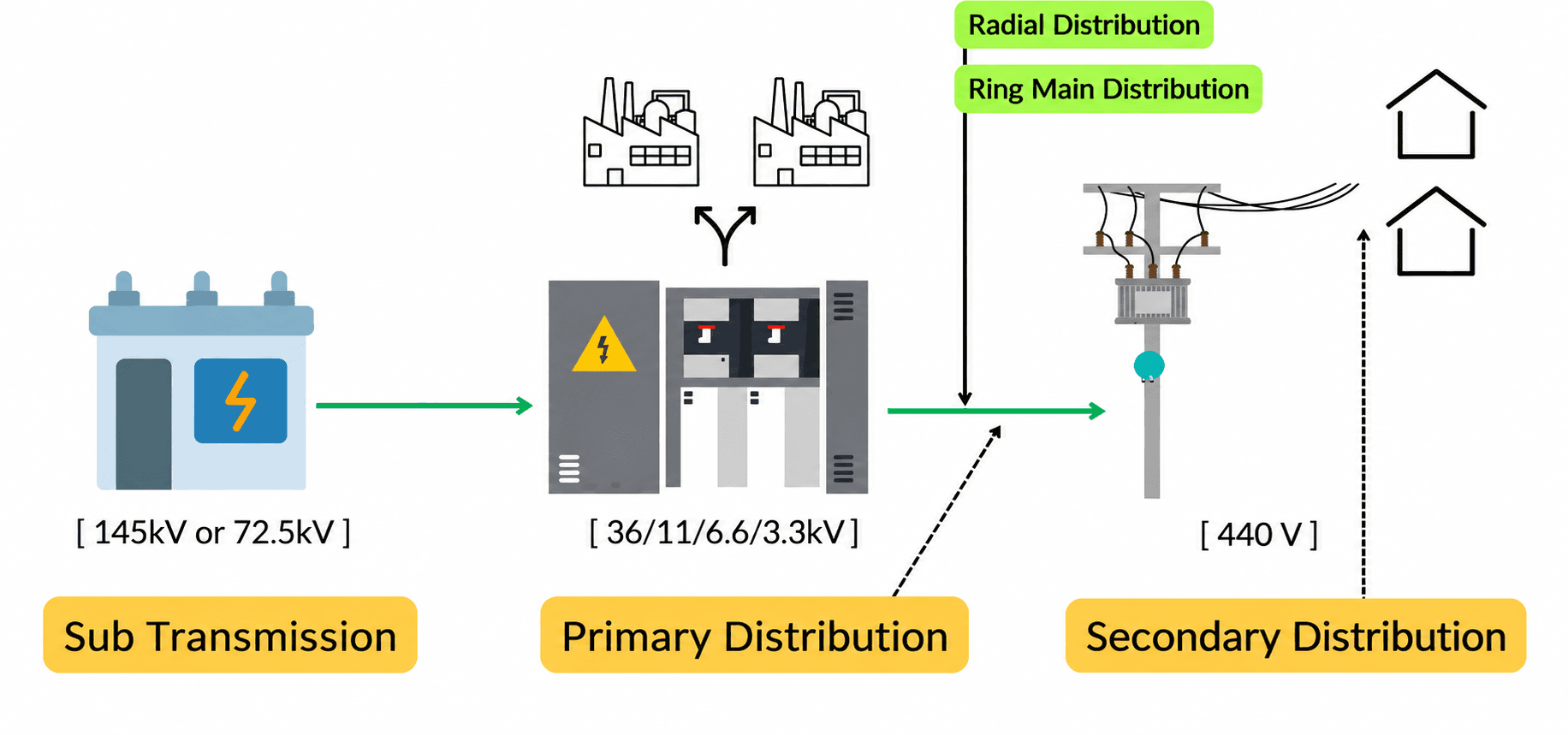
From there, another substation (often pole-mounted) steps that voltage down to 440V for homes and shops, the secondary distribution stage. Radial and ring main distribution specifically refer to primary distribution, the method used to deliver that intermediate voltage, 11 kV in a common example, to the secondary distribution network.
What is Radial Distribution?
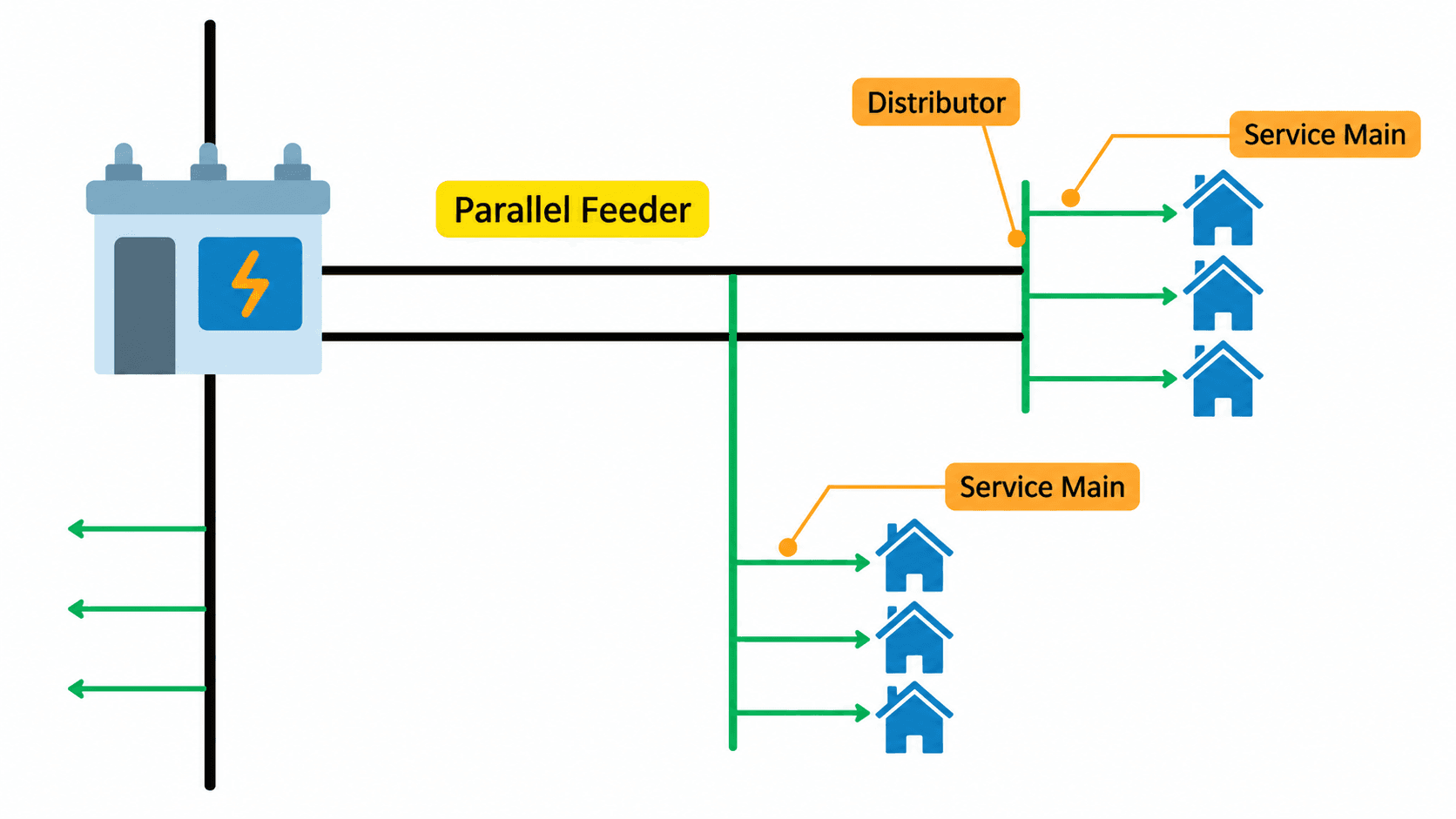
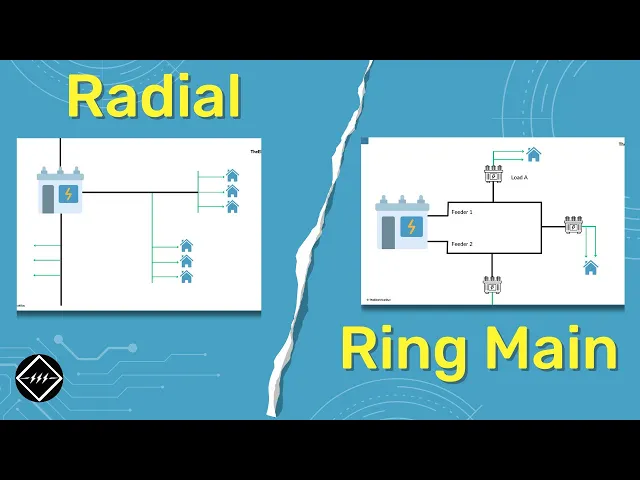
Radial distribution delivers power through a single main feeder that branches into distributors and service mains, similar to how a tree's main stem splits into branches and sub-branches.

A typical 36/11 kV substation, usually serving an area with roughly 5 MVA of load demand, has four to five feeders, each with roughly 1–2 MVA capacity. One main feeder takes several tappings (distributors), and from those distributors, power reaches individual consumers through service mains.
Why is it Called Radial (or Tree) Distribution?
Power "radiates" outward from the main feeder, separating into branches, which is exactly why it's called radial distribution, or alternatively tree-type distribution, given its visual resemblance to a tree's branching structure.
What are the Drawbacks of Radial Distribution?
Radial distribution has two major drawbacks: poor reliability, since a fault anywhere on a feeder cuts power to every load downstream of it, and voltage drop at the far end of the feeder as load and feeder length increase.
Poor reliability — if a fault occurs on a feeder, every connected load loses power until the fault is located and cleared; there's no alternate path.
Voltage drop at the tail end — loads farther from the substation experience lower voltage than loads closer to it, due to voltage drop accumulating along the distributor length. A load near the substation might see the full rated 230V, while a load at the tail end sees meaningfully less.
Despite these drawbacks, radial distribution remains the simplest and cheapest primary distribution method available, which is exactly why it's still widely used in low-density areas like villages, where load demand and supply-continuity requirements are lower.
How Does a Parallel Feeder Improve Radial Distribution?
A parallel feeder addresses radial distribution's reliability problem by running a second feeder alongside the main one, each capable of carrying the full load independently, so a fault on one feeder lets load transfer to the other with only a brief interruption during the switchover.
This improvement comes at a cost: a parallel feeder setup is more expensive than standard radial distribution, so it's used specifically where supply continuity matters enough to justify the added investment, without going as far as a full ring main system.
[Image: radial distribution with parallel feeder — alt text: "radial distribution feeder with a parallel backup feeder for improved reliability"]
What is Ring Main Distribution?
Ring main distribution, also called open loop distribution, connects two feeders from the same substation in a loop, so every load along the ring can draw power from either feeder.

Switches at each branch point allow any section to be isolated while power continues flowing from the opposite direction. If feeder one develops a fault, closing the appropriate switch redirects power through feeder two, with minimal interruption.
How Does Ring Main Distribution Solve Radial Distribution's Problems?
Ring main distribution delivers the highest reliability among primary distribution methods, since both feeders can independently carry the full load, and it also improves voltage regulation compared to radial distribution.

Since every load has access to power from two directions instead of one dead-end path, both the reliability problem and the voltage-drop problem inherent to radial distribution are directly addressed.
What Role Does a Ring Main Unit (RMU) Play?
A Ring Main Unit (RMU) is the switching device used at each connection point in a ring main distribution system, allowing a feeder to be isolated and power rerouted through the alternate feeder when a fault occurs.
In normal operation, a load typically draws power through one feeder, RMU, and transformer, with the switch to the second feeder kept open. If that primary feeder faults, closing the switch reroutes power through the second feeder, RMU, and transformer instead, restoring supply with minimal disruption.
[Image: ring main unit switching between feeders — alt text: "ring main unit rerouting power from a faulted feeder to the backup feeder"]
What is an Interconnected System?
An interconnected system is a variation of ring main distribution where the two feeders originate from two different substations instead of a single shared substation, offering the same looped reliability with additional source redundancy.
Radial vs Ring Main Distribution — Quick Comparison
Aspect | Radial Distribution | Ring Main Distribution |
Structure | Single main feeder with branching distributors | Two feeders connected in a loop |
Reliability | Poor; a fault cuts power to everything downstream | Highest; load can draw from either feeder |
Voltage regulation | Poor at the feeder's tail end | Significantly better |
Cost | Cheapest available method | Expensive, needs duplicate feeders and RMUs |
Maintenance | Lower | Higher |
Best suited for | Low-density areas, villages | Dense, high-load areas like cities |
Key device needed | None special | Ring Main Unit (RMU) |
Which System Should You Choose, Radial or Ring Main?
The right choice depends entirely on load density and how critical supply continuity is for that area, not on one system being universally superior.
Choose radial distribution for low-density areas like villages, where load demand is modest and the added cost of ring main infrastructure wouldn't be justified.
Choose ring main distribution for dense, high-load areas like cities, where frequent faults and extended outages from a simpler radial system would be far more costly than the upfront investment in ring main infrastructure.
FAQ
Why is radial distribution called "tree-type" distribution?
Because its structure visually resembles a tree: a main feeder (the trunk) branches into distributors (branches) and then service mains (sub-branches), with power radiating outward from the main feeder.
What's the main reliability problem with radial distribution?
If a fault occurs anywhere along a feeder, every load connected downstream of that fault loses power entirely until the fault is located and cleared, since there's no alternate path for power to take.
How does a ring main unit (RMU) improve reliability?
An RMU allows a faulted feeder to be isolated by opening a switch, while closing a connecting switch reroutes power through the second feeder in the loop, restoring supply with minimal interruption.
Is ring main distribution always better than radial distribution?
No. Ring main distribution costs significantly more and requires higher maintenance, so it's only the better choice where supply continuity genuinely justifies that added cost, typically in dense, high-load urban areas.
What's the difference between a standard ring main system and an interconnected system?
A standard ring main system draws both feeders from the same substation. An interconnected system draws the two feeders from two different substations, adding source-level redundancy on top of the looped reliability.
Conclusion
Radial and ring main distribution solve the same problem, delivering primary distribution power, with fundamentally different trade-offs. Radial distribution is simple and cheap but leaves every downstream load vulnerable to a single fault and suffers voltage drop at the feeder's tail end. Ring main distribution eliminates both weaknesses by giving every load two possible supply paths, at a meaningfully higher cost. Choosing between them comes down entirely to load density and how much supply continuity is actually worth in that specific area.
For the full visual walkthrough, watch the complete video on the TheElectricalGuy YouTube channel.
Watch the Youtube Video

About Author
Gaurav Joshi
Gaurav started his career on the floor of the electrical industry — not in a classroom. Working across Siemens and Schneider Electric, he saw firsthand how wide the gap was between what colleges teach and what the industry actually needs.
So he did something about it.
Today, he's built a global community of 300,000+ engineers and professionals across YouTube and beyond — and TheElectricalGuy Academy is where that knowledge lives in its most structured, practical form.