
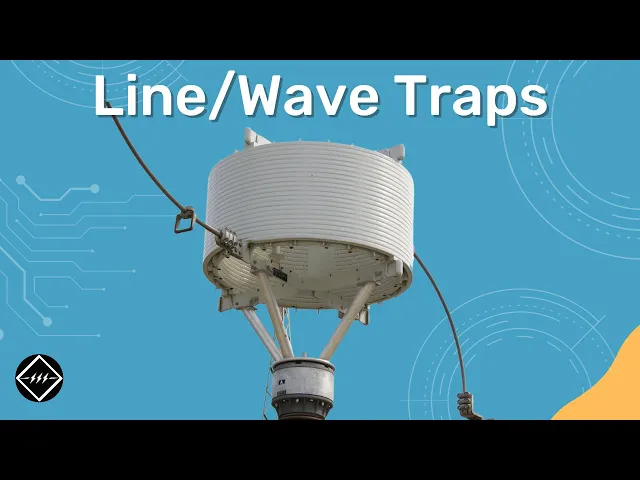
A wave trap, also called a line trap, is an inductor coil connected in series with a transmission line. It blocks high-frequency communication signals (40 to 500 kHz) from entering the substation while passing 50 or 60 Hz power freely. The blocked signals are diverted through a capacitor voltage transformer (CVT) or coupling capacitor to the communication equipment.

A transmission line does more than deliver power. It also carries communication signals between substations. That is useful, but it creates a problem: those signals must never enter the substation equipment. The device that stops them is the wave trap.
This article covers why wave traps are needed, the principle they use, their main components, how they are mounted, and where the blocked signal goes.
Why Do Transmission Lines Carry Communication Signals?
Transmission lines carry communication signals through power line carrier communication (PLCC), which reuses the existing transmission network instead of building a separate communication link.
PLCC carries voice communication, data transfer, remote metering, and control signals between substations. It is widely used and accepted in many countries because it is economical: the transmission network already exists, so the utility saves the cost of a dedicated communication network.
Why Must Communication Signals Be Blocked From Entering the Substation?
Communication signals must be blocked because substation equipment is designed for power frequency only, and a high-frequency signal can have an adverse effect on it.
The two signals are separated by frequency:
Signal | Frequency |
Power | 50 or 60 Hz |
Communication (PLCC) | 40 kHz to 500 kHz |
Take a transformer designed for 50 Hz. If a 200 kHz communication signal enters it, the effect on the transformer is harmful. To protect substation equipment and keep the system reliable, only the power frequency should be allowed in. The device that blocks the rest is the wave trap.
What Principle Does a Wave Trap Use to Block High-Frequency Signals?
A wave trap works on inductive reactance: a coil in series with the line offers high opposition to high frequencies and very little to power frequency.
In AC circuits, opposition to current is called impedance, and two types depend on frequency:
Inductive reactance (XL = 2πfL): rises as frequency rises. A higher frequency meets more opposition.
Capacitive reactance (XC = 1 / 2πfC): falls as frequency rises. A higher frequency meets less opposition.
To block high frequencies, you need the first one. Inserting inductive reactance into the line gives a high-frequency signal heavy opposition, while the 50 or 60 Hz power sees almost none, so there is almost no power loss. In effect, the wave trap acts as a filter.
What Are the Main Components of a Wave Trap?
A wave trap has three main components: a main coil, a tuning device, and a lightning arrester or spark gap.

Component | What It Does |
Main coil | Provides the inductive reactance. Carries the full rated line current continuously and is tested for short-circuit current (for example, rated for 3,150 A continuous and 40 kA for 3 seconds). |
Tuning device | An RLC circuit connected in parallel with the coil. Sets the frequency band that gets blocked (for example, 100 kHz to 300 kHz). |
Lightning arrester or spark gap | Connected in parallel with the tuning device to protect it from surge voltages, because the tuning device is delicate. |
The coil alone is not enough. Without the tuning device, you cannot define which band of frequencies is blocked. That is why the coil and tuning device work as a pair.
What Does a Wave Trap Look Like?

Insulated coil: the white outer body is the insulation around the main coil.
Corona ring: reduces field concentration at the edges. You can read more in what causes the corona effect on high voltage lines.
Bird barrier: because the device is hollow and outdoors, birds can enter it, so a barrier is often fitted.
Tuning device and arrester: housed inside the structure.
How is a Wave Trap Mounted?
A wave trap is mounted in one of three ways: on the gantry, on a support insulator, or on a CVT.
On the gantry of the tower, mounted directly on it.
On a support insulator with a dedicated support structure.
On a capacitor voltage transformer (CVT), directly above it.
Not every substation has wave traps. Only substations that use power line carrier communication need them.
Where Does the Blocked Communication Signal Go?
The blocked signal does not go to earth. It takes the path of least opposition, which is through a CVT or coupling capacitor to the communication equipment.
Because capacitive reactance falls as frequency rises, a high-frequency signal meets very little opposition through a capacitor. The wave trap blocks the signal from entering the substation, so it flows into the CVT next to it and on to the PLCC communication equipment. If a CVT is not available, a coupling capacitor does the same job.
This is why a CVT is placed next to the wave trap. A CVT serves two purposes: it is an instrument transformer that provides voltage for monitoring and relay inputs, and it acts as the link between the line signal and the communication device.
[Image: signal path through the CVT, alt text: “communication signal blocked by the wave trap and diverted through a capacitor voltage transformer to the PLCC equipment”]
FAQ
What is the difference between a wave trap and a line trap?
They are the same device. Both names refer to the inductor coil that blocks high-frequency communication signals from entering a substation.
What frequency range does a wave trap block?
Power line carrier communication typically uses 40 kHz to 500 kHz. The tuning device sets the exact band the wave trap blocks, for example 100 kHz to 300 kHz.
Why does the main coil need a short-circuit current rating?
The coil sits in series with the line, so it carries the full rated current continuously. It is also tested for short-circuit current, for example 40 kA for 3 seconds, so it can withstand a fault on the line.
Can a coupling capacitor replace a CVT in this role?
Yes. If a CVT is not available, a coupling capacitor gives the blocked signal the same low-opposition path to the communication equipment. A CVT also works as an instrument transformer for voltage monitoring and relay inputs.
Does every substation have wave traps?
No. Only substations that use power line carrier communication need them.
Conclusion
A wave trap keeps communication signals out of the substation by using one idea: an inductor offers more opposition as frequency rises. The main coil blocks the high-frequency signal, the tuning device sets the blocked band, and the lightning arrester protects the tuning device.
The blocked signal then takes the capacitor path through the CVT to the communication equipment, while 50 or 60 Hz power passes through unaffected.
To see how a wave trap looks and works on real equipment, watch my complete video on the TheElectricalGuy YouTube channel.
Watch the Youtube Video

About Author
Gaurav Joshi
Gaurav started his career on the floor of the electrical industry — not in a classroom. Working across Siemens and Schneider Electric, he saw firsthand how wide the gap was between what colleges teach and what the industry actually needs.
So he did something about it.
Today, he's built a global community of 300,000+ engineers and professionals across YouTube and beyond — and TheElectricalGuy Academy is where that knowledge lives in its most structured, practical form.