
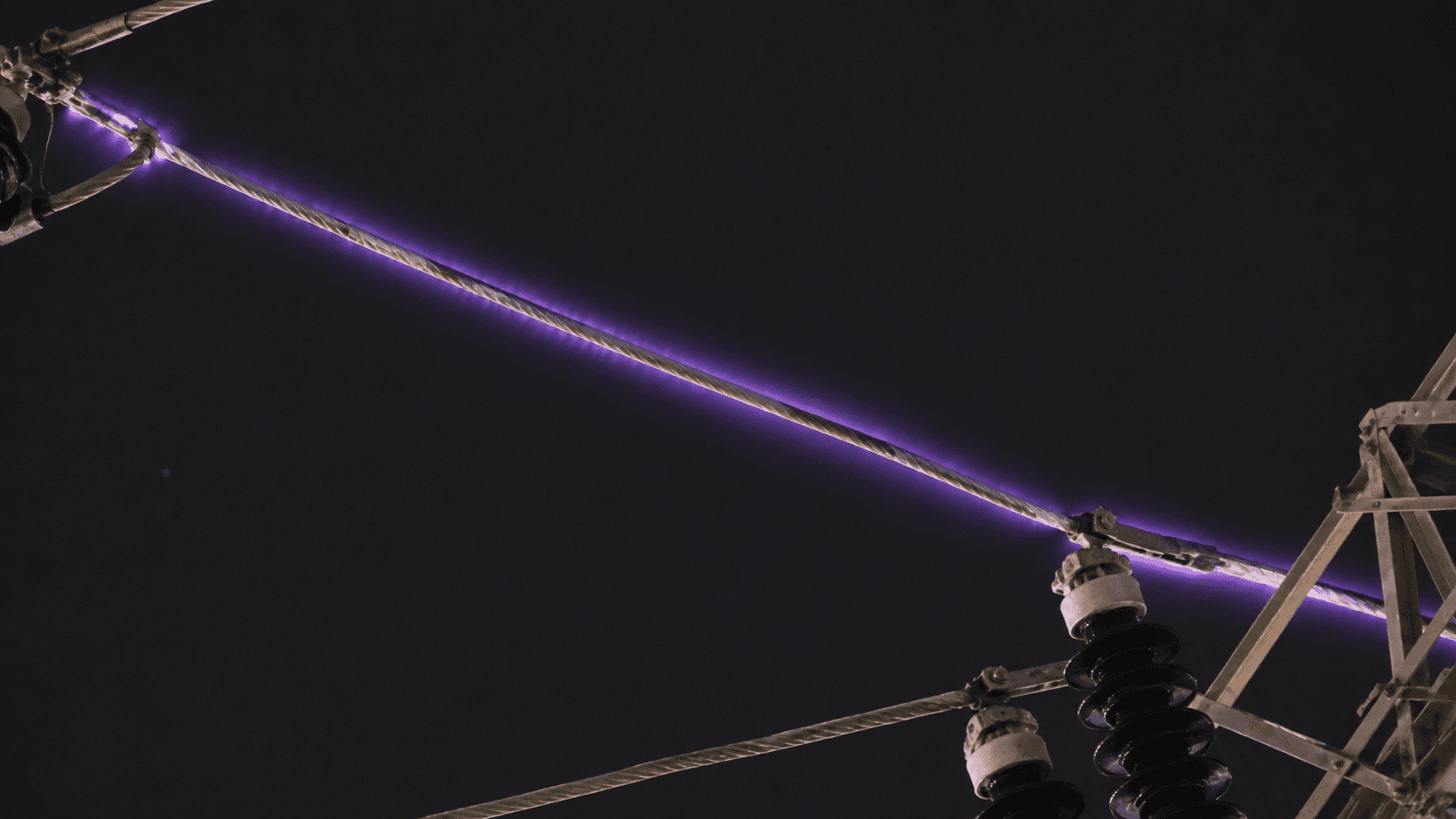
The corona effect is the ionization of air around a high voltage conductor when the surface electric field exceeds a critical threshold, producing a violet glow, a hissing sound, and ozone gas. It's generally observed on lines rated 245 kV and above, and left unmanaged it causes continuous power loss, protection-signal interference, and accelerated insulation degradation.
Most electrical engineers have heard of the corona effect, but far fewer know exactly what's happening physically, or that it silently costs power utilities real money every year. By the end of this article, you'll also understand why every extra high voltage line uses bundled conductors instead of a single thick wire.
Let's start with what's actually happening at the conductor surface.
Why Does the Corona Effect Happen?
The corona effect happens because air is never a perfect insulator, and a strong enough electric field at a conductor's surface ionizes the air molecules around it.
Air always contains free electrons and ions, even under normal conditions. A high voltage conductor generates a strong electric field around itself, and that field is most intense right at the conductor surface, weakening as distance from the conductor increases, similar to how a magnet's pull weakens with distance.
When the electric field intensity at the surface exceeds roughly 30 kV per centimeter, the surrounding air begins to break down. Free electrons gain enough energy to ionize the surrounding air molecules, and this ionization is what triggers the corona effect.
The voltage at which this ionization first begins is called the critical disruptive voltage, a term worth remembering for interviews.
What Are the Visible Signs of Corona Discharge?
Corona discharge produces three simultaneous effects: a violet or bluish-white glow, a hissing or crackling sound, and the smell of ozone gas.
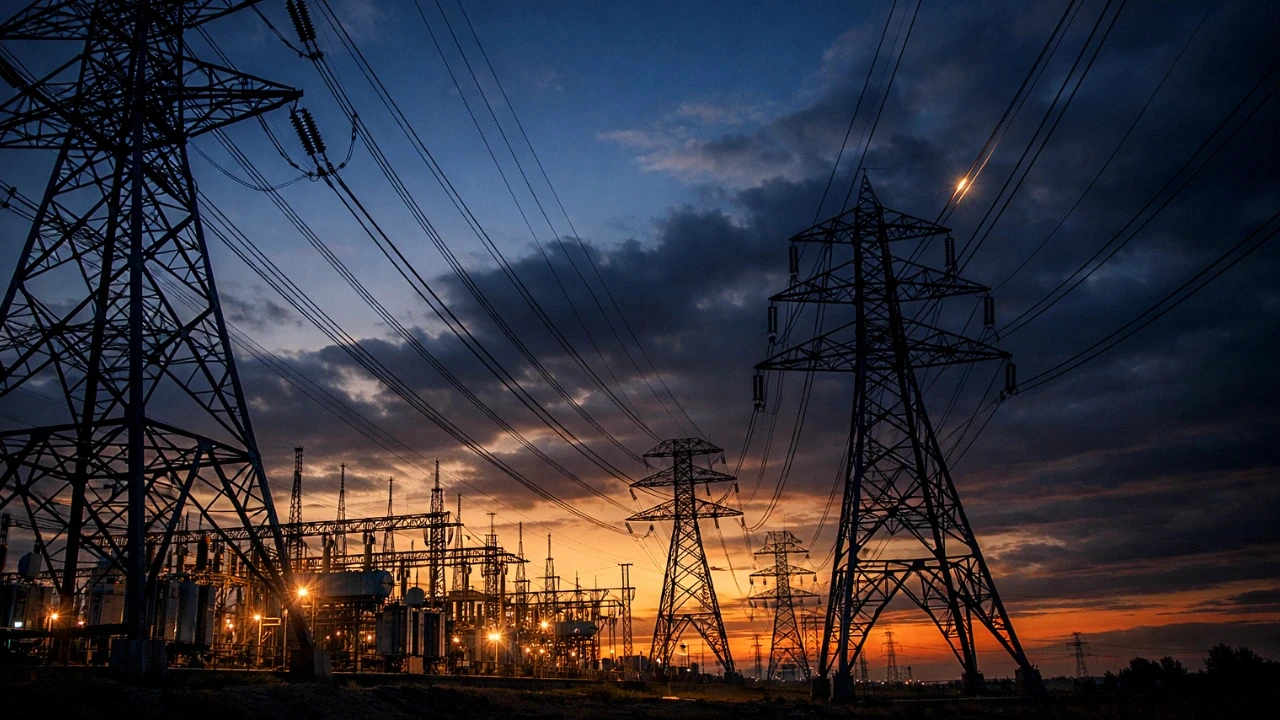
The glow comes from electron excitation and photon emission, mainly from nitrogen in the surrounding air. This is the light visible around HV lines at night.
The sound is caused by rapid micro-expansion of the air, audible standing near a large HV substation.
The ozone smell comes from corona energy breaking oxygen molecules apart; the freed oxygen atoms combine with nearby oxygen and nitrogen molecules to form ozone.
At What Voltage Does the Corona Effect Occur?
Corona effect is generally observed on transmission lines rated 245 kV and above, since lower-voltage lines don't create a strong enough electric field to break down the surrounding air.
Standing near a 36 kV or 11 kV line, you won't see this glow, because the electric field at those voltage levels simply doesn't reach the ionization threshold. Corona isn't limited to transmission lines either; it can also occur on extra high voltage outdoor switchgear, transformer bushings, and similar high-field equipment.
What Factors Make Corona Worse?
Corona severity is influenced by temperature, humidity, air pressure, conductor surface condition, and pollution level, not just the voltage alone.
Humid weather and rain make corona noticeably worse. A rough, damaged, or dirty conductor surface produces far more intense corona than a smooth, clean one, because the electric field concentrates at rough points and sharp edges. This is exactly why conductor surface condition is checked closely during line inspection.
Why is the Corona Effect a Real Engineering Problem?
The corona effect causes three measurable costs: continuous power loss, interference with protection and communication signals, and accelerated equipment degradation from ozone exposure.
How Much Power Does Corona Waste?
Corona discharge causes continuous, measurable power loss along the entire length of a transmission line, even in fair weather. As an illustrative example, a 400 kV line running 500 km might see corona losses in the range of roughly 1 to 5 kW per kilometer, depending on line configuration and weather, meaning several hundred to a couple thousand kW could be dissipating into the air continuously.
During monsoon or heavy rain, this loss can climb several times higher. That's power generated at the plant and transmitted hundreds of kilometers, lost before it ever reaches the load.
How Does Corona Interfere With Protection Systems?
Corona produces high-frequency electromagnetic interference, typically in the 0.5 MHz to 30 MHz range, the same general band used by AM radio and, more critically, by power line carrier communication, the signaling system protection relays use to coordinate between the two ends of a transmission line. A protection signal corrupted by corona noise is a direct threat to grid reliability, a real and documented concern on long EHV lines in high-corona areas.
How Does Ozone From Corona Damage Equipment?
Ozone generated by corona is highly reactive and, over time, attacks polymer compounds in insulator material, cable sheathing, and rubber gaskets. An insulator normally rated for around 30 years of service life can see meaningfully shortened life under continuous corona exposure in a polluted environment. On a 400 kV line, the consequences of an insulator failure at that scale can be severe for the wider grid.
How Do Engineers Prevent the Corona Effect?
Engineers prevent the corona effect by reducing the electric field intensity at the conductor or terminal surface, using three main methods: larger conductor diameter, bundled conductors, and corona rings.
Why Increase Conductor Diameter?
Since corona starts once surface electric field intensity exceeds the critical threshold, increasing conductor diameter spreads that field over a larger surface area, reducing intensity at any single point. This is a major reason high voltage lines use ACSR (aluminum conductor steel reinforced) conductors sized well beyond what current-carrying capacity alone would require; the diameter is chosen partly for corona control.
Why Do High Voltage Lines Use Bundled Conductors?
Bundled conductors, two, three, or four sub-conductors per phase, spaced roughly 30 to 60 cm apart using spacers, behave electrically like a single conductor with a much larger effective diameter, keeping electric field intensity at each individual conductor surface below the corona threshold.
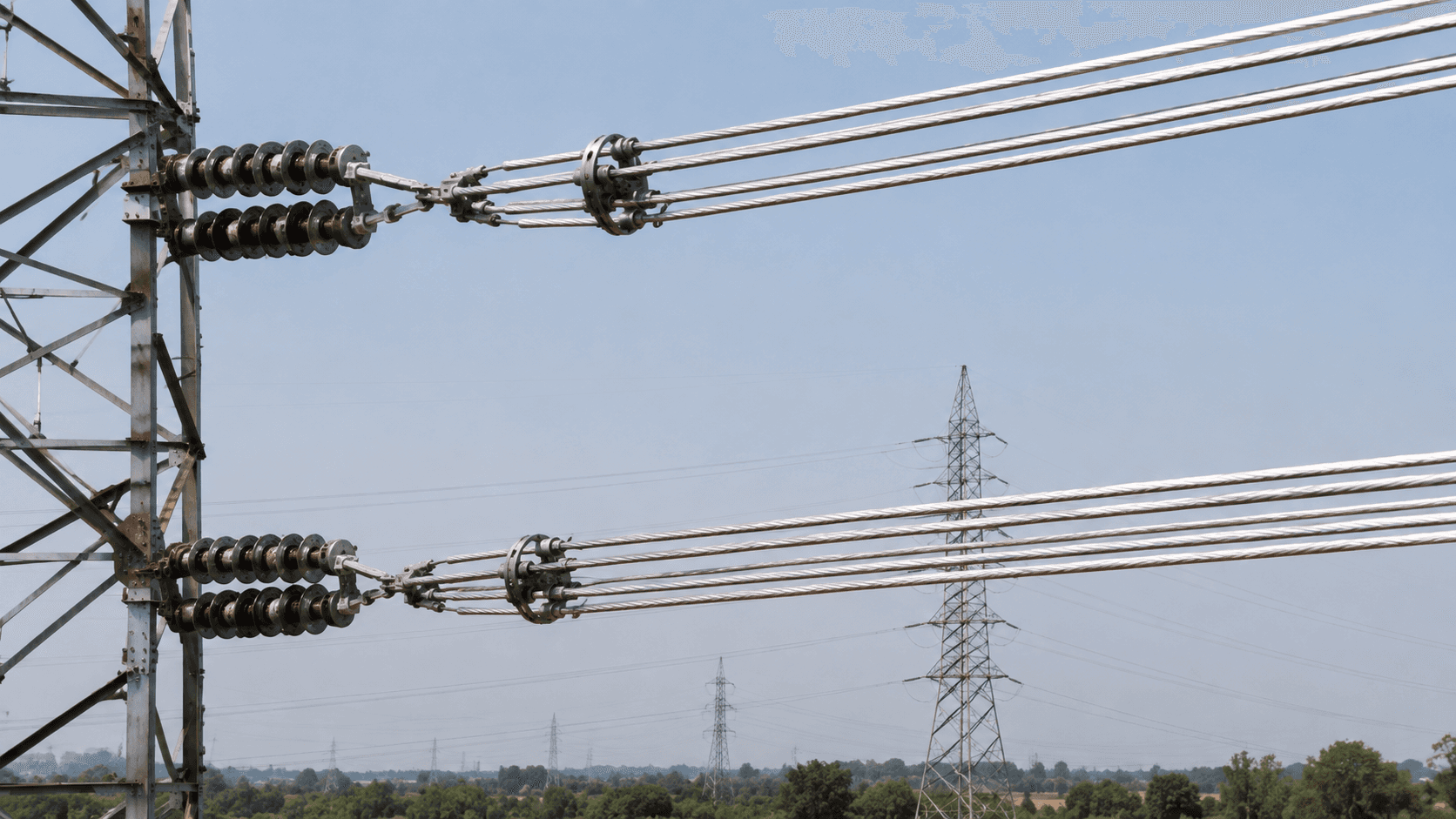
This is why 400 kV lines in India typically use a twin bundle (two conductors per phase), while 765 kV lines can use a quad bundle (four conductors per phase). It's the direct answer to why EHV lines never use a single thick wire per phase.
What is a Corona Ring and What Does It Do?
A corona ring is a large-diameter toroidal metal ring fitted around high voltage equipment terminals, such as transformer bushings, circuit breaker terminals, or disconnector switches, to eliminate the sharp local field concentration that occurs at edges and points.
By redistributing the electric field around a smooth, continuous curved surface, corona rings prevent the steady erosion of terminals and surrounding insulation that would otherwise occur. They're a standard fitting on high voltage equipment, generally 400 kV and above.
How is Corona Used as an Early Warning Indicator?
Corona is not just a problem to prevent; increasing corona activity around a piece of equipment is often one of the earliest warning signs of a developing insulation problem, before complete failure occurs.
Modern diagnostic tools detect this early:
UV cameras visualize corona discharge even in daylight, appearing as a bright glowing spot when aimed at a substation bushing, telling maintenance teams to investigate before failure.
Acoustic sensors and high-frequency current transformers detect the partial discharge signatures associated with corona, including inside enclosed metal-clad switchgear.
Corona is technically a type of partial discharge, alongside surface discharge and internal discharge, each with its own detection signature.
If you want to go beyond recognizing corona and actually learn to test for partial discharge on live equipment, the Partial Discharge Testing course on TheElectricalGuy Academy covers exactly that: hands-on PD testing, taught by industry practitioners, and CPD accredited. It's built for engineers who want this to be a skill they can actually apply on site, not just a concept they can explain in an interview.
FAQ
At what field strength does the corona effect start?
Corona onset typically occurs once the electric field at the conductor surface exceeds roughly 30 kV per centimeter, causing the surrounding air to ionize.
Why don't you see corona on 11 kV or 36 kV lines?
The electric field generated at these lower voltage levels isn't strong enough to reach the ionization threshold in air, so no visible glow or corona discharge occurs.
Why do extra high voltage lines use bundled conductors instead of one thick wire?
A bundle of two to four sub-conductors per phase behaves electrically like a single much larger conductor, spreading the electric field and keeping intensity at each conductor's surface below the corona threshold.
Is corona always a problem to eliminate?
Not entirely. While corona causes power loss and equipment stress, increasing corona activity detected by UV cameras or partial discharge sensors can also serve as an early warning sign of developing insulation problems, useful for predictive maintenance.
How does weather affect corona severity?
Humid weather and rain significantly worsen corona activity, and a rough, dirty, or damaged conductor surface produces far more intense corona than a smooth, clean one.
Conclusion
The corona effect is the ionization of air at a high voltage conductor's surface once the electric field crosses a critical threshold, producing a visible glow, an audible hiss, and ozone gas.
Left unmanaged, it causes continuous power loss, interference with protection communication, and accelerated equipment degradation from ozone exposure. Engineers address it through larger conductor diameters, bundled conductors, and corona rings, and increasingly use it as an early diagnostic signal rather than treating it purely as a problem to eliminate.
For the full explanation with real footage and diagrams, watch the complete video on the TheElectricalGuy YouTube channel.
Watch the Youtube Video

About Author
Gaurav Joshi
Gaurav started his career on the floor of the electrical industry — not in a classroom. Working across Siemens and Schneider Electric, he saw firsthand how wide the gap was between what colleges teach and what the industry actually needs.
So he did something about it.
Today, he's built a global community of 300,000+ engineers and professionals across YouTube and beyond — and TheElectricalGuy Academy is where that knowledge lives in its most structured, practical form.