
Yes. A heavier load on the secondary raises the primary current, because the turns ratio links the two currents. The voltages do not change with load, since they depend only on the supply voltage and the turns ratio. In the simulation below, halving the load resistance doubled both currents.
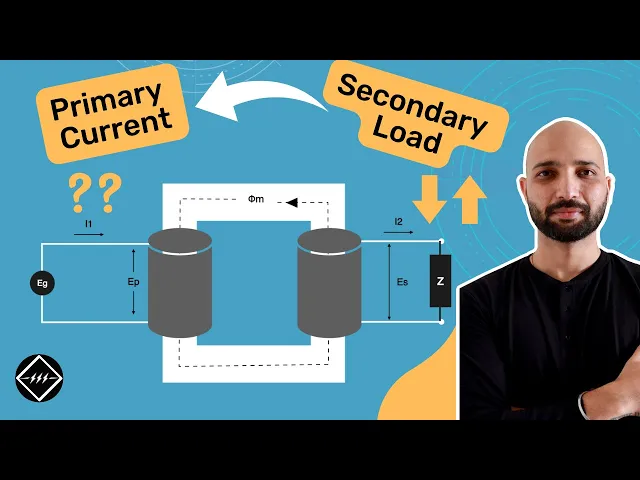
This is one of the most frequently asked transformer questions: if I increase the load on the secondary, does it change the current flowing into the primary? Many people assume the primary side is unaffected.

A simple circuit simulation answers it clearly. Following the steps in order shows what happens to the voltage, to the current at no load, and to the current on load.
What Does the Simulation Setup Look Like?
The simulation uses a 1:2 step-up transformer with a 50 Hz AC source and a resistive load on the secondary.
Source: 50 Hz AC, 200 V peak, which reads about 141 V RMS on the meters.
Transformer: step-up, turns ratio 1:2.
Measurements: a voltmeter in parallel and an ammeter in series on each side.
Load: a 1 kΩ resistor, purely resistive.

All readings are RMS values. A smaller load resistance means a heavier load, because it draws more current.
Does Changing the Secondary Load Change the Voltage?
No. Changing the load does not change the primary or secondary voltage.
With the 1 kΩ load, the primary voltage is 141 V and the secondary voltage is 282 V, as expected for a step-up transformer. Doubling the load resistance to 2 kΩ leaves both readings unchanged.

Load Resistance | Primary Voltage | Secondary Voltage |
1 kΩ | 141 V | 282 V |
2 kΩ | 141 V | 282 V |
The reason is the transformation ratio:
E1 / E2 = N1 / N2 = a
Once a transformer is built, the turns N1 and N2 are fixed. So the voltages are tied directly to each other, and the only thing that changes the secondary voltage is the primary voltage. To change the voltage on the secondary, you change the supply on the primary. Changing the load does not do it. The auto transformer vs regular transformer article shows why this ratio also decides when an auto transformer saves copper.
What Current Flows When the Secondary Has No Load?
With no load, the secondary current is zero, but a small current still flows in the primary.
Remove the load and the secondary current reads 0 A. The primary, however, still draws a small current.
That current exists because the simulation uses a practical transformer, not an ideal one. The core of a practical transformer has losses, such as hysteresis and eddy current losses, and the primary draws this small current to supply them. It is often called the magnetising current.
An ideal transformer has a lossless core, so with no load both currents would be zero. For more on how core losses and heat arise, see 4 Power Transformer Systems Every Engineer Should Know.
What Happens to the Primary Current When the Load Changes?
The primary current changes whenever the secondary load changes: more secondary current means more primary current.

Load Resistance | Secondary Current | Primary Current |
No load | 0 A | Small no-load current |
2 kΩ | 141 mA | 293 mA |
1 kΩ | 282 mA | 570 mA |
500 Ω | 563 mA | 1.13 A |
Look at the pattern. Each time the load resistance is halved, the secondary current doubles, and the primary current doubles with it. Increasing the load from 2 kΩ to 1 kΩ moves the primary from 293 mA to 570 mA. Going down to 500 Ω takes it to 1.13 A. Making the load lighter does the opposite: when the resistance is doubled, the primary current falls.
Why Does the Primary Current Follow the Secondary Current?
The primary current follows the secondary current because of the current ratio, which is the reciprocal of the voltage ratio.
N1 / N2 = I2 / I1, which can be written as N1 × I1 = N2 × I2
The turns are fixed, so the primary current is directly proportional to the secondary current. If the secondary current changes, the primary current changes by the same factor.

The numbers confirm it. This is a 1:2 step-up transformer, so the primary current is about twice the secondary current: 570 mA against 282 mA at 1 kΩ, and 1.13 A against 563 mA at 500 Ω. The small extra on the primary side is the no-load current from the practical transformer.
What Should You Remember?
Three points sum up the whole behaviour.
Voltage: a change in secondary load does not change the primary or secondary voltage.
No load: the secondary current is zero, but a small current flows in the primary to supply the core losses.
On load: a change in secondary load changes the primary current, because of the current ratio.
FAQ
Does adding load on the secondary change the secondary voltage?
In the simulation, no. The secondary voltage is set by the primary voltage and the turns ratio, so it stayed at 282 V when the load changed from 1 kΩ to 2 kΩ.
Why does the primary draw current when the secondary is open?
A practical transformer has core losses, such as hysteresis and eddy current losses. The primary draws a small current to supply them. An ideal transformer would draw none.
What happens to the primary current if I double the load resistance?
It falls. In the simulation, going from 1 kΩ to 2 kΩ halved the secondary current from 282 mA to 141 mA, and the primary current dropped from 570 mA to 293 mA.
In a step-up transformer, which side carries more current?
The primary. In the 1:2 example, the primary current is about twice the secondary current, because the current ratio is the reciprocal of the voltage ratio.
Why is the primary current slightly more than twice the secondary current?
The extra is the no-load current of the practical transformer, which flows on top of the current that supports the load.
Conclusion
A change in secondary load does not change the voltages of a transformer, but it does change the primary current. The voltages are fixed by the supply and the turns ratio, while the currents are linked by the reciprocal current ratio, so a heavier secondary load always draws more current from the primary. A small no-load current flows on the primary even with nothing connected, because a practical transformer has core losses.
To see the circuit simulation run step by step, watch my complete video on the TheElectricalGuy YouTube channel
Watch the Youtube Video

About Author
Gaurav Joshi
Gaurav started his career on the floor of the electrical industry — not in a classroom. Working across Siemens and Schneider Electric, he saw firsthand how wide the gap was between what colleges teach and what the industry actually needs.
So he did something about it.
Today, he's built a global community of 300,000+ engineers and professionals across YouTube and beyond — and TheElectricalGuy Academy is where that knowledge lives in its most structured, practical form.