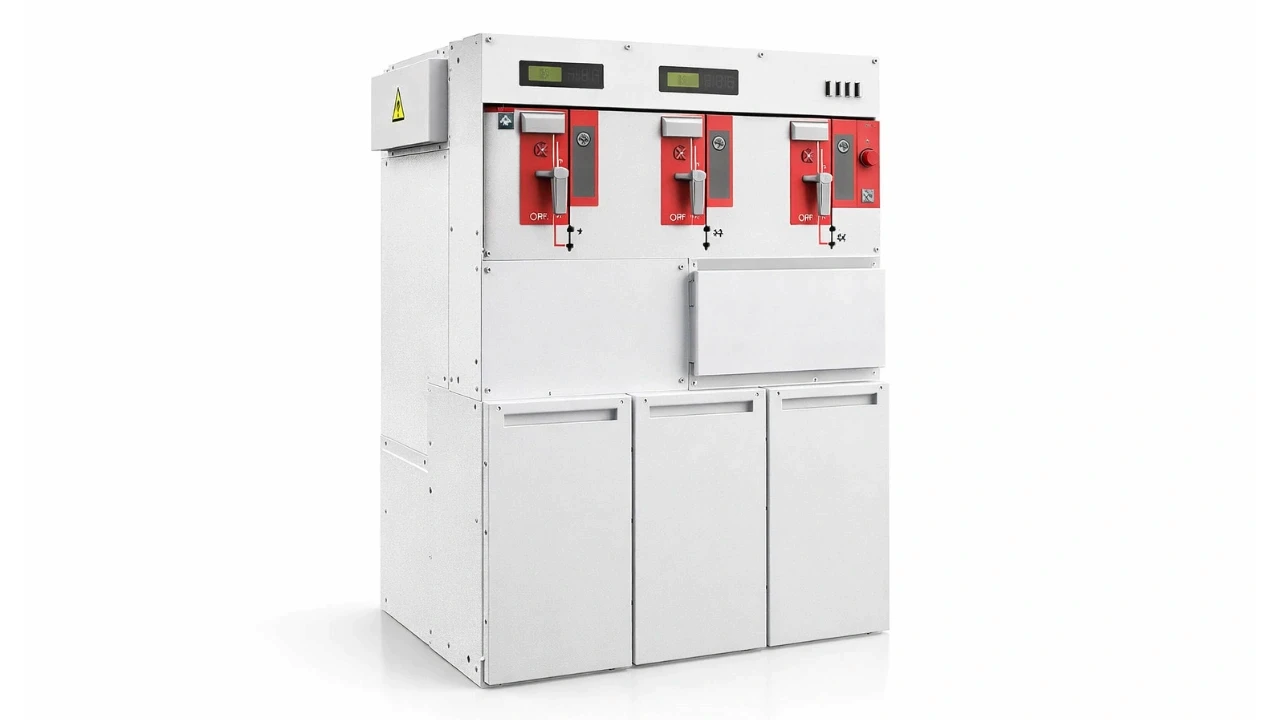

A ring main unit (RMU) is compact, sealed, metal-enclosed medium voltage switchgear for secondary distribution, commonly rated 630 A and up to 25 kA. A conventional MV panel is modular switchgear for higher ratings and advanced protection at main substations. RMUs win on size, maintenance, and cost for distribution; panels win on capacity and flexibility.
In electrical distribution, people often ask why ring main units are used instead of the conventional medium voltage switchgear panel. Some are even unsure that an RMU counts as switchgear at all. This article clears up both questions and compares the two on five practical criteria.
Is a Ring Main Unit a Switchgear?
Yes. An RMU is switchgear, and it does the same fundamental jobs as any switchgear: protect, monitor, and isolate when needed.

Protect: the circuit breaker branch protects the distribution transformer. A current transformer feeds it, so it trips when a fault occurs.
Monitor: an RMU can include voltage transformers, relays, and voltage sensors to sense conditions on the network.
Isolate: the three-position switches can be opened or earthed, so a feeder or section can be isolated safely.
What is a Ring Main Unit?
A ring main unit is metal-enclosed, factory-assembled switchgear designed for medium voltage electrical distribution, acting as a key node in a ring-type distribution network.

Three terms in that definition are worth unpacking:
Metal-enclosed: everything sits inside a metal enclosure.
Factory-assembled: it arrives as a plug-and-play unit. You place it on a plinth, make the connections, and it is ready to use.
Secondary distribution: it is used for secondary electrical distribution. If those terms are new, radial vs ring main distribution explains primary and secondary distribution.
Take a simple ring network with two power sources, power transformer 1 and power transformer 2. The ring means that if transformer 1 fails, transformer 2 can still feed the load. That needs a switch for each source and a switch for the distribution transformer that feeds the loads.

Combine those three switches, put them inside a tank filled with an insulating gas such as SF6, and enclose it in metal. That is a ring main unit. In my view, a modern ring-type distribution grid, including ideas like the self-healing grid, is not possible without RMUs. For a full walkthrough of its parts, see What is a Ring Main Unit (RMU)?.
RMUs are very compact and sealed for life. A good-quality unit is typically fine for 20 to 25 years, needs very little maintenance, and suits remote locations where nobody monitors the device. They can also be extended if a few more functions are needed.
What is a Conventional MV Switchgear Panel?
A conventional MV panel is metal-enclosed, mostly factory-assembled switchgear built from separate compartments.
In an air-insulated panel, the compartments are the cable compartment, the circuit breaker compartment, the bus bar compartment, and the low voltage compartment. An RMU also has a cable compartment and a low voltage compartment, but it puts all its switching functions inside one sealed tank.

That compartment design brings two advantages:
Replaceable components: if a circuit breaker is not working, you can swap in a new one. That is not possible with an RMU. Note that this applies to air-insulated panels. A gas-insulated panel has the same limitation as an RMU.
Withdrawable devices: you can pull out a circuit breaker, or a potential transformer, for testing and maintenance, then put it back or replace a faulty one. See components of a vacuum circuit breaker for withdrawable breakers in detail.
Panels also offer much higher current and short-circuit capacities.
Why Use an RMU Instead of a Conventional MV Panel?
You can use a conventional panel for distribution, but you don’t need to, because the RMU is a better-suited, more compact, and safer solution for that job.
Think of a nail cutter. You can cut your nails with a sword too, but you don’t need to when you already have a better, safer tool. The comparison below shows why, on five criteria.
How Do They Compare on Rating and Fault Level?
An RMU has lower ratings than a conventional panel, and that limit is exactly what keeps it compact.
RMU: commonly 630 A rated current and short-circuit capacity up to 25 kA, most often around 21 kA or lower. Versions with 800 A or 1,200 A exist, but they cost you compactness.
Conventional panel: up to 4,000 A, and up to 50 kA of short-circuit breaking and withstand capability.

Distribution to residential and commercial zones does not need panel-level ratings, because currents rarely rise above about 600 A and fault levels are generally lower than 25 kA. Panels with large ratings suit utility substations handling tens of MVA. One step below that, an RMU makes more sense.
How Do They Compare on Footprint and Space?
An RMU needs far less space and far less civil work than a conventional panel.

RMUs are mostly gas-insulated, using SF6 or an SF6 alternative, which is what makes them compact. You build a simple plinth, put the unit on top, and it is ready. They can be installed outdoors, or inside compact substations.

Conventional panels are mostly indoor, so they need a room or building. That is why RMUs are the usual choice for ring networks in public areas: walk along a footpath and you will see them, because they are safe and need no major civil work.
How Do They Compare on Maintenance and Longevity?
An RMU is close to a fit-and-forget device, while a conventional air-insulated panel needs regular maintenance.
RMU: very little maintenance, typically fine for 20 to 25 years with a good-quality product.
Conventional AIS panel: needs regular maintenance, and withdrawable types need greasing as well.
Conventional GIS panel: maintenance drops significantly.
In distribution, maintenance every six months means power interruptions and extra manpower, which is what a distribution network wants to avoid. That favours the RMU.
How Do They Compare on Protection Schemes?
An RMU offers limited protection that is enough for distribution, while a conventional panel supports advanced protection.

RMU: typically installed where no utility staff are watching, so it uses a self-powered relay that draws its power from the current transformer. There is no dedicated auxiliary supply and no advanced protection scheme. That is good enough for the distribution zone.
Conventional panel: supports advanced relays, extensive indications, and more, housed in the low voltage compartment. That is needed because it handles large amounts of power.
If you need an advanced protection scheme, an RMU may not be right for you.
How Do They Compare on Initial Cost?
An RMU has a lower initial cost, but a conventional air-insulated panel is easier to repair.
RMU: compact, with no major civil work, so the initial cost is lower. The catch is the sealed gas-insulated tank. If something goes wrong inside, you may not be able to fix it on site. The unit goes back to the manufacturer, and it may or may not be repairable.
Conventional AIS panel: components can be replaced, so a faulty breaker is simply swapped. The initial cost is higher, and an indoor installation also needs a building.
For distribution, the advantages a panel adds are not needed, so the RMU makes more sense.
RMU vs MV Switchgear Panel: Quick Comparison
Criterion | Ring Main Unit (RMU) | Conventional MV Panel |
Rating | Commonly 630 A | Up to 4,000 A |
Short-circuit capacity | Up to 25 kA, most often around 21 kA or lower | Up to 50 kA |
Footprint | Compact, plinth only, outdoor capable | Larger, mostly indoor, needs a room or building |
Maintenance | Minimal, fit and forget, typically 20 to 25 years | AIS needs regular maintenance, GIS much less |
Protection | Self-powered relay, limited scheme | Advanced relays and indications |
Component replacement | Not possible, sealed tank | Possible in AIS panels |
Initial cost | Lower | Higher |
Typical use | Secondary distribution in ring networks | Main and utility substations |
When Should You Choose an RMU, and When a Conventional Panel?
Choose by the job: an RMU for distribution at the load end, a conventional panel for main substations that handle large power.
Choose an RMU for:
Urban distribution networks, especially ring networks.
Solar and wind plants, where a single-function RMU can be used.
Commercial buildings, where current ratings are limited.
Dusty or coastal outdoor environments, because the unit is sealed.
Choose a conventional panel for:
Main substations.
Handling large amounts of power.
Future extensibility.
Advanced protection schemes.
FAQ
Is a ring main unit a type of switchgear?
Yes. It protects, monitors, and isolates like any other switchgear, and it is designed for medium voltage secondary distribution.
Why can’t you replace a breaker inside an RMU?
Its switches and breaker sit inside a sealed tank. If something fails, you may not be able to repair it on site, and it may have to go back to the manufacturer.
What is the typical rating of an RMU?
Commonly 630 A rated current and short-circuit capacity up to 25 kA, most often around 21 kA or lower. Versions with 800 A or 1,200 A exist, but they give up some of the compactness.
Why does an RMU use a self-powered relay?
RMUs are usually installed where nobody monitors them, so the relay draws power from the current transformer, with no dedicated auxiliary supply. That gives limited protection, which is enough for distribution.
Does a gas-insulated panel have the same replacement problem as an RMU?
Yes. A gas-insulated conventional panel has the same limitation as an RMU, because its components sit in a sealed gas compartment. Only air-insulated panels allow simple component replacement.
Conclusion
RMUs and conventional MV panels are both switchgear, but they are built for different jobs. An RMU is compact, sealed, low-maintenance, and lower in initial cost, with ratings sized for distribution.
A conventional panel offers higher current and fault ratings, withdrawable and replaceable parts, and advanced protection for main substations. For secondary distribution, the extra capability of a panel is not needed, and that is why the RMU is the usual choice.
If you want to learn the RMU from the ground up in a structured way, explore The RMU Blueprint: Master Ring Main Units.
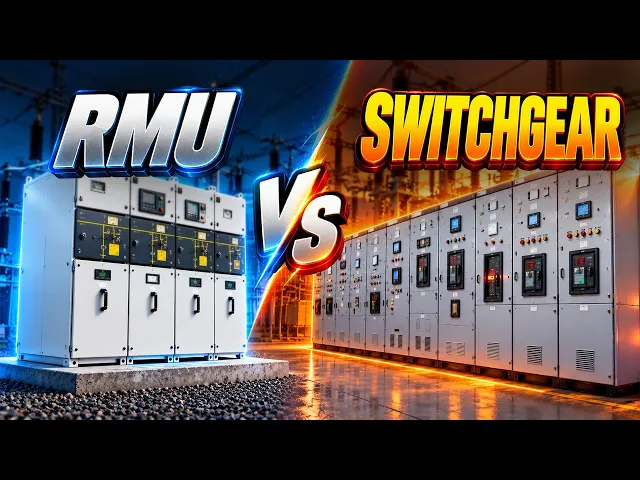
Watch the Youtube Video

About Author
Gaurav Joshi
Gaurav started his career on the floor of the electrical industry — not in a classroom. Working across Siemens and Schneider Electric, he saw firsthand how wide the gap was between what colleges teach and what the industry actually needs.
So he did something about it.
Today, he's built a global community of 300,000+ engineers and professionals across YouTube and beyond — and TheElectricalGuy Academy is where that knowledge lives in its most structured, practical form.