
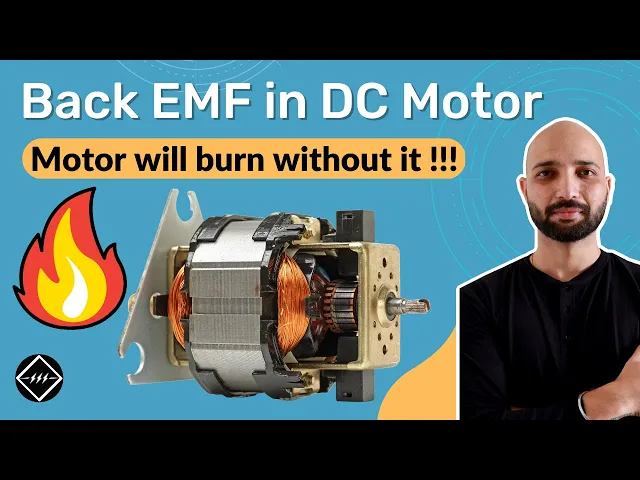
Back EMF, also called counter EMF, is the voltage induced in a DC motor's armature as it rotates in the magnetic field. It acts against the supply voltage, so armature current equals the supply minus back EMF, divided by armature resistance. It is zero at standstill, so starting current is high, then builds with speed and limits the current.

Back EMF is one of the most important ideas in a DC motor. Without it, the motor could be damaged, and so could the system it is connected to.
To see why, you need two basic principles first. Then we can follow what happens inside the armature from the moment the supply is switched on.
What Two Basic Principles Explain Back EMF?
Back EMF follows from two principles: a current-carrying conductor in a magnetic field feels a force, and a changing flux induces a voltage in a conductor.
What is the Motor Principle?
A current-carrying conductor placed in a magnetic field experiences a force.

Current through a conductor creates its own magnetic field. That field interacts with the field of a permanent magnet or electromagnet, and the interaction pushes the conductor, causing it to rotate or move. It is the same idea as two magnets with the same polarity repelling each other. This is the basic principle on which a motor works.
What is the Generator Principle?
If the flux linking a conductor changes with time, a voltage is induced between its terminals. This is Faraday's law of electromagnetic induction.
Place a conductor in a magnetic field and move the magnet, and the flux through the conductor changes, so a voltage appears across it. The same happens if the conductor moves instead. Faraday's law is covered further in How Does an Induction Motor Work?.
How Does Back EMF Develop in a DC Motor?
Back EMF develops because the rotating armature cuts the magnetic field, which induces a voltage in the armature that opposes the supply.

A DC motor has a field produced by permanent magnets or electromagnets, and an armature made of conductors. Connect a supply Es, say 100 V, to the armature. Here is what follows:
The motor principle acts: the armature conductors experience a force and start rotating.
The generator principle acts: as they rotate, the conductors cut the magnetic field, so the flux linking them changes and an EMF is induced in the armature. This is called the generating effect, and the induced voltage is E0.
E0 opposes Es: the induced EMF acts in the opposite direction to the supply voltage. If the supply is positive, E0 acts as a negative.
Because it counters the supply, E0 is called back EMF, or counter EMF.
How Does Back EMF Limit the Armature Current?
Back EMF reduces the net voltage across the armature, and that reduces the current.
The net voltage is the supply voltage minus the back EMF, Es − E0. The armature resistance Ra is very small, so the current is:
Ia = (Es − E0) / Ra
The larger the back EMF, the smaller the net voltage, and the smaller the current. This is why back EMF protects the motor.
What Happens at Starting, When Back EMF Is Zero?
At starting, the armature is at standstill, so there is no back EMF and the current is limited only by the armature resistance.
At standstill, no flux is being cut, so no EMF is induced and E0 is zero. The current becomes Es / Ra. Take a supply of 100 V and an armature resistance of 2 Ω:
Ia = 100 / 2 = 50 A
That is a very large current. If back EMF never developed, the 50 A would keep flowing, and a motor not designed to carry it would be damaged after a while. The same starting current problem appears in AC motors, as covered in What is a Star Delta Starter?.
How Does the Current Change as the Motor Speeds Up?
The current falls as the motor speeds up, because the back EMF builds up and reduces the net voltage.
Stage | Back EMF (E0) | Net Voltage (Es − E0) | Armature Current |
Standstill | 0 V | 100 V | 50 A |
Accelerating | 60 V | 40 V | 20 A |
Near full load speed | Builds further | Smaller still | Drops further |
Worked example with Es = 100 V and Ra = 2 Ω.

Once the motor starts accelerating, the back EMF builds up. In the video's example it reaches 60 V, and the current drops from 50 A to 20 A. As the motor approaches its full load speed, the back EMF builds up further and the current continues to fall.
Why is Back EMF So Important in a DC Motor?
Back EMF is important because it limits the current, and without it the motor and the connected system could be damaged.
Without back EMF, the full starting current would flow continuously. The motor is not designed to carry it, so it would be damaged after a certain period. The effect is not limited to the motor either. The system the motor is connected to would also be affected. That is why understanding back EMF is essential for DC motors.
FAQ
What is back EMF in a DC motor?
It is the voltage induced in the armature as the motor rotates and cuts the magnetic field. It acts in the opposite direction to the supply voltage, so it is also called counter EMF.
Why is back EMF zero when a DC motor starts?
At standstill, the armature is not cutting any flux, so no EMF is induced. The current is then Es / Ra, which is very high because the armature resistance is small.
How do you calculate armature current with back EMF?
Ia = (Es − E0) / Ra. For example, with Es = 100 V, E0 = 60 V and Ra = 2 Ω, the current is 20 A.
Why does the current drop as the motor speeds up?
The back EMF builds up with speed, so the net voltage across the armature falls, and the current falls with it.
What would happen without back EMF?
The full starting current, 50 A in the example, would flow continuously. The motor is not designed for that, so it would be damaged, and the connected system could be affected too.
Conclusion
Back EMF is the voltage induced in a DC motor's armature as it rotates, acting against the supply. At standstill it is zero, so the armature draws a large current. As the motor accelerates, the back EMF builds and the current falls. Without that opposing voltage, the high current would flow continuously and damage the motor and the system around it.
To see back EMF explained with the diagrams and the worked example, watch my complete video on the TheElectricalGuy YouTube channel.
Watch the Youtube Video

About Author
Gaurav Joshi
Gaurav started his career on the floor of the electrical industry — not in a classroom. Working across Siemens and Schneider Electric, he saw firsthand how wide the gap was between what colleges teach and what the industry actually needs.
So he did something about it.
Today, he's built a global community of 300,000+ engineers and professionals across YouTube and beyond — and TheElectricalGuy Academy is where that knowledge lives in its most structured, practical form.