
A STATCOM, or Static Synchronous Compensator, is a power electronic device that stabilizes grid voltage by dynamically injecting or absorbing reactive power, responding within about two cycles (roughly 40 milliseconds). It uses a voltage source converter to generate its own voltage and compares it against the grid voltage to decide whether to supply or consume reactive power.
At a 245 kV substation in Gujarat, India, engineers were facing a voltage regulation problem. In the evening, as load increased, voltage would drop well below the desired range. In the morning, as load disconnected, voltage would shoot back up. It never settled at the target 220 kV. After installing a STATCOM at the substation, voltage regulation improved significantly.
That real example is the clearest way to understand why this device exists. Let's look at the problem it solves, how it works, and where it's used.
Why Do Power Systems Need Voltage Regulation?
Power systems need voltage regulation because transmission line loading is never constant, and that constantly shifting load causes the voltage received at one end of a line to differ from the voltage sent at the other end.
Loading changes hour to hour: morning, afternoon, and evening peaks all pull different amounts of power. That variability creates a mismatch between sending-end and receiving-end voltage, driven by inductive and capacitive reactance in the line.
A useful illustration of the extreme case: when load is suddenly disconnected from a transmission line, the sending-end voltage might stay around 353 kV, while the receiving end can shoot up past 520 kV, an effect known as the Ferranti effect. Left uncorrected, this kind of voltage swing is far outside what substation and industrial equipment is designed to handle.
How Do Power Systems Correct Voltage Imbalances?
Power systems correct voltage imbalances by inserting an equal and opposite amount of reactive power into the line, which is why voltage control is fundamentally reactive power control.
When capacitive reactance dominates and pushes voltage too high, adding inductive reactance cancels it out and brings the voltage back into balance. When inductive reactance dominates instead, capacitor banks are added to correct it the other way. This works well when the required correction is fixed and known in advance, since a fixed reactor or capacitor bank can simply be switched in.
The real challenge is that reactive power demand isn't fixed. It changes constantly, and capacitors and reactors can't be switched on and off frequently, because their voltage and current sit 90 degrees out of phase, which makes circuit breakers face repeated switching stress. Manual or fixed switching just isn't fast or flexible enough for real grid conditions.
What is a STATCOM?
A STATCOM (Static Synchronous Compensator) is the automatic, continuously self-adjusting solution to this problem: it dynamically controls reactive power in the system without needing manual switching.
Think of it like a camera's manual versus auto mode. Manual mode means adjusting settings yourself for each scene; auto mode calibrates everything automatically. A STATCOM is the "auto mode" for grid voltage control, continuously calculating how much reactive power the system needs and supplying or absorbing it in real time.
How Does a STATCOM Work?
A STATCOM works by generating its own voltage using a voltage source converter, then comparing that voltage against the grid voltage to decide whether to inject or absorb reactive power.
Unlike a Static VAR Compensator (SVC), a STATCOM doesn't depend on the grid's own voltage to function; it produces its own voltage independently. Based on the comparison between its internal voltage and the grid voltage, it takes one of three actions, covered in the next section.
What Are the Components of a STATCOM?
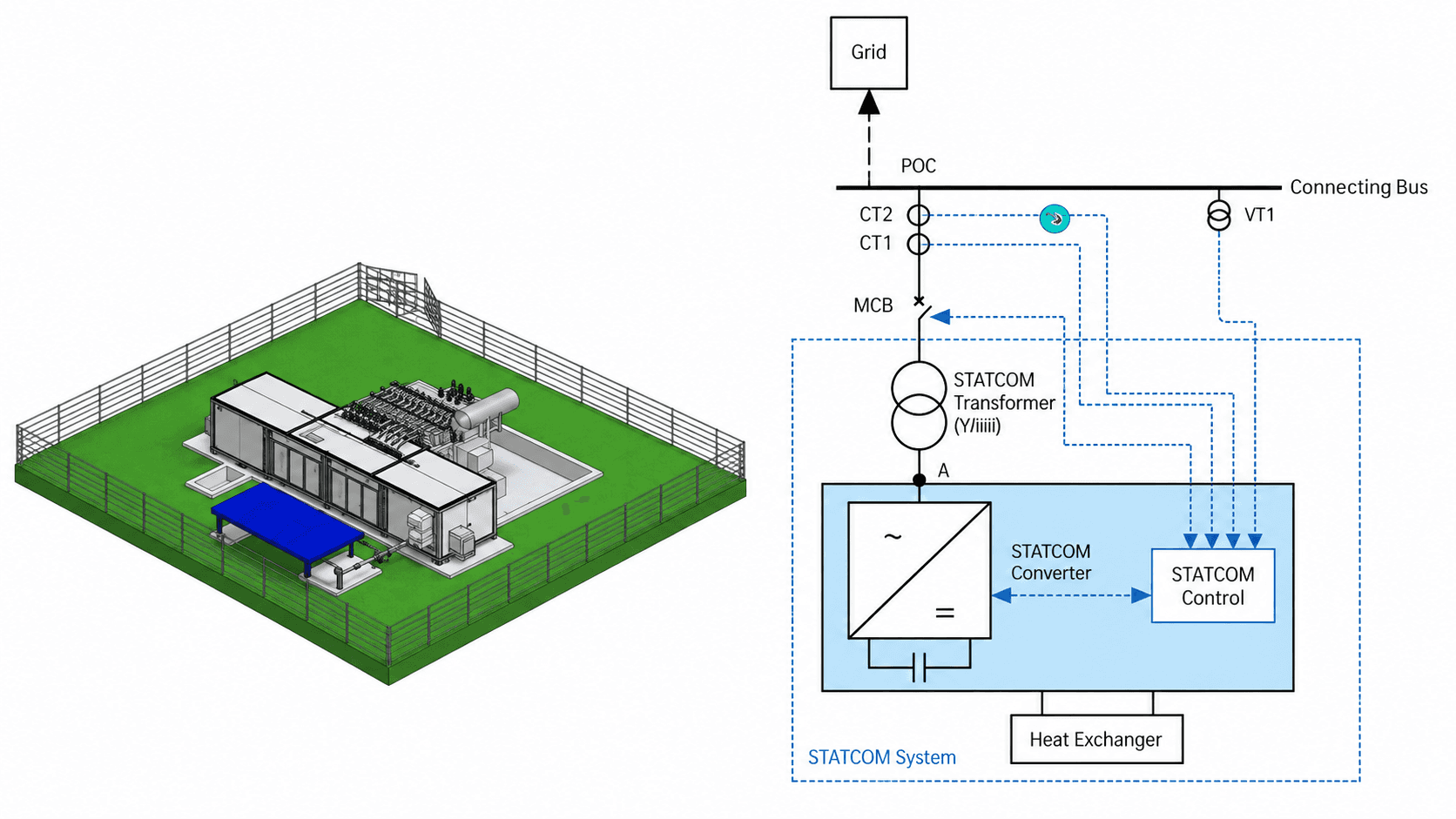
A STATCOM is built from a point of connection to the grid, current and voltage transformers for measurement, a protective circuit breaker, a step-up/step-down transformer, a voltage source converter, and a cooling system, all coordinated by a central controller.
Point of Connection (POC) — where the STATCOM connects to the grid bus bar
Current transformers and voltage transformer — measure grid conditions and feed data to the controller
STATCOM controller — the decision-making "brain" that determines when to inject or consume reactive power
Circuit breaker — provides protection for the installation
STATCOM transformer — steps voltage up or down as needed for the converter
Voltage source converter (VSC) — built on IGBTs (insulated gate bipolar transistors), converts DC to a near-sinusoidal AC waveform through fast switching
DC capacitor — supplies the reactive power source for the converter
Heat exchanger / cooling system — manages the heat generated by high-speed IGBT switching, commonly liquid-cooled
What Are the Operating Modes of a STATCOM?
A STATCOM operates in three modes, capacitive, inductive, and neutral, determined by comparing its own generated voltage against the grid voltage.
Capacitive mode — grid voltage is lower than the STATCOM's voltage, so it injects reactive power into the grid.
Inductive mode — grid voltage is higher than the STATCOM's voltage, so it absorbs reactive power from the grid.
Neutral mode — the STATCOM's voltage and grid voltage are balanced, so it neither supplies nor consumes reactive power.
Why is a STATCOM Better Than Other Voltage Control Methods?
A STATCOM outperforms fixed reactors, capacitor banks, and SVCs mainly because of its speed, independence from grid voltage, and cleaner power quality.
Fast, dynamic response — reacts within about two cycles (roughly 40 milliseconds), providing near-instantaneous reactive power support in either direction.
Improved system stability — better-balanced voltage directly improves overall grid stability.
Better power quality — the converter technology generates significantly less harmonic distortion than devices like SVCs, which use thyristor-based switching.
Grid-forming capability — a STATCOM can generate its own voltage and frequency independently of the grid, a capability other voltage control methods don't offer.
Some manufacturers now pair STATCOMs with Battery Energy Storage Systems (BESS), giving the combined system both reactive power support and active power capability for additional grid services.
Why Does a STATCOM Use Capacitors Instead of Batteries?
A STATCOM uses DC capacitors rather than batteries because batteries store active power, not reactive power, and can't switch fast or frequently enough for continuous grid support.
Reactive power support requires extremely fast, repeated switching, and battery chemistry isn't built for that kind of frequent cycling; repeated fast switching would degrade a battery quickly. Capacitors handle this rapid switching without degradation, which is why they, not batteries, sit at the core of a standard STATCOM. Where active power support is also needed, manufacturers pair a STATCOM with a separate BESS rather than relying on batteries inside the STATCOM itself.
Where is a STATCOM Used?
STATCOMs are used across utility transmission networks, renewable energy sites, industrial plants, and transportation systems, anywhere fast reactive power support or power quality improvement is needed.
Utilities — voltage regulation on transmission and distribution networks
Renewable energy — reactive power support where conventional sources would normally help, since renewable sources typically can't supply reactive power on their own
Industry — power quality and power factor improvement
Transportation — reactive power and power quality support in transport-sector power systems
Containerized, mobile STATCOM units are also available for temporary reactive power support at a site.
FAQ
What's the difference between a STATCOM and an SVC?
Both provide reactive power compensation, but a STATCOM generates its own voltage using a voltage source converter and doesn't depend on grid voltage to operate, giving it faster response and better power quality than an SVC, which relies on thyristor-switched components referenced to the grid voltage.
How fast does a STATCOM respond to voltage changes?
A STATCOM typically responds within about two cycles, roughly 40 milliseconds, making it fast enough to provide near-instantaneous reactive power support as grid conditions change.
Why can't fixed capacitor banks or reactors replace a STATCOM?
Fixed capacitor banks and reactors work only when the required reactive power correction is known and stable. Real grid demand changes constantly, and these components can't be switched frequently due to the phase relationship between their voltage and current, which stresses circuit breakers.
Can a STATCOM supply active power as well as reactive power?
Not on its own; a standard STATCOM is a reactive power source built around DC capacitors. When active power support is also needed, manufacturers pair a STATCOM with a Battery Energy Storage System (BESS).
Is a STATCOM only used by utilities?
No. While utilities are a major user, STATCOMs are also used in renewable energy installations, industrial plants for power quality improvement, and transportation-sector power systems.
Conclusion
A STATCOM solves a problem every power system faces: reactive power demand that changes constantly and can't be corrected fast enough with fixed reactors, capacitor banks, or manual switching.
By generating its own voltage through a voltage source converter and comparing it continuously against the grid, a STATCOM injects or absorbs reactive power within milliseconds, keeping voltage stable, improving system reliability, and cleaning up power quality along the way.
For the full explanation with circuit simulations and a 3D component walkthrough, watch the complete video on the TheElectricalGuy YouTube channel.
Watch the Youtube Video

About Author
Gaurav Joshi
Gaurav started his career on the floor of the electrical industry — not in a classroom. Working across Siemens and Schneider Electric, he saw firsthand how wide the gap was between what colleges teach and what the industry actually needs.
So he did something about it.
Today, he's built a global community of 300,000+ engineers and professionals across YouTube and beyond — and TheElectricalGuy Academy is where that knowledge lives in its most structured, practical form.