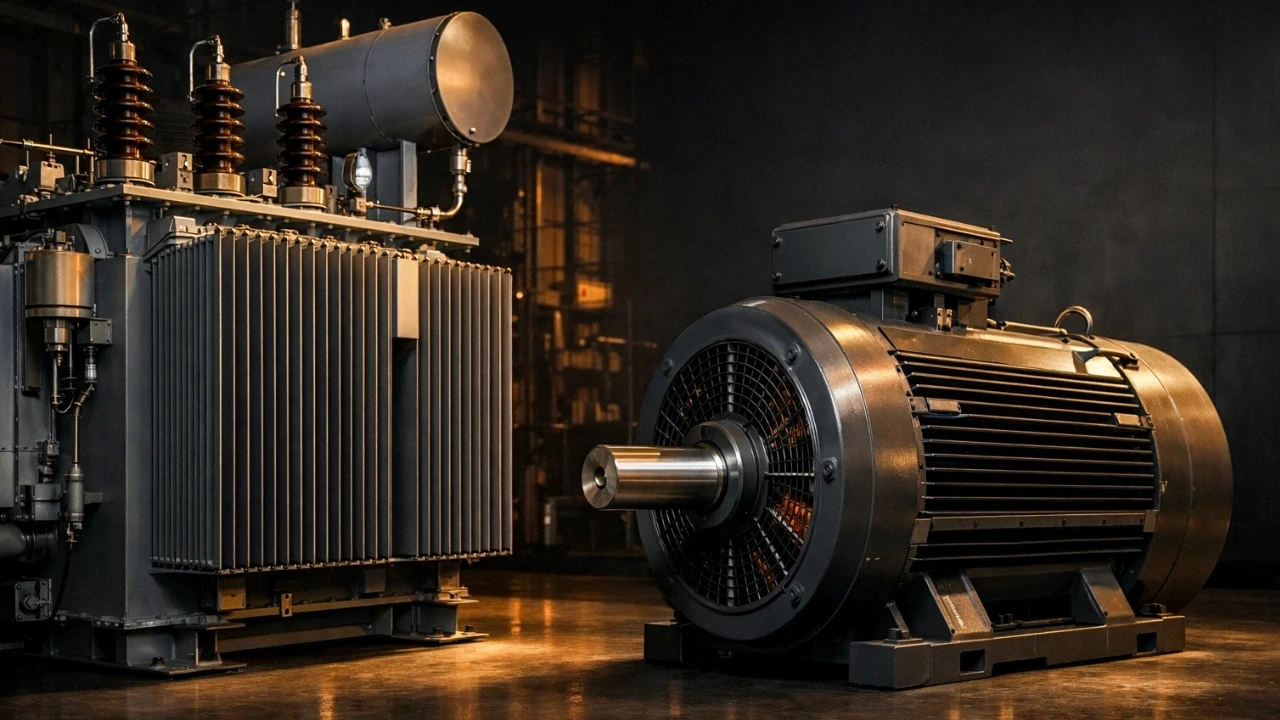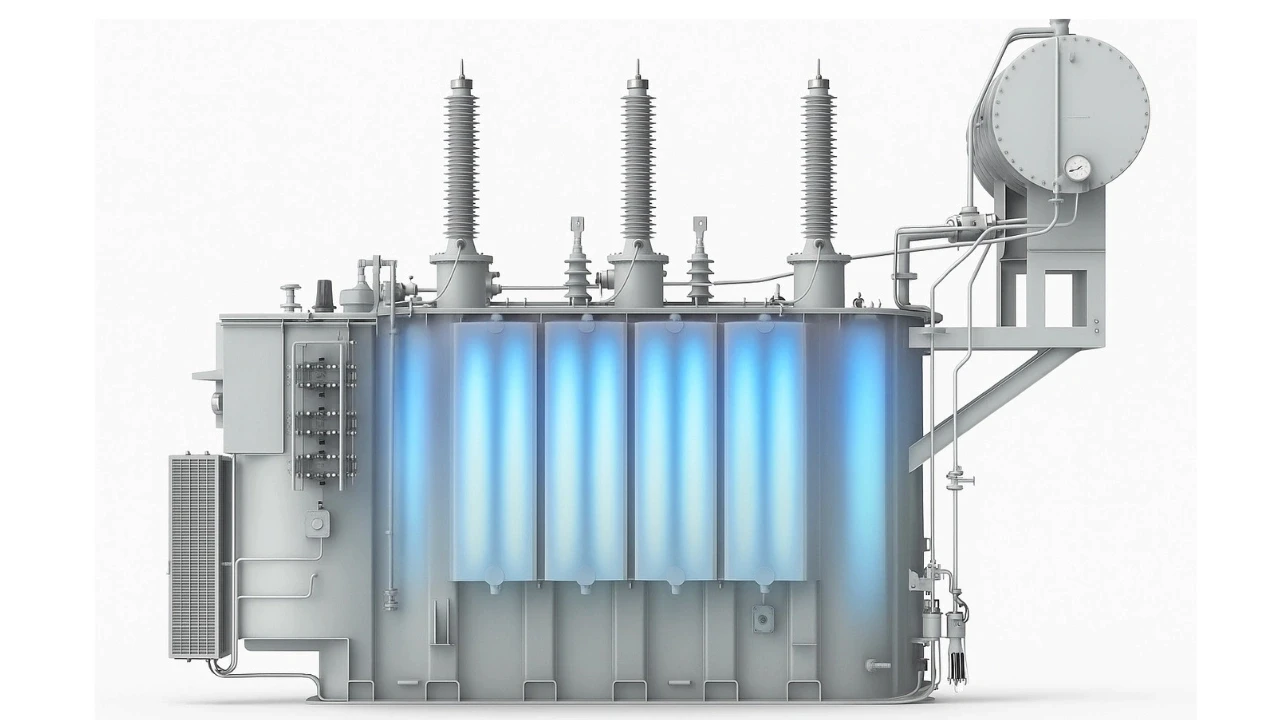

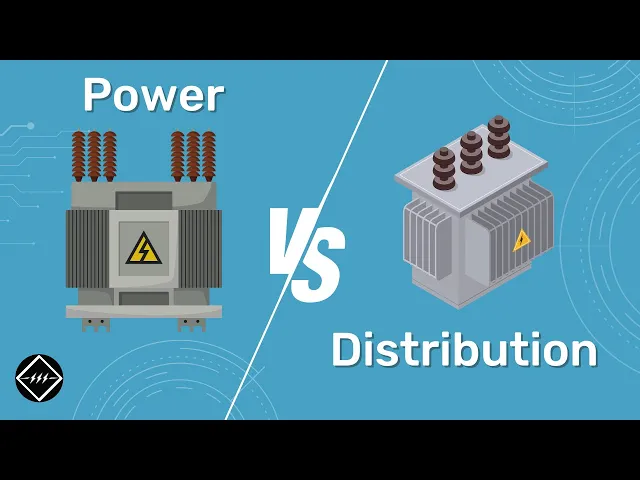
A power transformer steps voltage up or down at generation and transmission substations, operates near full load, and is designed to minimize copper losses. A distribution transformer steps voltage down for end consumers, runs continuously at partial load (typically 50–70%), and is designed to minimize iron losses instead. The two serve different stages of the power system, which is why their designs diverge on every major parameter.

Power and distribution transformers do their jobs at different stages of the electricity journey, transmission and distribution respectively, and that difference shapes almost every design decision engineers make about them, including how losses are managed.
Let's go through the key differences: application, rated voltage, power rating, operating condition, efficiency, and losses.
What is a Power Transformer Used For?
A power transformer is used in generating and transmission substations for both step-up and step-down purposes.
For example, electricity generated at 11 kV gets stepped up to 420 kV using a power transformer at the generating substation, then transmitted across zones and stepped down again to 145 kV using another power transformer at the transmission substation, so it can connect to the grid at that voltage level. Both the step-up and step-down transformers at these substations are power transformers; only the direction of conversion differs.
What is a Distribution Transformer Used For?
A distribution transformer is used in distribution substations strictly for step-down purposes, taking incoming supply and stepping it down for delivery to end consumers.

The pole-mounted transformers visible on streets are distribution transformers. An 11 kV line, for instance, connects to a pole-mounted transformer that steps it down to 440V before distributing it to individual consumers.
How Do Rated Voltage and Power Rating Differ?
Power transformers carry much higher rated voltages and power ratings than distribution transformers, reflecting their role in generation and transmission rather than final delivery.
Power transformer voltage ratings, based on IEC standards (though specific values can vary by country), typically range from 72.5 kV up to 800 kV. Distribution transformers, by contrast, are generally rated below 36 kV, with common ratings like 36 kV, 20 kV, 11 kV, and 430V. A pole-mounted transformer stepping 11 kV down to 430V is a typical example.
Power rating follows the same pattern: power transformers are generally rated above 200 MVA, while distribution transformers stay below 200 MVA. This difference in voltage and power rating is also why power transformers are physically much larger.
How Does Operating Condition Differ?
Power transformers mostly operate near full load, while distribution transformers run continuously but rarely reach full load.
A power transformer typically operates at 90% load or higher, and it's rarely run at significantly lower voltages or loads. A distribution transformer, by contrast, stays connected to the system 24 hours a day, 365 days a year, but its load fluctuates constantly.
A residential distribution transformer, for example, carries less load during the day and more in the evening as lighting and appliance use increases. Calculated across a full day, that loading typically averages 50% to 70% of full-load capacity, never reaching full load in normal operation.
How Does Efficiency Design Differ?
Power transformers are designed for maximum efficiency at full load, while distribution transformers are designed for maximum efficiency at partial load, matching how each actually operates.
Since power transformers mostly run above 90% load, their design targets peak efficiency at that full-load condition; running one at only 50% load won't deliver its rated efficiency.
Distribution transformers face the opposite reality: since they typically operate at 50–70% load, designing them for maximum efficiency at 100% load would be a poor design choice that increases losses in actual daily use. They're instead optimized for maximum efficiency in that 50–70% load range.
How Do Copper Losses and Iron Losses Differ Between the Two?
Power transformers are designed to minimize copper losses, while distribution transformers are designed to minimize iron losses, because each loss type depends on a different operating condition.
Copper losses depend on secondary load current. Since a power transformer's secondary current is consistently near maximum, minimizing copper losses delivers the biggest efficiency gain. Iron losses, on the other hand, occur continuously regardless of load, since the transformer is energized 24/7.
Since a distribution transformer never carries full load current for long, minimizing copper losses would offer little benefit; minimizing iron losses matters far more, because that loss is constant whether the transformer is lightly or heavily loaded.
Power Transformer vs Distribution Transformer - Quick Comparison
Parameter | Power Transformer | Distribution Transformer |
Application | Step-up and step-down at generation and transmission substations | Step-down only, at distribution substations for end consumers |
Rated voltage | ~72.5 kV to 800 kV | Generally below 36 kV |
Power rating | Generally above 200 MVA | Generally below 200 MVA |
Operating condition | Near full load (90%+), rarely run at lower load | Continuous 24/7 connection, but only 50–70% average load |
Efficiency design | Optimized for maximum efficiency at full load | Optimized for maximum efficiency at 50–70% load |
Loss priority | Designed to minimize copper losses | Designed to minimize iron losses |
FAQ
Can a power transformer be used as a distribution transformer?
Not effectively. A power transformer designed for maximum efficiency at full load and minimal copper losses will perform poorly at the fluctuating, partial-load conditions typical of distribution use, resulting in higher losses than a purpose-built distribution transformer.
Why are distribution transformers designed for low iron losses instead of low copper losses?
Because iron losses occur continuously whenever the transformer is energized, regardless of load, and a distribution transformer stays connected 24/7 while rarely carrying full load current, so minimizing the constant loss matters more than minimizing the load-dependent one.
Why do power transformers operate near full load while distribution transformers don't?
Power transformers serve generation and transmission, where load is planned and relatively steady near capacity. Distribution transformers serve variable end-consumer demand directly, which naturally fluctuates through the day and rarely reaches full load.
What voltage range separates a power transformer from a distribution transformer?
Power transformers are typically rated from around 72.5 kV up to 800 kV, based on IEC voltage classes, while distribution transformers are generally rated below 36 kV, though exact values can vary by country standard.
Conclusion
Power and distribution transformers serve different stages of the power system, and every major design choice, voltage rating, power rating, operating condition, efficiency target, and loss priority, follows directly from that difference.
Power transformers are built for high-voltage, near-full-load operation with minimal copper losses. Distribution transformers are built for continuous, partial-load operation with minimal iron losses. Matching the right transformer type to the right stage of the system is what keeps losses low and efficiency high in practice.
For the full explanation with the original summary slide, watch the complete video on the TheElectricalGuy YouTube channel.
Watch the Youtube Video

About Author
Gaurav Joshi
Gaurav started his career on the floor of the electrical industry — not in a classroom. Working across Siemens and Schneider Electric, he saw firsthand how wide the gap was between what colleges teach and what the industry actually needs.
So he did something about it.
Today, he's built a global community of 300,000+ engineers and professionals across YouTube and beyond — and TheElectricalGuy Academy is where that knowledge lives in its most structured, practical form.