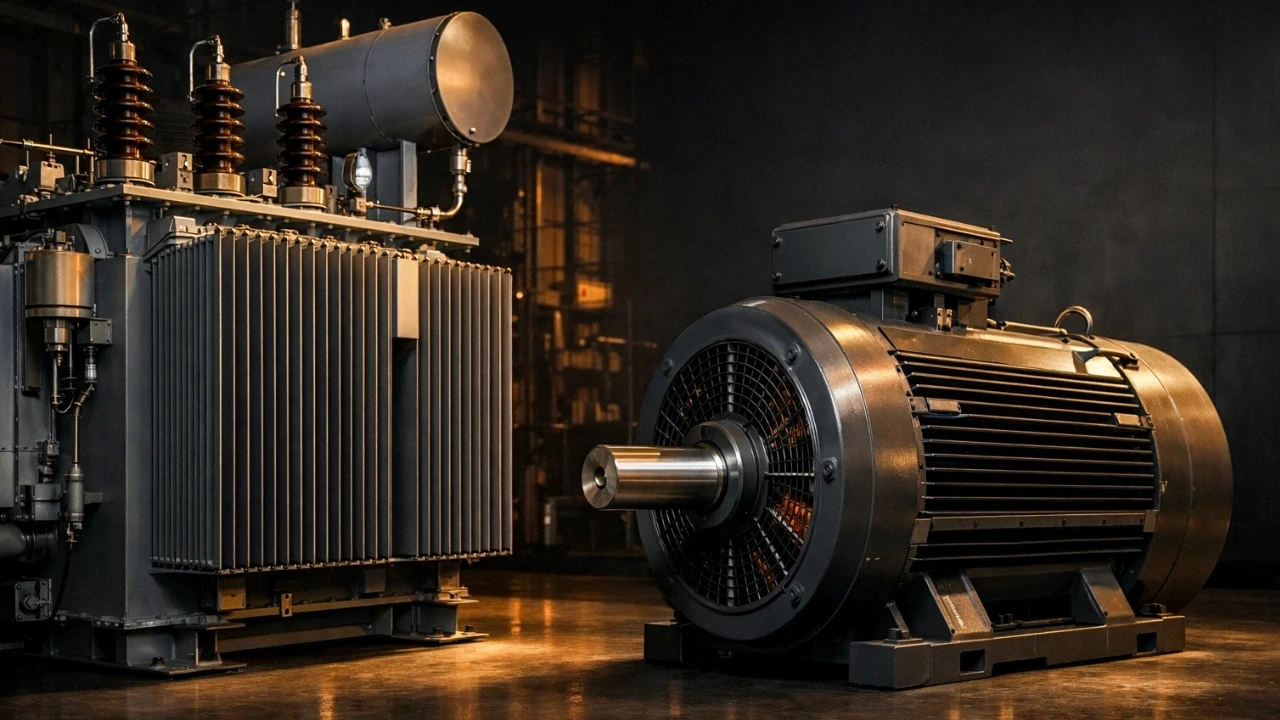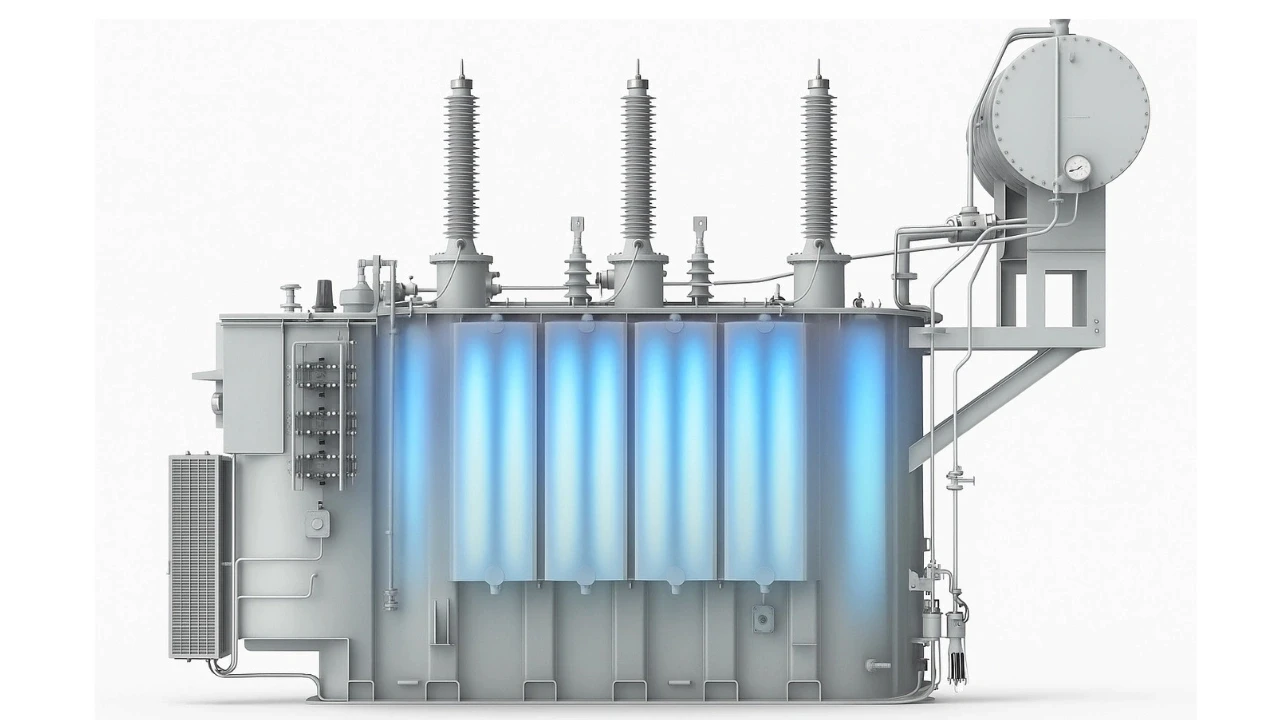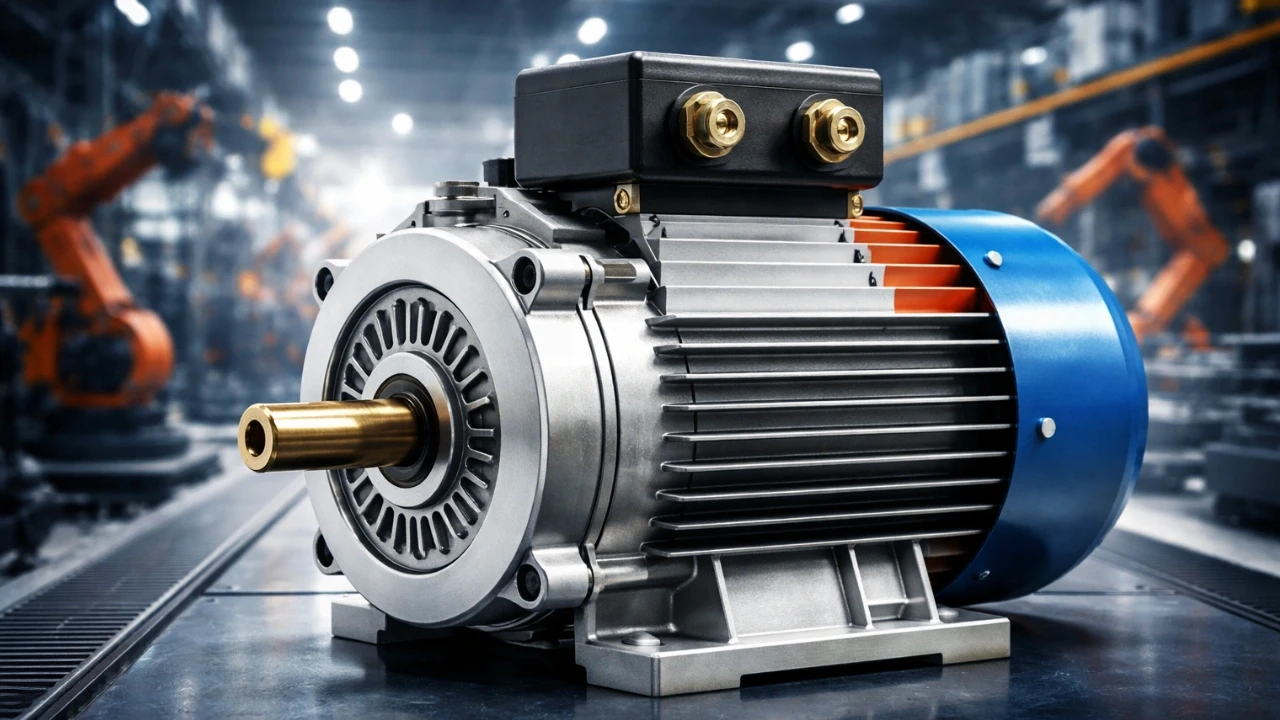

An induction motor nameplate lists 15+ parameters grouped into a few categories: identification (machine number, frame), power and performance (output power, efficiency, power factor, IE class), electrical ratings (voltage, current, frequency tolerance), speed and slip, thermal and environmental ratings (ambient temperature, thermal class, IP rating), mechanical and maintenance details (bearings, grease, weight), and duty class. Misreading any one of these, especially rated power versus input power, is a common and costly mistake.

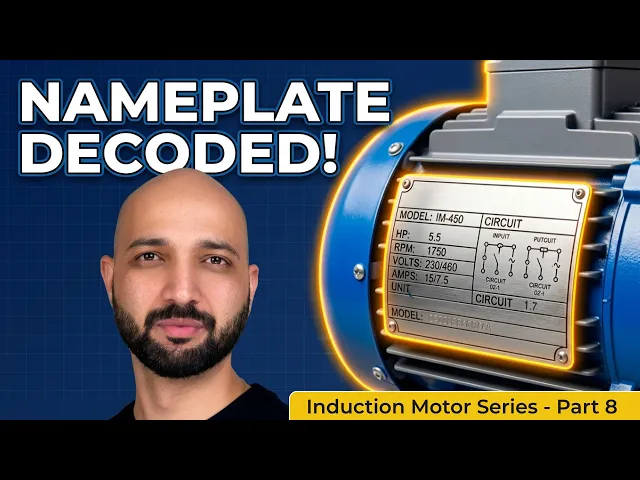
A nameplate holds far more information than voltage, frequency, and rated speed, but most engineers don't fully understand what every field on it actually means. This walkthrough uses a real nameplate from a 100 HP induction motor, the same unit disassembled on camera in an earlier part of this series, to cover every parameter, one group at a time.
What Do the Identification Parameters Tell You?
The identification parameters, machine number, frame number, and connection diagram number, exist mainly to help you or the manufacturer reference the exact motor and its configuration during repair or maintenance.
Machine number — manufacturer-assigned, used as the reference when reporting a problem or requesting support; the manufacturer can look up internal records against this number.
Frame number — a coded reference to the motor's physical frame size, useful for sourcing an exact-fit replacement frame during maintenance.
Connection diagram number — points to the manufacturer's specific wiring diagram for that motor, which should be followed exactly to get correct output.
What Do the Power and Performance Parameters Mean?
Power and performance parameters, rated power, efficiency percentage, power factor, and IE efficiency class, describe what the motor actually delivers and how efficiently it converts electrical input into mechanical output.
Is Rated Power (kW/HP) the Input or Output?
Rated power is the mechanical output of the motor, not the electrical input it consumes. A 75 kW (approximately 100 HP) rating means the motor can deliver up to 75 kW of mechanical output, not that it draws 75 kW from the supply. Selecting the wrong output rating for the load, oversized or undersized, is a common and costly mistake: an oversized motor runs at poor efficiency, and an undersized one struggles under load.
What Does Efficiency (%) Actually Represent?
Efficiency, shown here as 93.7%, indicates how much of the electrical input is delivered as usable mechanical output; the remaining 6–7% is lost to iron, copper, and core losses during energy conversion. Since a motor's operating cost over its lifetime typically exceeds its purchase cost, even a small efficiency improvement can produce meaningful electricity savings, which is also why the IE efficiency class matters directly.
What Does the IE Efficiency Class Indicate?
The IE (International Efficiency) class, defined by IEC, ranges from IE1 (standard efficiency) through IE2 (high efficiency), IE3 (premium), IE4 (super premium), to IE5 (ultra premium). This motor is rated IE2. For continuous-duty applications running 24/7, choosing a higher efficiency class is generally worth the added upfront cost, since operational electricity cost typically outweighs the purchase price difference over the motor's life.
What Does Power Factor Tell You?
Power factor, here 0.85, indicates that only 85% of total power consumed is active power (the power that actually does mechanical work); the remaining 15% is reactive power needed to sustain the rotating magnetic field. A higher power factor is better, and it also directly affects cable sizing, since poor power factor draws more current from the system for the same useful output.
What Do the Electrical Rating Parameters Mean?
Electrical rating parameters, voltage, current, and frequency tolerance, define the supply conditions the motor is designed to handle and the current draw used for protection and cable sizing.
Rated voltage (415V ±10%) — the motor tolerates a supply voltage swing of plus or minus 10%, but that tolerance is a safety margin, not a target; sustained operation at the edge of that range should still be corrected, not relied upon.
Rated current (131A, delta) — this is the motor's normal, full-load current when connected in delta configuration, not its starting current. It's one of the key inputs used to size cables, relays, circuit breakers, and MCBs for the motor, though not the only factor.
Frequency tolerance (50 Hz ±5%) — the accepted variation in supply frequency the motor is designed to handle.
What Does Rated Speed Reveal About Slip?
Rated speed on the nameplate is the actual rotor speed under load, not the synchronous speed, and the gap between the two is the slip.
For a 50 Hz, 6-pole machine, synchronous speed calculates to 1,000 RPM using Ns = 120 × f ÷ P. If the nameplate lists an actual rated speed of 987 RPM, that 13 RPM gap is the slip, an unavoidable and necessary characteristic of every induction motor, since it can never run at exactly synchronous speed.
What Do the Thermal and Environmental Ratings Mean?
Thermal and environmental ratings, ambient temperature, thermal class, temperature rise class, and IP rating, together define the operating conditions the motor is designed to survive without insulation damage.
What Does the Ambient Temperature Rating Mean?
Ambient temperature, listed here as 50°C, is the maximum surrounding temperature the motor is designed and tested to handle. Installing the motor where ambient conditions consistently exceed this rating risks problems, since it wasn't tested for that range. A roughly 10°C increase in ambient temperature above rating can reduce insulation life by around 50%, which makes correct ambient rating selection a genuinely high-stakes decision.
What Do Thermal Class and Temperature Rise Class Mean?
Thermal class (here, Class F) defines the maximum temperature the motor's insulation material can safely withstand without failing, 155°C for Class F. Temperature rise class (here, Class B) defines how much the internal winding temperature is expected to rise above ambient under continuous full-load operation, up to 80°C for Class B.
Combined, these two figures reveal a built-in safety buffer: if ambient temperature is 40°C, and the motor's temperature rise stays within Class B's 80°C limit, the internal temperature reaches roughly 120°C, well under the insulation's 155°C Class F limit, leaving a real margin of safety.
What Does IP Rating Mean?
IP (Ingress Protection) rating, here IP55, indicates the enclosure's resistance to dust and water ingress.
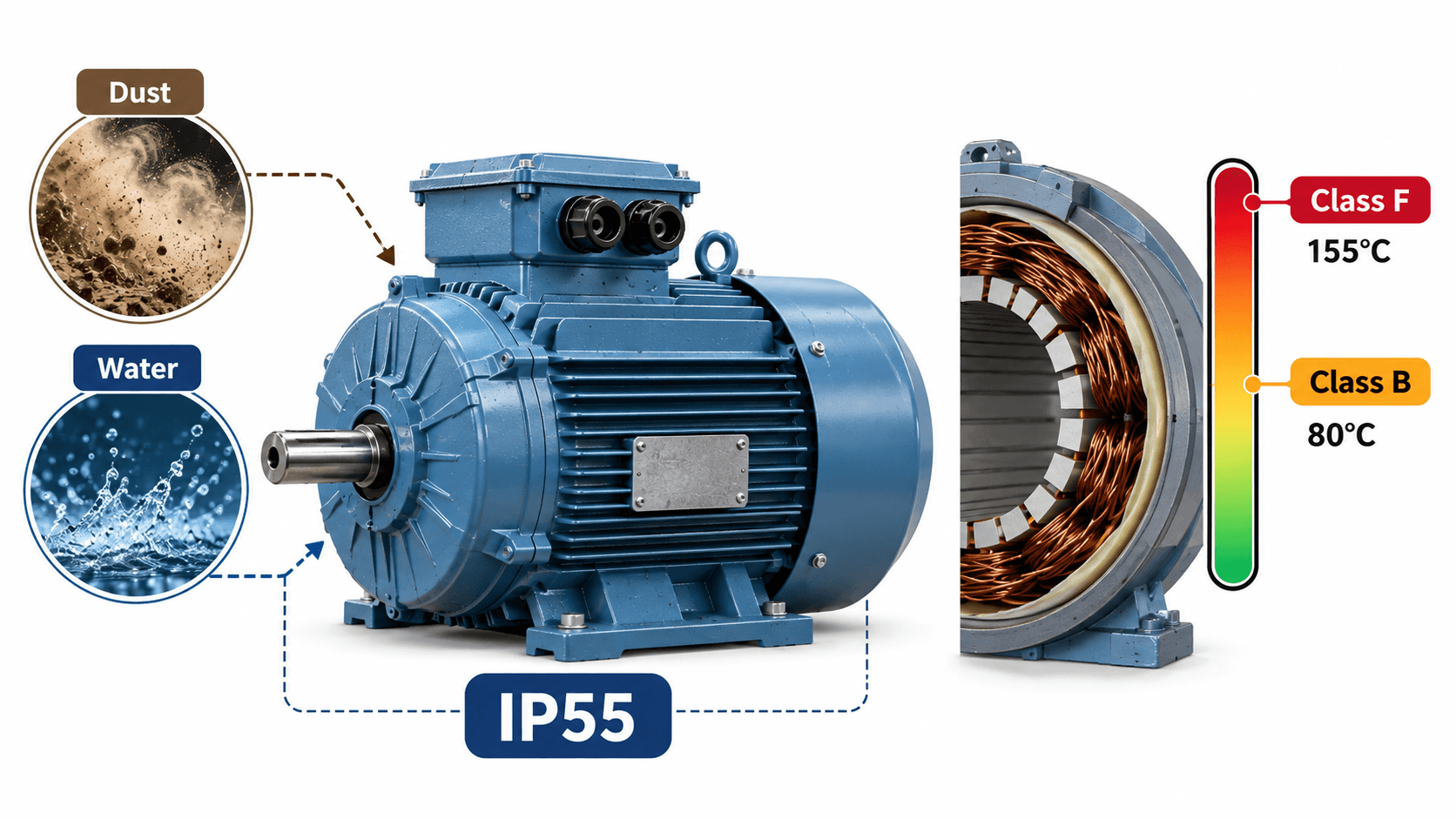
IP55 is generally suitable for outdoor installations and environments with elevated moisture, though the exact requirement should always be matched to the actual installation environment.
What Do the Mechanical and Maintenance Parameters Mean?
Mechanical and maintenance parameters, bearing details, grease type, relubrication schedule, half key balance, and weight, guide correct installation, coupling, and ongoing maintenance.
Bearing (DE/NDE) — DE (Drive End) is the shaft-coupling side, where the motor connects to a gearbox, pulley, or load; NDE (Non-Drive End) is the fan-covered side. The listed bearing code (e.g. 6319-C3) identifies the exact deep groove ball bearing to source for replacement, since bearing failure is one of the most common induction motor faults.
Grease type — the manufacturer's recommended grease (e.g. type N3); using the specified grease rather than a cheaper substitute is a genuine reliability factor, not a minor detail.
Relube hours and quantity — how often (e.g. every 9,000 hours) and how much (e.g. 200g) grease should be applied. This interval can shorten in harsh operating environments; both over-greasing and under-greasing are recognized causes of bearing failure.
Half key balance — indicates the manufacturer balanced the motor using a half key during manufacturing; the coupled component (gearbox, pulley, shaft) needs to match this balancing convention to minimize vibration.
Weight — the total motor weight (e.g. 900 kg for this 100 HP unit), relevant for installation, lifting, and foundation planning.
What Do the Standard and Duty Class Parameters Mean?
The governing IEC standard and duty class define how the motor was tested and the operating pattern it's actually built for.
What Does the IEC Standard Reference Mean?
The nameplate cites IEC 60034-1, the standard governing rating and performance of rotating electrical machines, the parent standard this motor is designed and tested against.
What Does Duty Class (S1) Mean?
Duty class S1 indicates the motor is built for continuous operation. Using an S1-rated motor for an application requiring frequent starting and stopping, such as a crane, is a selection mismatch that will cause the motor to underperform or fail prematurely; that application needs a duty class specifically suited to intermittent operation instead.
FAQ
Is the kW/HP rating on a motor nameplate the input or output power?
It's the mechanical output power the motor can deliver, not the electrical input it draws from the supply. The actual electrical input is higher, since the difference is accounted for by the motor's efficiency rating.
Why does an induction motor's actual speed never match the synchronous speed on the nameplate?
Synchronous speed is the speed of the rotating magnetic field, calculated from frequency and pole count. The actual rotor speed is always slightly lower, this gap is the slip, and it's what allows current, and therefore torque, to be produced at all.
What's the difference between thermal class and temperature rise class?
Thermal class defines the maximum temperature the motor's insulation material can safely withstand. Temperature rise class defines how much the winding temperature is expected to increase above ambient during normal full-load operation, ideally with a safety margin remaining below the thermal class limit.
Why shouldn't I use a continuous-duty (S1) motor for a crane application?
S1 duty class motors are designed for steady, continuous operation. Crane applications need frequent starting, stopping, and reversing, conditions an S1-rated motor isn't built to handle reliably, risking premature failure.
Why does the manufacturer's recommended grease matter so much?
Using a cheaper or incompatible grease instead of the manufacturer-specified type is a common, avoidable cause of bearing problems; matching both the recommended type and quantity protects bearing life significantly.
Conclusion
An induction motor nameplate is a dense but genuinely useful reference once you know how to read it. Grouped by category, identification, power and performance, electrical ratings, speed and slip, thermal and environmental limits, mechanical and maintenance details, and duty class, these 15+ parameters together tell you exactly what the motor can do, what conditions it's designed to survive, and how to maintain it correctly. Misreading even one, especially confusing output power for input power, is a mistake worth avoiding entirely.
For the full walkthrough on the actual nameplate photograph, watch the complete video on the TheElectricalGuy YouTube channel.
Watch the Youtube Video

About Author
Gaurav Joshi
Gaurav started his career on the floor of the electrical industry — not in a classroom. Working across Siemens and Schneider Electric, he saw firsthand how wide the gap was between what colleges teach and what the industry actually needs.
So he did something about it.
Today, he's built a global community of 300,000+ engineers and professionals across YouTube and beyond — and TheElectricalGuy Academy is where that knowledge lives in its most structured, practical form.