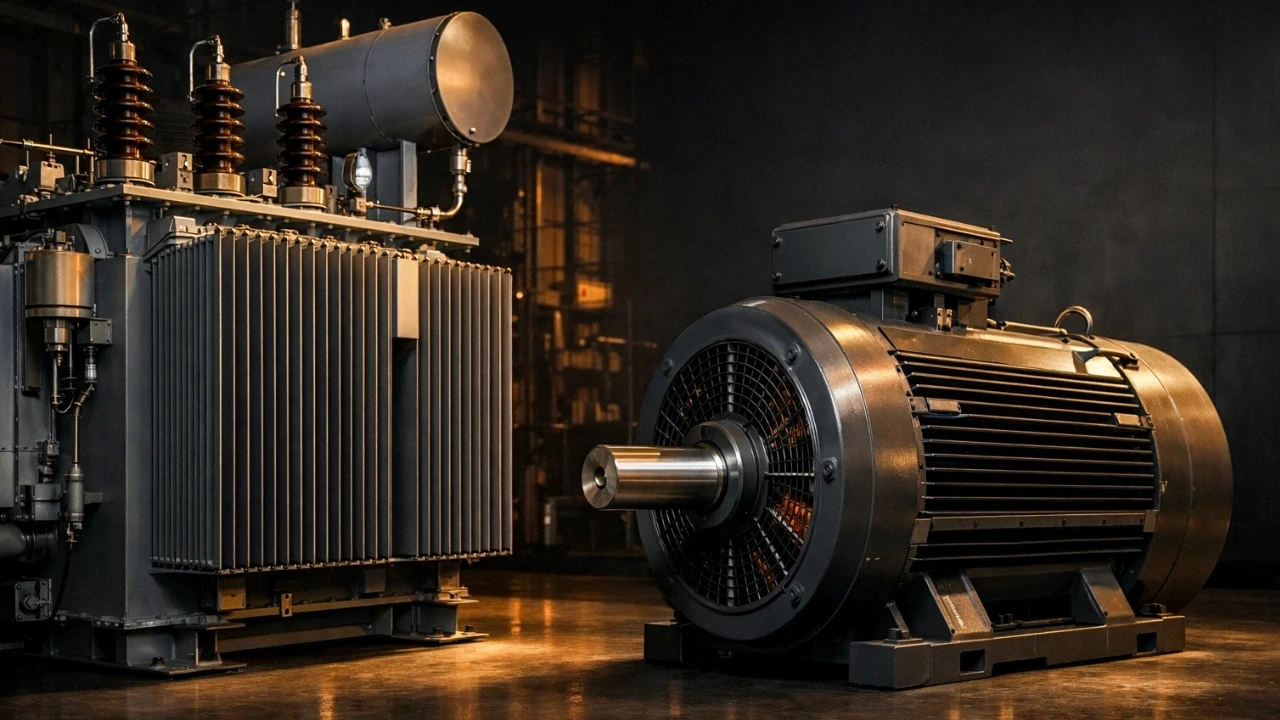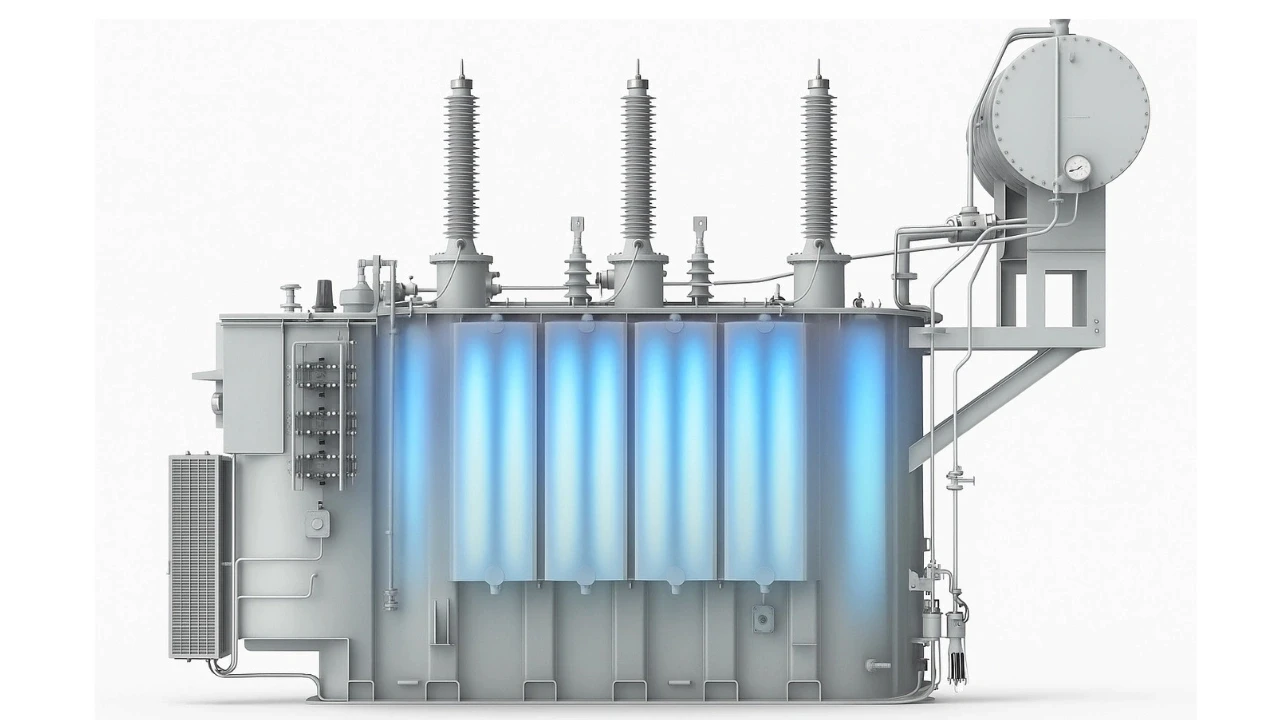

An auto transformer uses a single tapped winding for both primary and secondary connections instead of two separate windings, saving up to 50% of the copper needed compared to a regular transformer, along with better efficiency and a smaller footprint. The trade-off is that it loses electrical isolation between primary and secondary, meaning a fault on one side can directly expose dangerous voltage on the other, which is exactly why utilities avoid using it everywhere, especially in distribution.
An auto transformer can save you nearly half the copper of a regular transformer. That sounds like an easy win, so why don't utilities use it everywhere? The answer lies entirely in the basic construction difference between the two, and once you understand that, both the advantage and the risk become obvious.
How is an Auto Transformer's Construction Different From a Regular Transformer?
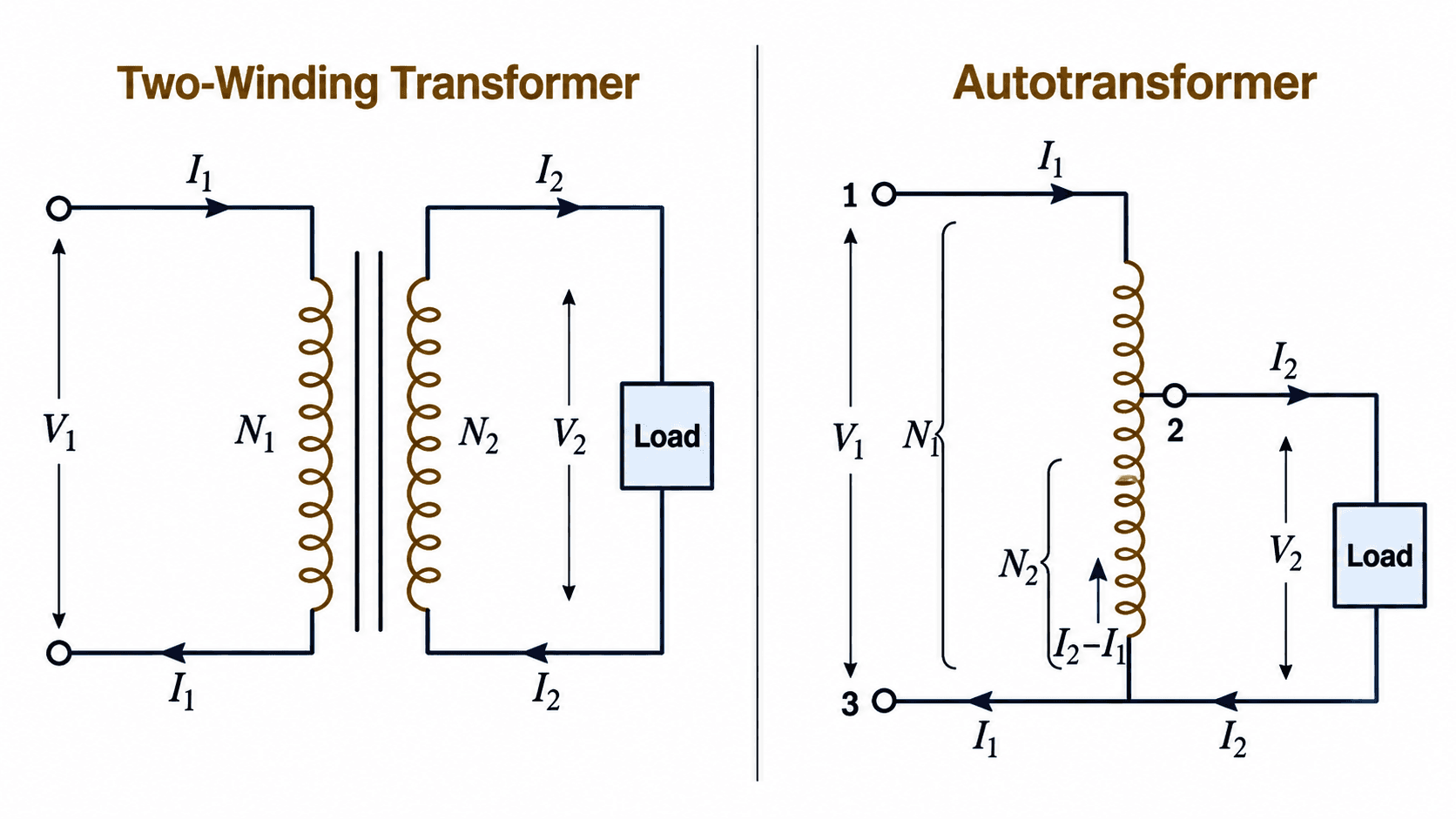
A regular transformer uses two separate windings, a primary and a secondary, coupled only through electromagnetic induction. An auto transformer uses a single winding with a tap, where part of the winding serves as the primary and the tapped portion serves as the secondary.
Connecting supply across the full winding (N1 turns) creates the primary connection; connecting the load between the tap point and the winding's other end creates the secondary. Because there's only one physical winding shared between both roles, an auto transformer's coupling is both magnetic (electromagnetic induction) and electrical, an important distinction from the purely magnetic coupling in a regular transformer.
Why Does an Auto Transformer Save Copper?
An auto transformer saves copper because it eliminates the need for a dedicated secondary winding entirely, using one shared winding for both roles instead.
Since one full winding is removed from the design, less copper is needed for the same transformer rating, up to roughly 50% less compared to an equivalent regular transformer.
What Other Advantages Come From Using Less Copper?
Reduced copper usage in an auto transformer also improves efficiency, shrinks the physical footprint, and lowers overall cost compared to an equivalent regular transformer.
Better efficiency — less copper means lower copper losses, directly improving overall transformer efficiency.
Smaller footprint — less copper and a simpler winding structure mean less overall material and steel needed, resulting in a footprint roughly 10–50% smaller than an equivalent regular transformer.
Lower cost — less material across the board, copper, steel, and enclosure size, makes the auto transformer more cost-effective for the same rating.
Why Isn't an Auto Transformer Used Everywhere?
An auto transformer isn't used everywhere because eliminating the dedicated secondary winding also eliminates electrical isolation between the primary and secondary sides, meaning a fault on one side can directly transfer full voltage to the other.
In a regular transformer, primary and secondary are electrically isolated; voltage transfers only through electromagnetic induction, so a fault on one side generally doesn't directly expose the other side to full voltage. In an auto transformer, primary and secondary share the same physical winding, so there's no such isolation. If something fails on the primary side, that fault current has a direct electrical path to the secondary side.
What Happens If an Auto Transformer's Primary Winding Fails?
If an open-circuit fault occurs on the primary side of a step-down auto transformer, the full primary voltage can appear directly on the secondary side, potentially exposing connected equipment and people to voltage far beyond what the secondary circuit is designed for.
Consider an 11 kV auto transformer stepping down to 220V for household use. Under normal operation, everything works fine. If an open-circuit fault occurs on the 11 kV primary side, the full 11 kV can appear on the secondary side instead of the intended 220V, a voltage far beyond what household appliances, or people, are built to handle safely.
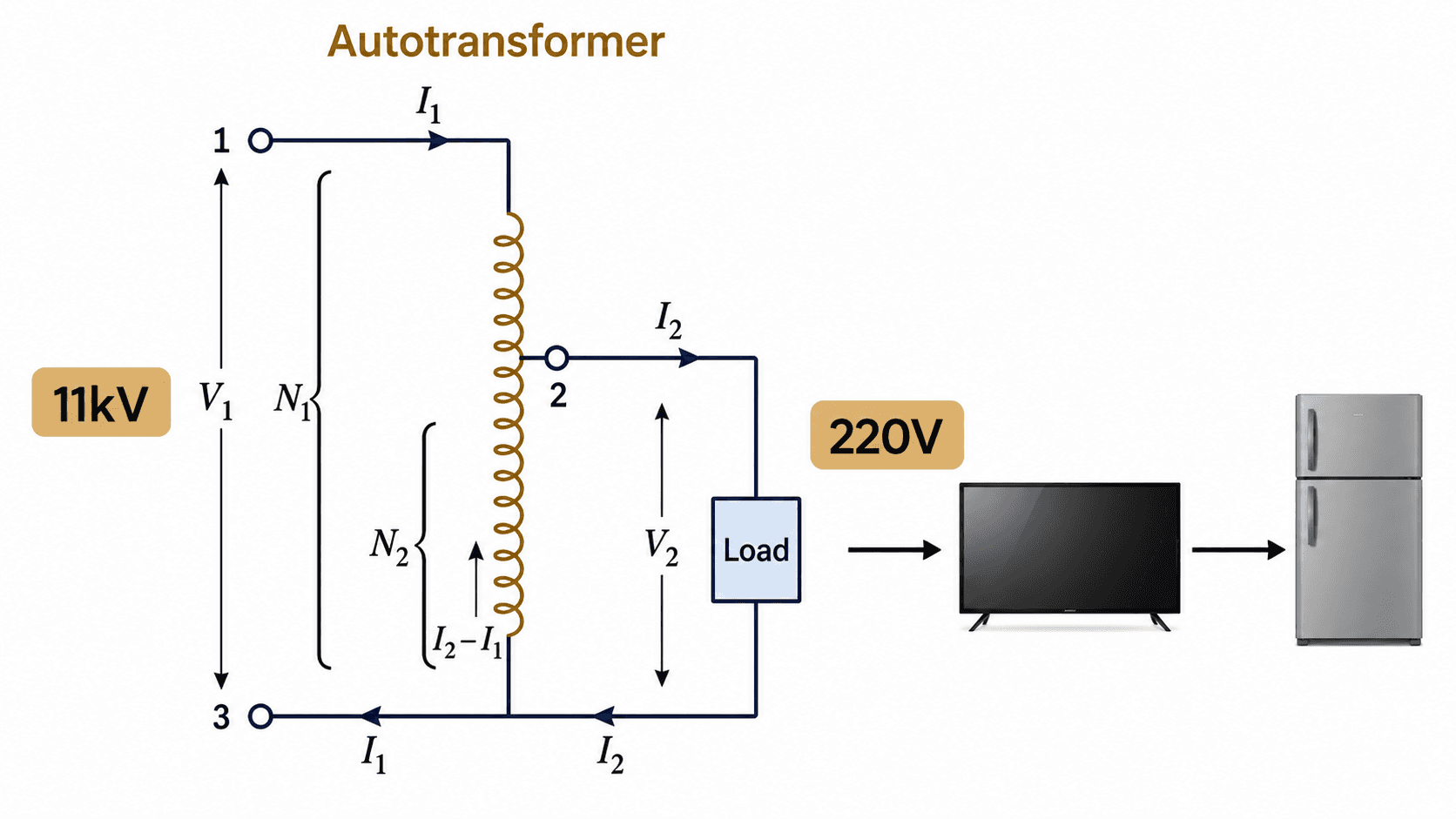
A circuit simulation confirms this directly: opening the primary circuit causes primary and secondary voltage readings to become equal, exactly the failure mode described above. This risk is the core reason utilities generally avoid auto transformers on the distribution side, where the consequences of exposing end users to such a fault would be severe.
Where Does the Name "Auto Transformer" Come From?
The name comes from the Greek word "auto," meaning self, referring to the fact that a single, self-contained winding serves both the primary and secondary role, not to any automatic voltage-changing function.
This is a common misunderstanding: the name has nothing to do with automatic operation. It simply describes the self-sustained, single-winding construction.
When Does the Copper-Saving Advantage Actually Apply?
The copper-saving and efficiency advantages of an auto transformer are strongest when the transformation ratio is close to 1:1, meaning input and output voltage are relatively similar; the further that ratio moves from 1:1, the more those advantages diminish.

A transformation ratio near 1:1 means, for example, roughly 1 kV in and roughly 1 kV out. As the ratio moves further from 1:1, say toward 1:2 or beyond, the copper savings and efficiency gains shrink accordingly. This is also part of why auto transformers are reserved for specific applications rather than replacing regular transformers universally; the specific applications where they're commonly used deserve their own dedicated explanation.
Auto Transformer vs Regular Transformer — Quick Comparison
Parameter | Regular Transformer | Auto Transformer |
Winding construction | Two separate windings (primary, secondary) | Single tapped winding for both roles |
Coupling type | Magnetic (electromagnetic induction) only | Magnetic and electrical |
Electrical isolation | Yes | No |
Copper required | More | Up to ~50% less |
Efficiency | Standard | Better, when transformation ratio is near 1:1 |
Footprint | Larger | ~10–50% smaller |
Fault behavior | Fault typically stays isolated to one side | Fault can transfer full voltage to the other side |
Best suited for | General-purpose, distribution-facing use | Ratios close to 1:1, applications where isolation isn't critical |
FAQ
Why does an auto transformer save copper compared to a regular transformer?
Because it uses a single tapped winding for both primary and secondary connections instead of two separate windings, eliminating one full winding's worth of copper.
Why don't utilities use auto transformers in distribution networks?
Because auto transformers lack electrical isolation between primary and secondary; a fault on the primary side can expose full primary voltage directly on the secondary side, a serious safety risk for end-user equipment and people.
Does "auto transformer" mean it changes voltage automatically?
No. The name comes from the Greek word for "self," referring to its single self-sustained winding serving both primary and secondary roles, not any automatic function.
When are the copper savings and efficiency gains of an auto transformer strongest?
When the transformation ratio is close to 1:1. As the ratio moves further from 1:1, those advantages diminish significantly.
What's the main risk if an auto transformer's primary winding develops an open-circuit fault?
The full primary-side voltage can appear directly on the secondary side, since there's no electrical isolation between the two, potentially damaging connected equipment or endangering anyone relying on the expected lower secondary voltage.
Conclusion
An auto transformer's single-winding design is both its greatest strength and its biggest limitation. Eliminating the dedicated secondary winding saves up to 50% of the copper, improves efficiency, and shrinks the footprint, but it also removes electrical isolation entirely, meaning a primary-side fault can directly expose the secondary side to dangerous voltage.
That trade-off, combined with the fact that its advantages only hold up near a 1:1 transformation ratio, is exactly why auto transformers are reserved for specific applications rather than replacing regular transformers everywhere.
For the full circuit simulation and visual explanation, watch the complete video on the TheElectricalGuy YouTube channel.
Watch the Youtube Video

About Author
Gaurav Joshi
Gaurav started his career on the floor of the electrical industry — not in a classroom. Working across Siemens and Schneider Electric, he saw firsthand how wide the gap was between what colleges teach and what the industry actually needs.
So he did something about it.
Today, he's built a global community of 300,000+ engineers and professionals across YouTube and beyond — and TheElectricalGuy Academy is where that knowledge lives in its most structured, practical form.