
A vacuum circuit breaker fails when its contact surfaces heat up enough to trigger thermionic emission, releasing free electrons that let the arc reignite instead of extinguishing at current zero. When this happens, the interruption fails completely, and the breaker can blast. Manufacturers prevent it by designing contacts that keep the arc rotating across the surface using a magnetic field, so heat never concentrates in one spot.
Vacuum circuit breakers are one of the most reliable technologies available for interrupting large fault currents. Vacuum does a near-perfect job building the dielectric strength needed to quench the arc. But there's one specific failure mode that can defeat this entirely, and when it happens, the breaker can fail to clear the fault and blast.
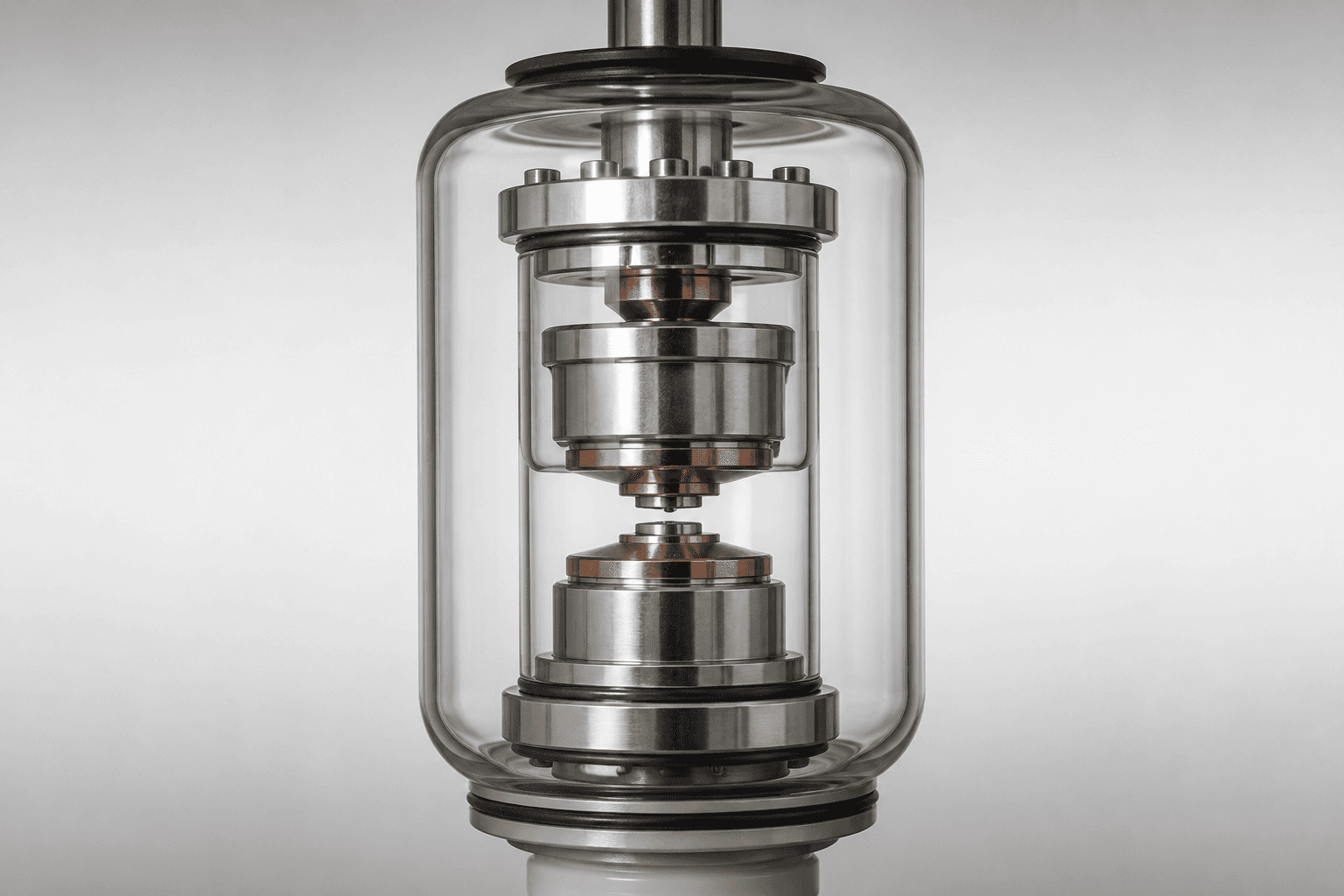
Let's look at why this happens, and how it's addressed by design.
How Does a Vacuum Circuit Breaker Normally Clear a Fault?
A vacuum circuit breaker clears a fault by letting the arc extinguish naturally at current zero, since the vacuum lacks enough free electrons to sustain it.
Inside the breaker, the contacts sit in an empty space, a vacuum. The moment the contacts open, an arc forms. That arc is unavoidable; it always forms the instant the contacts separate. But because the vacuum has no sufficient free electrons available, the arc extinguishes at the very next current zero.
Whether that interruption succeeds depends on a race between two values: the Rate of Rise of Dielectric Strength (RRDS) and the Rate of Rise of Recovery Voltage (RRRV). If RRDS rises faster than RRRV, the arc doesn't reignite, and the interruption is successful. That's the normal, healthy operation of a vacuum circuit breaker.
What is Thermionic Emission in a Vacuum Circuit Breaker?
Thermionic emission is when the metal contacts inside a vacuum interrupter heat up enough to start emitting free electrons on their own, and those free electrons let the arc reignite.
The arc that forms when contacts open is essentially current flowing through the air gap, and it's extremely hot. That heat transfers into the metal contacts. Metal doesn't emit free electrons immediately when heated, but beyond a certain temperature threshold, it starts to. This is the thermionic emission effect.
Once free electrons are available, they feed the arc directly. The dielectric strength drops, RRRV wins the race against RRDS, and the arc reignites instead of clearing. The more the arc heats the contact, the more free electrons are released, and the arc can grow large enough to cause a complete blast of the breaker.
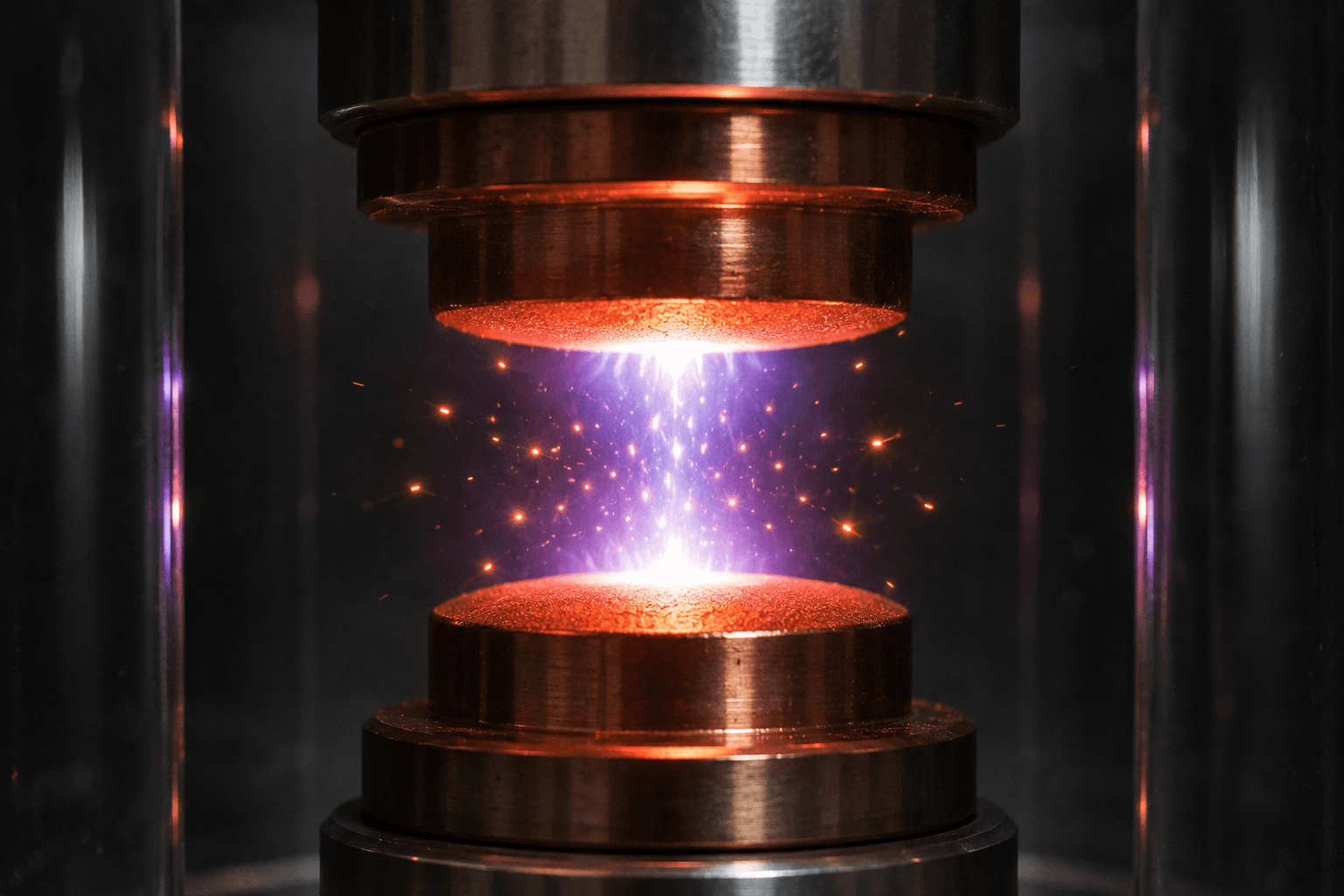
The core design challenge, then, is straightforward to state and hard to solve: keep the contact surface below the thermionic emission threshold at all times.
What are the Different Arc Modes Inside a Vacuum Interrupter?
The arc inside a vacuum interrupter can burn in different modes, and the mode it takes determines whether one spot on the contact overheats or the heat spreads out safely.
What is the Diffused Arc Mode?
The diffused arc mode spreads the arc across the entire contact surface, similar to water spraying out of a showerhead rather than a single stream. Because the arc isn't concentrated on one area, the heat distributes across the whole surface, and the contact temperature stays below the thermionic emission threshold. This is the safer of the two arc modes.
What is the Constricted Arc Mode?
The constricted arc mode holds the arc in a narrow, cylindrical form, similar to water coming out of a tap rather than a shower. This concentrates the arc's heat on one specific area of the contact. If the arc stays fixed on that spot long enough, it can heat the metal past the thermionic emission threshold, which is exactly the failure condition described above.
How Do Manufacturers Prevent Thermionic Emission?
Manufacturers prevent thermionic emission by keeping the arc rotating continuously across the contact surface, so no single point ever accumulates enough heat to emit free electrons.
For a diffused arc, the heat is already spread out, so this isn't a concern. For a constricted arc, the solution is to make it rotate rather than stay fixed in one place. This is achieved using a basic principle: introducing a magnetic field causes the current, and with it the arc, to rotate around the contact surface.
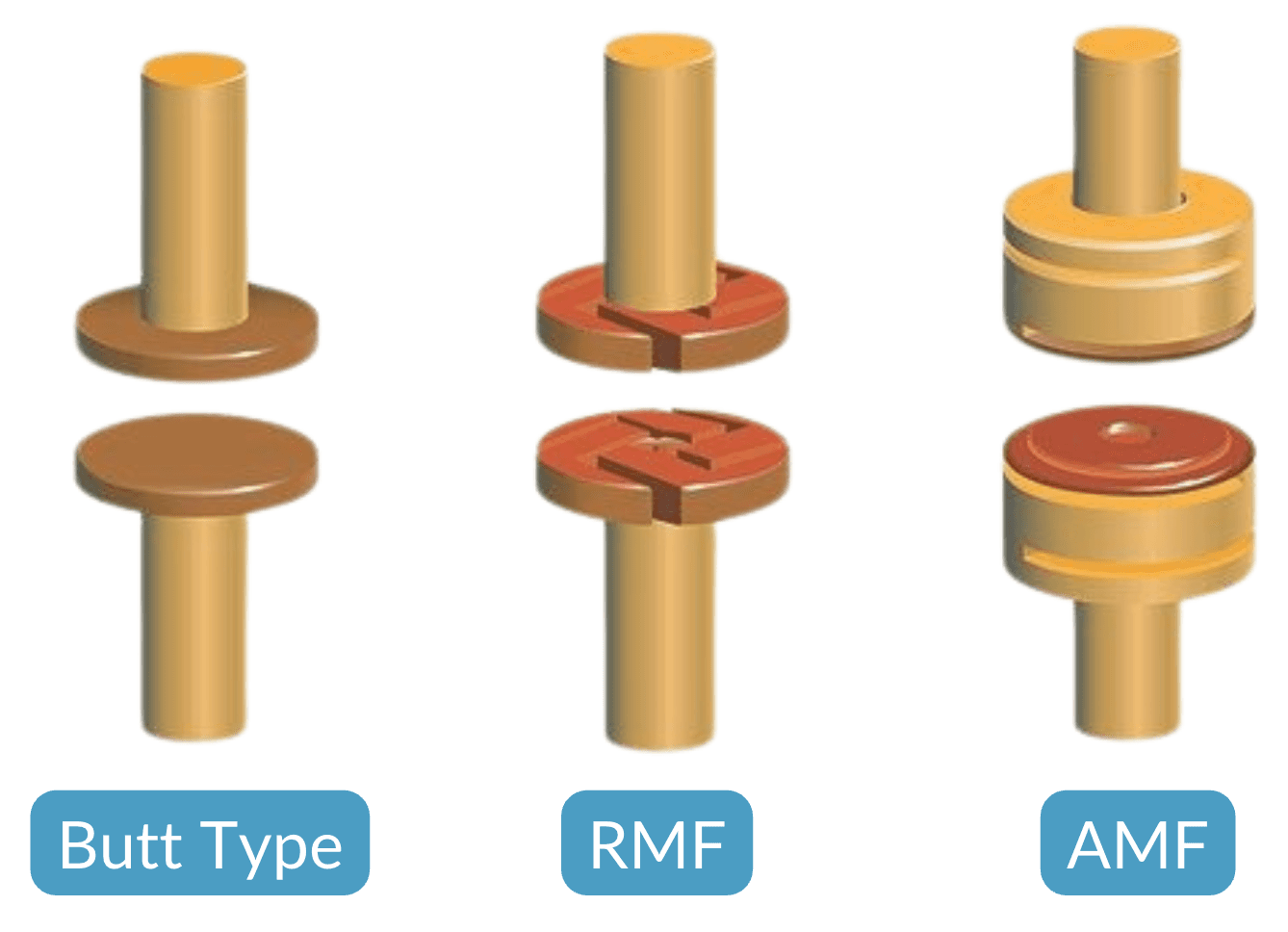
This gives rise to different contact designs built around the same underlying goal:
Diffused-mode contacts — spread the arc naturally across the surface
Constricted-mode rotating contacts — keep a cylindrical arc physically rotating around the contact
Axial Magnetic Field (AMF) contacts — use an axial magnetic field to keep the constricted arc rotating and prevent it from settling on one area
Different manufacturers use different specific contact designs, but the underlying technology, using a magnetic field to prevent the arc from dwelling in one spot, is consistent across the industry.
Why Does Contact Design Matter So Much in a Vacuum Circuit Breaker?
Contact design matters because it's the single factor that determines whether a vacuum circuit breaker's arc-quenching capability holds up under real fault conditions.
The design of the vacuum interrupter's contacts is one of the most crucial parameters of the whole breaker. It directly decides whether thermionic emission is avoided, and by extension, whether the breaker clears the fault or fails. Get this wrong, and no other part of the breaker's design can compensate for it.
FAQ
What is thermionic emission in a vacuum circuit breaker?
Thermionic emission is when the arc's heat raises the contact surface temperature past a threshold, causing the metal to release free electrons on its own, which then sustains and reignites the arc instead of letting it clear.
What's the difference between a diffused arc and a constricted arc?
A diffused arc spreads across the entire contact surface, distributing heat safely. A constricted arc stays concentrated in a cylindrical form on one area, which risks overheating that spot and triggering thermionic emission.
How does a magnetic field prevent vacuum circuit breaker failure?
Introducing a magnetic field makes the constricted arc rotate continuously around the contact surface instead of staying fixed in one place, preventing any single area from heating past the thermionic emission threshold.
What happens if thermionic emission occurs during fault clearing?
The arc reignites instead of extinguishing at current zero, the interruption fails, and in severe cases the breaker can blast.
Why is RRDS vs RRRV important to vacuum circuit breaker operation?
Successful fault clearing depends on the Rate of Rise of Dielectric Strength rising faster than the Rate of Rise of Recovery Voltage. Thermionic emission tips this race in the wrong direction by weakening dielectric strength at the critical moment.
Conclusion
A vacuum circuit breaker fails when its contacts heat up enough to trigger thermionic emission, and the resulting free electrons let the arc reignite instead of clearing at current zero. The difference between a diffused arc and a constricted arc determines whether that heat stays safely spread out or concentrates dangerously on one spot, and manufacturers address this by using a magnetic field to keep the arc rotating across the contact surface.
Contact design is one of the most crucial parameters in any vacuum circuit breaker, and it's worth understanding before you're troubleshooting a failure on site.
For the full explanation with real arc photographs and footage, watch the complete video on the TheElectricalGuy YouTube channel.
Watch the Youtube Video

About Author
Gaurav Joshi
Gaurav started his career on the floor of the electrical industry — not in a classroom. Working across Siemens and Schneider Electric, he saw firsthand how wide the gap was between what colleges teach and what the industry actually needs.
So he did something about it.
Today, he's built a global community of 300,000+ engineers and professionals across YouTube and beyond — and TheElectricalGuy Academy is where that knowledge lives in its most structured, practical form.