
STATCOM uses a voltage source converter to generate its own voltage independent of the grid, while SVC uses thyristor-switched reactors and capacitors that depend entirely on grid voltage to function. This single difference cascades into everything else: STATCOM responds faster, keeps working during deep voltage sags, needs a smaller footprint, and offers grid-forming capability, while SVC remains simpler, cheaper, and lower-loss for less demanding applications.
STATCOM (Static Synchronous Compensator) and SVC (Static VAR Compensator) serve the same core purpose, reactive power compensation and voltage control, and both belong to the FACTS (Flexible AC Transmission System) family of equipment. Despite that shared purpose, their construction and operating principle differ enough to create real performance gaps between them.
If you haven't read the basics of what a STATCOM is yet, start here before diving into this comparison.
What Do STATCOM and SVC Have in Common?
STATCOM and SVC share the same fundamental purpose, reactive power compensation and voltage control, and both belong to the FACTS family of equipment. Where they diverge is in how they achieve that purpose.
What's the Core Operating Principle Difference?
SVC behaves like an adjustable impedance using thyristor-based reactors and switched capacitors, while STATCOM behaves like an adjustable current source that generates its own voltage independent of the grid.
SVC depends on grid voltage to operate; it's often described as grid-following. STATCOM, because its voltage source converter (VSC) generates voltage on its own, doesn't depend on grid conditions to function, which is why it can continue supporting the system even when grid voltage drops significantly, something SVC simply cannot do.
How Does the Construction Differ?
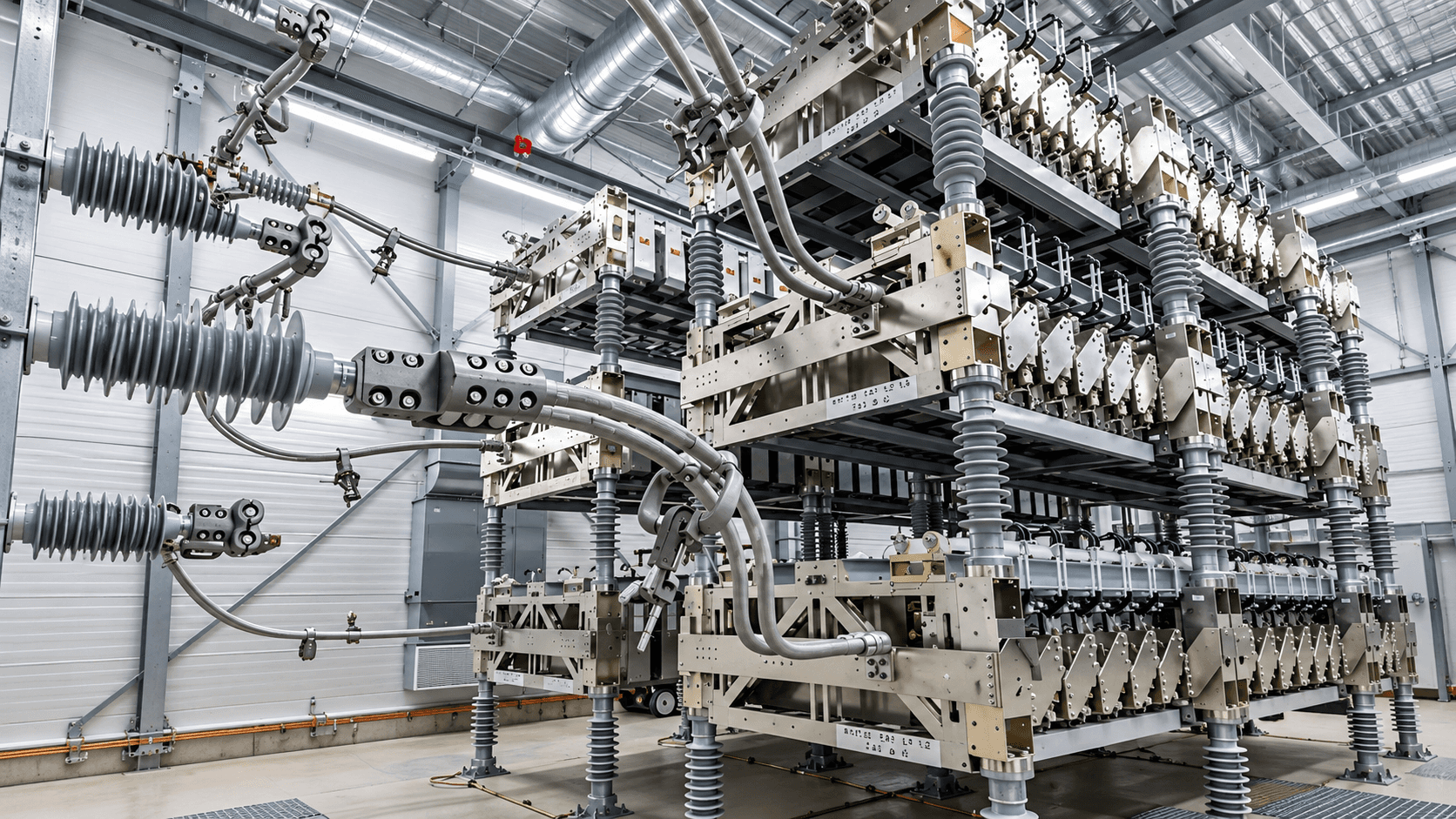
SVC uses a simpler construction, a coupling transformer with thyristor-switched reactors or capacitors, while STATCOM uses a more complex arrangement built around a voltage source converter, IGBTs, a dedicated controller, and a heat exchanger.
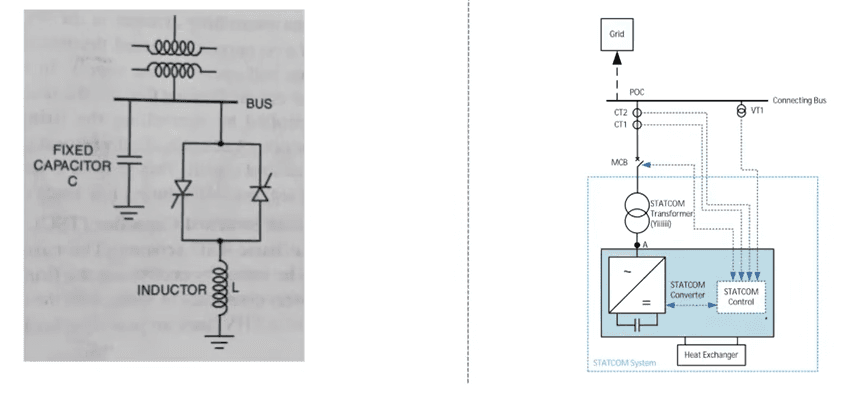
SVC's control system is correspondingly simpler. STATCOM's control is significantly more advanced, matching the complexity of its construction. STATCOM installations may also need a specially tuned transformer or dedicated reactors depending on the design.
How Do They Perform During a Voltage Sag?
SVC's output collapses during a significant voltage sag, since its reactors and capacitors charge based on grid voltage itself. STATCOM can continue supporting the grid down to as low as 0.2 per unit voltage (a system voltage falling to just 20% of normal), because it doesn't depend on the grid to generate its own output.
If SVC's stored energy comes from a grid that's already collapsing, there's little left to draw on. STATCOM's independent voltage source is exactly what avoids that limitation, and it's one of the clearest reasons engineers choose STATCOM over SVC for weak-grid applications.
How Do Their Response Times Compare?
SVC typically responds within two to three cycles (roughly 60 milliseconds), while STATCOM responds within under two cycles (well below 40 milliseconds), making it the faster of the two.
This speed difference traces directly back to construction: SVC relies on thyristors, while STATCOM uses IGBTs, which switch faster and more precisely.
Do STATCOM and SVC Both Need Harmonic Filters?
SVC needs a dedicated filter bank to remove harmonics generated by its thyristor-controlled reactors before pushing power into the system, while STATCOM's output is near-sinusoidal with much lower harmonic content, generally not requiring dedicated filter banks at all.
Removing the need for bulky filter banks is also a major reason STATCOM installations have a smaller physical footprint than equivalent-capacity SVC installations.
How Do STATCOM and SVC Compare in Size?
STATCOM installations are significantly more compact than equivalent-capacity SVC installations, since STATCOM doesn't require the bulky filter banks SVC needs.
According to manufacturers including Siemens Energy and Hitachi Energy, a STATCOM can be roughly 50% smaller than an SVC of equivalent MVAR capacity. For a 100 MVAR rating, that translates directly into meaningful land cost savings at the installation site.
How Do Losses and Capital Cost Compare?
SVC has lower losses and lower capital cost than STATCOM, particularly at higher MVAR capacity, though STATCOM's smaller footprint can offset some of that gap through land cost savings.
STATCOM's higher losses come mainly from IGBT switching losses, which run higher than thyristor losses in SVC, though ongoing research and development continues narrowing that gap.
On capital cost, SVC tends to be considerably cheaper at higher capacity ratings, reflecting its simpler construction and control system, while STATCOM's advanced control and construction carry a higher price tag. Whether the smaller footprint offsets the higher upfront cost depends on land cost at the specific project site.
What's the Difference in Grid-Forming Capability?
SVC only offers reactive power support and is grid-following, meaning its output depends entirely on grid voltage, while STATCOM offers grid-forming capability, generating its own voltage and frequency independent of the grid.
This grid-forming capability is what allows STATCOM to support functions like black start and ancillary services during severe voltage collapse. It's also why manufacturers increasingly pair STATCOM with Battery Energy Storage Systems (BESS), combining reactive power support with active power capability in a single installation. If you want to go deeper on BESS specifically, the 4-Week BESS Bootcamp for Engineers course covers exactly that.
STATCOM vs SVC — Full Comparison
Parameter | SVC | STATCOM |
Core principle | Adjustable impedance, thyristor-based | Adjustable current source, voltage source converter |
Dependence on grid voltage | Yes (grid-following) | No (independent voltage source) |
Construction complexity | Simpler | More complex |
Output during deep voltage sag | Collapses | Supports down to ~0.2 p.u. voltage |
Response time | ~2–3 cycles (~60 ms) | Under 2 cycles (~40 ms) |
Harmonic filters needed | Yes, dedicated filter banks | Generally not needed |
Footprint (equivalent MVAR) | Larger | ~50% smaller (per Siemens Energy / Hitachi Energy data) |
Losses | Lower | Higher (improving with R&D) |
Capital cost (higher MVAR) | Lower | Higher |
Grid capability | Grid-following, reactive power only | Grid-forming, can pair with BESS for active power |
Which One Should You Choose, STATCOM or SVC?
The right choice depends entirely on project requirements, not on one device being universally better than the other, similar to how gas-insulated and air-insulated switchgear both hold significant market share despite GIS having clear technical advantages.
Choose SVC if the grid is relatively stable, a very fast response isn't critical, and the reactive power support needed is modest.
Choose STATCOM if the grid is weak, voltage can fall significantly, a fast response is essential, or land cost at the site is high enough that STATCOM's smaller footprint offsets its higher upfront cost.
FAQ
Why can STATCOM support the grid during a severe voltage sag while SVC cannot?
STATCOM generates its own voltage using a voltage source converter, independent of grid conditions, while SVC's reactors and capacitors charge based on grid voltage itself, so they have little to draw on once the grid voltage collapses.
Is STATCOM always the better choice over SVC?
No. STATCOM offers clear performance advantages, but SVC remains the more cost-effective, lower-loss choice for stable grids that don't need fast response or deep voltage-sag support. The right choice depends on the specific project requirement.
Why doesn't STATCOM need harmonic filters while SVC does?
SVC's thyristor-controlled reactors generate harmonics that must be filtered before the output reaches the grid. STATCOM's IGBT-based converter produces a near-sinusoidal output with much lower harmonic content, generally avoiding the need for dedicated filter banks.
What does "grid-forming" mean for a STATCOM?
Grid-forming means STATCOM can generate its own voltage and frequency independent of the grid, supporting functions like black start and ancillary services, a capability SVC's grid-following design doesn't offer.
Why are STATCOM installations smaller than SVC installations?
Mainly because STATCOM doesn't require the bulky harmonic filter banks that SVC needs, which significantly reduces its physical footprint, reportedly around 50% smaller than an equivalent-capacity SVC per manufacturer data.
Conclusion
STATCOM and SVC solve the same problem, reactive power compensation and voltage control, using fundamentally different approaches. SVC's simpler, thyristor-based, grid-following design keeps cost and losses lower for stable-grid applications.
STATCOM's voltage source converter design trades higher cost and losses for faster response, deep voltage-sag support, a smaller footprint, and grid-forming capability. Neither is universally the right answer; the correct choice comes down to what the specific grid and project actually need.
For the full comparison with visuals, watch the complete video on the TheElectricalGuy YouTube channel.
Watch the Youtube Video

About Author
Gaurav Joshi
Gaurav started his career on the floor of the electrical industry — not in a classroom. Working across Siemens and Schneider Electric, he saw firsthand how wide the gap was between what colleges teach and what the industry actually needs.
So he did something about it.
Today, he's built a global community of 300,000+ engineers and professionals across YouTube and beyond — and TheElectricalGuy Academy is where that knowledge lives in its most structured, practical form.