
A disconnector can only carry current and provide isolating distance, never make or break it. A load break switch (LBS) also known as switch-disconnector can make and break normal current and provide isolating distance, but cannot break fault current. A circuit breaker can make and break both normal current and fault current. That single capability, breaking short-circuit current, is what ultimately separates a circuit breaker from the other two.
These three devices get confused constantly, and most of that confusion clears up once you understand their IEC definitions side by side. This article compares them across more than 10 real design and application parameters, not just the basic definitions.

If you want the deeper explanation of each device individually, I've covered that in What is a Load Break Switch (LBS)? this article focuses on the comparison itself.
What's the Core Difference Between These Three Devices?
The core difference comes down to what each device can do to current: a disconnector can only carry it, a load break switch can make and break normal current, and only a circuit breaker can make and break fault current.
Disconnector — an offload device; carries current and provides isolating distance, but cannot open or close under load.
Load break switch (LBS) / switch disconnector — a switch that also satisfies disconnector-level isolating distance; makes and breaks normal current, but not fault current.
Circuit breaker — makes and breaks both normal current and fault current, the only one of the three built to clear a short circuit.
What is Each Device's Primary Purpose?
Each device serves a distinct role in a substation: disconnectors isolate and reroute power, load break switches add normal-current switching to that same isolating role, and circuit breakers exist specifically to protect the system from fault current.
Why Do Substations Need Disconnectors?
Disconnectors serve two main purposes: isolating a specific section of equipment for maintenance, and rerouting power between bus bars.
For isolation, opening disconnectors on both sides of a circuit breaker before maintenance guarantees that section is completely isolated from the rest of the system. For rerouting, if one bus bar fails, opening the disconnector connected to it and closing the disconnector to a healthy bus bar (after opening the relevant breakers) shifts the power path without needing to shut down the load entirely.
What Does a Load Break Switch Add to That Role?
A load break switch performs the same isolation and rerouting functions as a disconnector, but adds the ability to switch normal current directly, a capability a disconnector doesn't have at all.
What is a Circuit Breaker's Primary Purpose?
A circuit breaker exists specifically to protect the system from abnormal fault and short-circuit currents, a capability neither the disconnector nor the load break switch has.
Disconnector vs Load Break Switch vs Circuit Breaker - Full Comparison
Parameter | Disconnector | Load Break Switch (LBS) | Circuit Breaker |
Make/break normal current | No | Yes | Yes |
Isolating distance when open | Yes | Yes | No (needs a separate disconnector) |
Carry short-circuit current (specified time) | Yes | Yes | Yes |
Break short-circuit current | No | No | Yes |
Primary purpose | Isolation, power rerouting | Isolation, rerouting, plus normal switching | Fault protection |
Voltage rating | Up to and including 800 kV (and UHV, e.g. 1100 kV) | Up to and including 52 kV only | Up to and including 800 kV (and UHV) |
Earths trapped charges | Yes, via dedicated earthing switches | Yes, via dedicated earthing switches | No |
Generates switching overvoltages | No | Negligible up to 52 kV | Yes, especially above 245 kV |
Governing IEC standard | IEC 62271-102 | IEC 62271-103 | IEC 62271-100 |
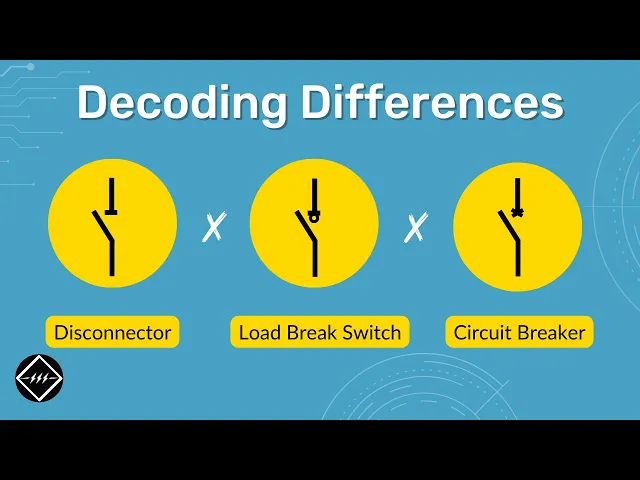
Symbol | Horizontal line | Horizontal line with a small circle | Cross mark |
Why Do Voltage Ratings Differ So Much Between These Devices?
Disconnectors and circuit breakers scale up to 800 kV and beyond because their designs are built for high and extra-high voltage isolation and protection, while load break switches remain limited to around 52 kV, a distribution-level design constraint.
You won't find a 245 kV or 400 kV rated load break switch; that voltage range is reserved for dedicated disconnectors and circuit breakers working together, not a combined device.
Which of These Devices Can Earth Trapped Charges?
Disconnectors and load break switches can both earth trapped charges through dedicated earthing switches, but circuit breakers cannot.

Trapped charges remain on a line even after circuit breakers open at both ends, and if someone working on that line inadvertently provides a path to ground, the result can be a severe shock. Disconnectors commonly include one or two dedicated earthing switches, or a three-position design where one position is dedicated to earthing, which safely discharges trapped charge to ground. Load break switches offer the same earthing switch capability. Circuit breakers, by design, don't include this feature at all.
Which of These Devices Generate Switching Overvoltages?
Circuit breakers generate switching overvoltages, particularly above 245 kV, while disconnectors and load break switches generally don't, or the effect is negligible at their operating voltage range.
Since a disconnector never switches under load, it produces no switching overvoltage regardless of voltage level. A load break switch does switch normal current, but at its maximum 52 kV rating, the resulting switching overvoltage is negligible. A circuit breaker, by contrast, does produce meaningful switching overvoltages, an effect that becomes significant above the 245 kV level.
How Can You Identify Each Device by Its Symbol?
Each device has a distinct single-line diagram symbol: a disconnector is shown as a horizontal line, a load break switch adds a small circle to that same horizontal line, and a circuit breaker is shown as a cross mark.
FAQ
What's the single biggest difference between a load break switch and a circuit breaker?
A circuit breaker can break short-circuit (fault) current; a load break switch can only carry it for a specified time, not break it. Both can make and break normal current.
Why can't a load break switch be used above 52 kV?
Load break switch design is inherently limited to distribution-level applications, up to and including 52 kV. Higher voltage levels require a dedicated disconnector and circuit breaker working together instead of a combined device.
Why do circuit breakers lack earthing switches while disconnectors and LBS units have them?
Earthing switches serve an isolation-related safety function, discharging trapped charge before maintenance. Since circuit breakers aren't used for isolation in the same way disconnectors and LBS units are, they aren't built with this feature.
At what voltage do circuit breaker switching overvoltages become a real concern?
The transcript-sourced rule of thumb is that switching overvoltages become significant above 245 kV; below that level, the impact is generally not considered significant.
How do I tell these three devices apart on a single line diagram?
Look at the symbol: a plain horizontal line is a disconnector, that same line with a small circle added is a load break switch, and a cross mark represents a circuit breaker.
Conclusion
Disconnector, load break switch, and circuit breaker sit on a clear capability ladder: a disconnector can only carry current and isolate, a load break switch adds the ability to make and break normal current, and only a circuit breaker can make and break fault current.
Voltage rating, earthing capability, switching overvoltage behavior, governing IEC standard, and single-line diagram symbol all follow directly from that core capability difference. Knowing this ladder cold is what makes reading a substation single line diagram, or specifying the right device for a job, straightforward.
For the full comparison walkthrough with all visuals, watch the complete video on the TheElectricalGuy YouTube channel.
Watch the Youtube Video

About Author
Gaurav Joshi
Gaurav started his career on the floor of the electrical industry — not in a classroom. Working across Siemens and Schneider Electric, he saw firsthand how wide the gap was between what colleges teach and what the industry actually needs.
So he did something about it.
Today, he's built a global community of 300,000+ engineers and professionals across YouTube and beyond — and TheElectricalGuy Academy is where that knowledge lives in its most structured, practical form.