
Understanding BESS parameters is essential for every engineer working with energy systems. These parameters define how a battery energy storage system performs in real conditions. They also help in designing, selecting, and operating systems effectively.
In this guide, we will break down the 10 most important BESS parameters. The explanation follows a simple and practical approach. The flow stays aligned with real-world understanding and application.

Also, this lesson comes from a detailed course on BESS engineering. If you want deeper learning, you can explore the 4-week BESS boot camp for engineers mentioned in the source.
Energy Capacity Explained
Energy capacity defines how much energy a battery can store. It works like a water tank. A bigger tank stores more water, and a bigger battery stores more energy.
When we say a battery has 100 kWh capacity, it means storage only. It does not mean you will get the same output. Losses will reduce the usable energy.
This parameter is measured in Wh, kWh, or MWh. For example, the Hornsdale Power Reserve is one of the most well-known BESS projects. In this project, you can see multiple battery cabinets installed in rows. These cabinets together form the entire storage system. The total energy capacity of this project is 194 MWh, which is quite large. This clearly shows how grid-scale battery systems are built using multiple units combined. It also helps you understand how capacity scales in real-world applications.
Understanding Power Rating
Power rating tells how fast energy can be delivered. It is like the pipe connected to a water tank. A bigger pipe allows faster flow. Similarly, a battery with higher power rating delivers energy quickly. It is measured in kW or MW.
For example, the same Hornsdale project has a 150 MW rating. This differs from energy capacity. Both must be understood clearly. When combined, they define system performance. That leads us to the next parameter.
What is Duration and Why It Matters
Duration shows how long the battery can supply power. It depends on both energy capacity and power rating. The formula is simple. Divide energy capacity by power rating.
For instance, the Kilokari BESS Project has 40 MWh capacity and 20 MW power. So, the duration becomes 2 hours.
Projects above 6 or 8 hours are long-duration systems. Others fall under short-duration systems. Each serves different applications.
Round Trip Efficiency in Simple Terms
Round trip efficiency shows how much energy you get back. It compares energy input and output. Think of filling a tank with 100 liters. You may only get 95 liters back. Losses occur during storage and transfer.
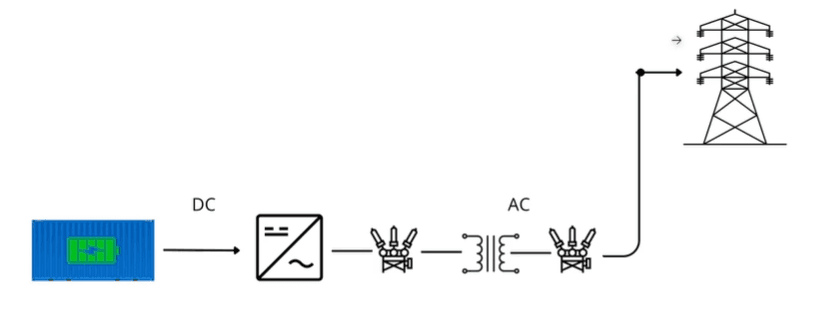
Similarly, batteries lose energy during charging and discharging. If you input 100 kWh and get 85 kWh, efficiency is 85%.
There are two types to understand:
DC to DC efficiency focuses only on the battery
AC to AC efficiency includes the entire system
AC to AC is more practical. It includes losses in transformers, converters, and cables. Typically, large systems show 80% to 90% efficiency.
Depth of Discharge (DOD)
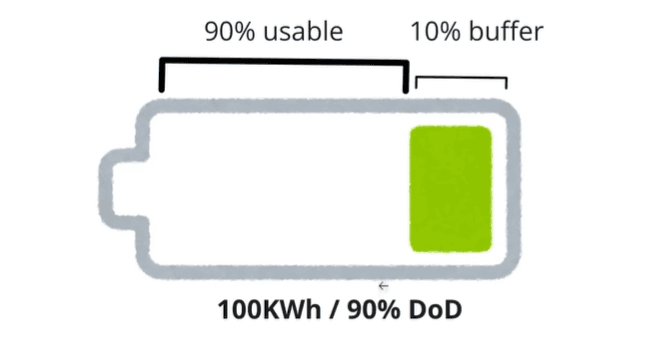
Depth of discharge defines usable battery capacity. You cannot use 100% of stored energy. Manufacturers suggest keeping a buffer. This protects battery life.
For example, if DOD is 90%, only 90 kWh is usable from 100 kWh. The remaining stays unused. Different battery types have different limits:
Lithium-ion: around 80–90%
Lead-acid: around 50–60%
This parameter is critical during system design. It impacts actual usable output.
Cycle Life and Battery Aging
Cycle life defines how many times a battery can operate fully. One cycle means full charge and discharge. Each cycle slowly degrades battery performance. Over time, capacity reduces.
For example, a battery may support 8000 cycles. After that, performance drops significantly. Also, partial cycles matter. Charging without discharging counts as half a cycle.
This parameter helps estimate system lifespan. Engineers must calculate cycles based on daily usage.
C Rate and Its Impact on Performance
C rate defines how fast a battery charges or discharges. It directly affects performance and stress. A higher C rate means faster operation. However, it increases stress and losses.
For example:
1C means full charge in one hour
2C means full charge in 30 minutes
0.5C means two hours
0.25C means four hours
Higher current increases heat and losses. That reduces battery life. Therefore, utility-scale systems usually use lower C rates like 0.5C or 0.25C.
Calendar Degradation Over Time
Calendar degradation happens even without usage. Time, temperature, and environment reduce battery capacity.
Even if the battery stays idle, degradation continues. For lithium-ion batteries, it is around 1–2% per year.
Manufacturers usually define calendar life as 20–25 years. This parameter is important for long-term planning. It affects overall system reliability.
State of Charge (SOC)
State of charge shows how much energy remains in the battery. It is expressed as a percentage. For example, if half the energy is used, SOC becomes 50%.
This parameter helps control battery operation. Systems avoid overcharging or deep discharging. Energy management systems use SOC for decision-making. It ensures safe and efficient performance.
State of Health (SOH)
State of health shows the condition of the battery. A new battery starts at 100% SOH. Over time, usage and aging reduce this value.
For example, if capacity drops by 10%, SOH becomes 90%. Manufacturers define an end-of-life value. It is usually around 70% (will vary based on the type of battery chemistry). After this point, the battery may not serve its primary purpose.
Factors affecting SOH include:
Cycle usage
Temperature
Charging speed
Environmental conditions
This parameter is key for long-term system planning.
Conclusion
Understanding these BESS parameters helps engineers design better systems. Each parameter affects performance, life, and efficiency.
From energy capacity to state of health, every factor plays a role. When combined, they define the complete system behavior.
For a clearer and more practical understanding, it is recommended to watch the full video explanation.
Want to Go Deeper on BESS?
If you want to go beyond theory and truly understand BESS systems, there is a structured learning path available. The 4-week BESS Bootcamp for Engineers covers everything from basics to real-world applications in a simple and practical way.
The course walks you through system design, battery behavior, safety concepts, and actual project insights. It is built for engineers who want clarity, not just concepts.
If you are serious about building expertise in battery energy storage, this course can help you move from basic understanding to real confidence.
Watch the Youtube Video


About Author
Gaurav Joshi
Gaurav started his career on the floor of the electrical industry — not in a classroom. Working across Siemens and Schneider Electric, he saw firsthand how wide the gap was between what colleges teach and what the industry actually needs.
So he did something about it.
Today, he's built a global community of 300,000+ engineers and professionals across YouTube and beyond — and TheElectricalGuy Academy is where that knowledge lives in its most structured, practical form.