
What Is HVDC Transmission and Why Is It Used?
Quick answer HVDC (high voltage direct current) transmission converts AC power to DC at the sending end, carries it as direct current over long distances, and converts it back to AC at the receiving end. It is used where AC reaches its limits: long-distance bulk power transfer, undersea cables, and linking grids that run at different frequencies — because DC avoids the reactive-power and stability problems that limit AC over distance.
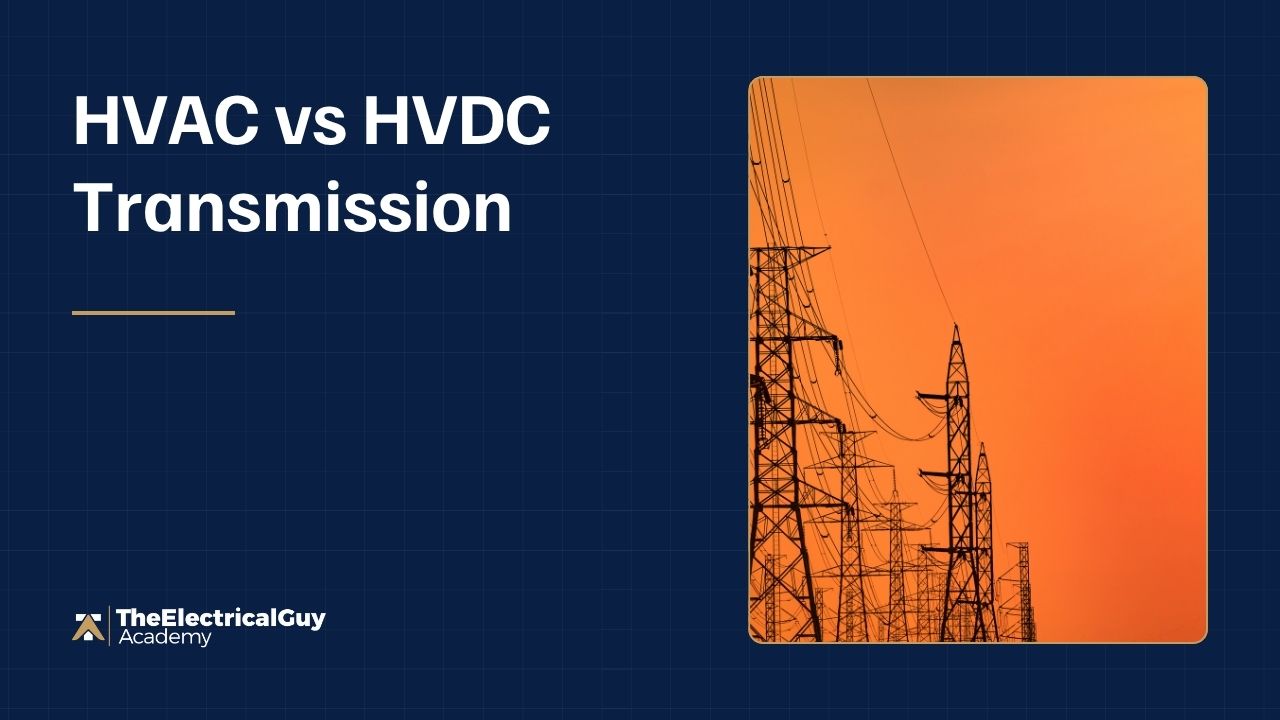
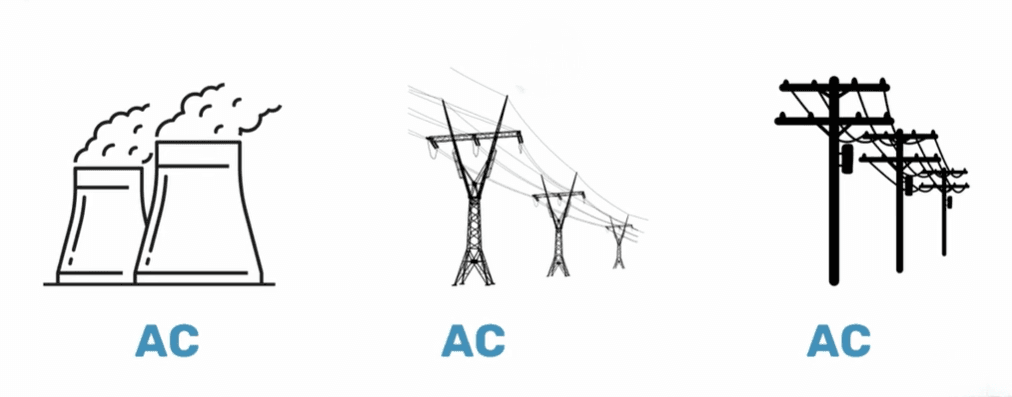
Most of the world's power is generated, transmitted, and distributed as alternating current, and for the majority of networks AC works well. But on a few specific jobs — moving thousands of megawatts across very long distances, running power under the sea, or tying together two grids that don't share a frequency — AC runs into hard physical limits. That's where HVDC transmission comes in.
In this article I'll walk through why HVDC is needed, how it works, its main advantages, where it costs more, and three real projects that show it in action.
Why Do We Need HVDC Transmission?
HVDC is needed because AC transmission cannot move large amounts of power over very long distances efficiently, and cannot directly connect grids that differ in frequency. AC remains the backbone of power systems, but physical and system-level constraints cap how far and how much power an AC line can carry. Those constraints raise losses and weaken stability. HVDC solves the cases where AC struggles.
To see why, look at three limitations of HVAC transmission.
What Are the Limitations of HVAC Transmission?
HVAC transmission is limited by reactive effects over distance, by the difficulty of interconnecting large AC systems, and by frequency incompatibility between grids. Each one is a barrier HVDC removes.
Inductive and Capacitive Effects in AC Lines
Every AC line has inductance and capacitance, and these are unavoidable. As distance grows, reactive power rises, which limits how much real power the line can carry. Voltage control gets harder, losses climb, and stability falls. As a rough illustration, sending 10,000 MW over 2,000 km on AC alone is not practical for these reasons.
Difficulty Interconnecting Large AC Systems
Directly connecting two strong AC systems is hard. Short-circuit (fault) levels rise sharply when large networks are tied together, and they can exceed the breaking capacity of available circuit breakers. Such interconnections can also create unwanted power-flow paths that destabilise the system. These risks often make direct AC interconnection impractical.
AC Systems Running at Different Frequencies
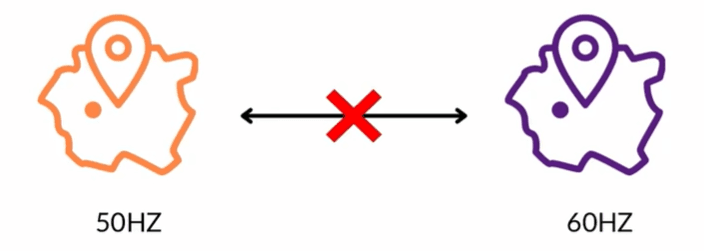
Two AC networks must share the same frequency to connect directly. A 50 Hz system and a 60 Hz system cannot be tied together with AC at all. This is a common barrier between regions and countries — and one HVDC handles cleanly.
How Does HVDC Transmission Solve These Problems?
HVDC solves them by converting AC to DC, carrying the power as direct current, then converting it back to AC at the far end. Because the line carries DC, the inductive and capacitive effects that limit AC distance no longer apply. And because the link decouples the two grids, it can transfer power between systems running at different frequencies. That makes HVDC highly effective in exactly the scenarios where AC fails.
How Does an HVDC System Work?
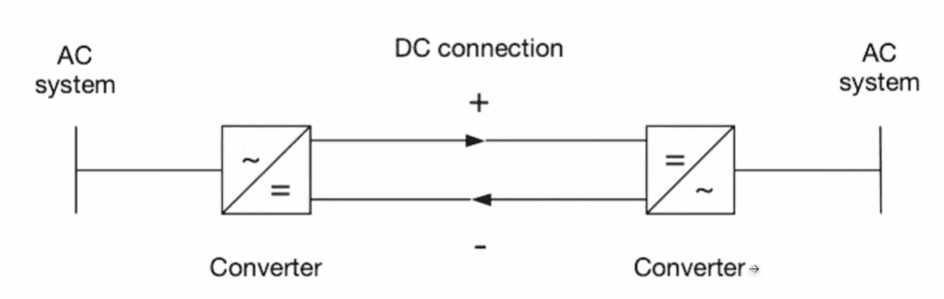
An HVDC link connects two AC networks through a DC line: a converter station rectifies AC to DC at the sending end, the DC flows over the line, and a second converter station inverts it back to AC at the receiving end. Here is the structure piece by piece.
Overview of the System Structure
At the sending end, a converter station turns AC into DC — this is called rectification. The DC then travels over transmission lines or cables. At the receiving end, a second converter station turns the DC back into AC — this is called inversion — and feeds it into the receiving grid.
The Role of Converter Stations
Converter stations are the heart of an HVDC system. The sending-end station acts as a rectifier; the receiving-end station acts as an inverter. Together they control how much power flows, the voltage level, and the direction of flow.
Transmission Lines Used in HVDC
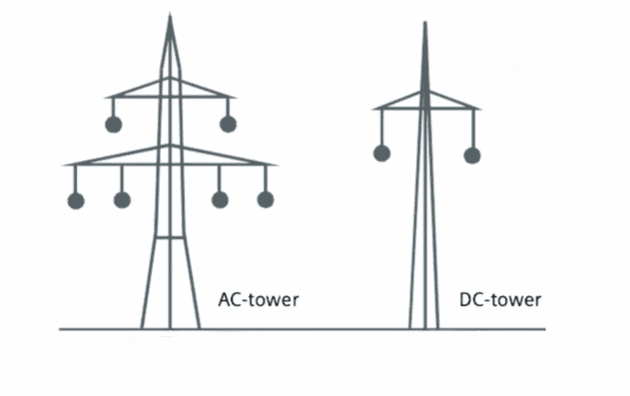
An HVDC line typically uses just two conductors — one at positive voltage and one at negative. AC needs more. Fewer conductors mean less material, simpler towers, and a smaller physical footprint.
Bidirectional Power Flow
HVDC can send power either way along the same link, with no physical changes to the system. The direction is set electronically at the converter stations, which makes the link flexible as demand shifts.
What Are the Advantages of HVDC Transmission?
HVDC's main advantages are long-distance capability, precise control of power flow, lower transmission losses, and a smaller environmental footprint. Each is summarised below.
Advantage | What it means in practice |
|---|---|
No practical distance limit | DC avoids the reactive effects that cap AC distance, so very long links become feasible. |
Precise power-flow control | Operators set how much power flows and in which direction, unlike AC where flow follows impedance. |
Higher efficiency | No reactive power on the line means lower losses, so corridors carry more usable power. |
Smaller footprint | Two conductors and lighter towers mean less steel, less land, and lower visual impact. |
No Practical Limit on Distance
Because HVDC removes inductive and capacitive line effects, there is effectively no theoretical distance limit. In practice, commercial HVDC links already span from several hundred to a few thousand kilometres, which makes HVDC the natural choice for connecting remote generation to distant load centres.
Better Control Over Power Flow
In an AC system, power follows the lowest-impedance path, which limits control. HVDC lets operators decide the exact amount and direction of flow, improving stability and grid reliability.
Higher Transmission Efficiency
With no reactive power on the line, losses fall and existing corridors can carry more power. That raises the utilisation of the infrastructure already in the ground.
Environmental Benefits
HVDC towers use less steel and fewer conductors, with a simpler, more compact design. That reduces land use and visual impact compared with equivalent AC towers.
When Is HVDC Worth the Cost?
HVDC carries a high upfront cost — mainly the converter stations — so it pays off only beyond a "break-even distance," where its lower losses outweigh that initial cost. Below that distance, HVAC is usually cheaper.
The Break-Even Distance Concept
The break-even distance is the point at which HVDC becomes more economical than HVAC. Beyond it, lower losses and higher efficiency offset the cost of the converter stations. Below it, HVAC stays more cost-effective. Planners use this concept to pick the right technology per project.
When HVAC Is Still the Better Choice
HVAC remains the better choice for shorter distances (commonly below about 200 km) and when both ends already run at the same frequency. HVDC complements AC transmission — it doesn't replace it.
Where Is HVDC Used? Real-World Projects
HVDC is used worldwide for long overhead links and undersea cables; three examples are the Rihand–Dadri link in India, the Western HVDC Link in the UK, and the North Sea Link between Norway and the UK.
Project | Length | DC voltage | Power | Notable for |
|---|---|---|---|---|
Rihand–Dadri (India) | ~814 km | 500 kV | 1,500 MW | Long-distance overhead bulk transfer |
Western HVDC Link (UK) | ~422 km | 600 kV | 2,200 MW | Reinforces grid stability and transfer capacity |
North Sea Link (Norway–UK) | ~730 km | 515 kV | 1,400 MW | One of the longest submarine HVDC links |
Rihand–Dadri HVDC Link, India
The Rihand–Dadri link runs about 814 km at 500 kV DC and transmits around 1,500 MW (source: Hitachi Energy). It's a clear case of HVDC for long-distance overhead transfer.
Western HVDC Link, United Kingdom
The Western HVDC Link is about 422 km at 600 kV DC, rated near 2,200 MW. It strengthens grid stability and power-transfer capacity between regions.
North Sea Link Between Norway and the UK
The North Sea Link connects Norway and the UK over a distance of 730 kilometers. It operates at 515 kV DC and transmits 1,400 megawatts of power. The entire link uses offshore cables, making it one of the longest submarine HVDC projects.
Why Is HVDC Used for Offshore Transmission?
HVDC is used offshore because long undersea AC cables suffer severe capacitive charging current that limits their distance, whereas DC cables do not. That single reason is why most long submarine links are HVDC.
How Do Engineers Choose Between HVAC and HVDC?
Engineers choose by weighing distance, power level, frequency compatibility, and system strength against cost. HVDC is selected only where its advantages clearly outweigh its higher upfront cost — otherwise HVAC stays the default.
Frequently Asked Questions
What does HVDC stand for?
HVDC stands for high voltage direct current. It is a transmission method that carries bulk power as direct current instead of alternating current, usually to move large amounts of power over long distances or under the sea.
Why is DC better than AC for long-distance transmission?
DC avoids the inductive and capacitive effects that build up on long AC lines. Without that reactive power, losses are lower and there is no practical distance limit, so DC carries more usable power further than AC.
Can HVDC connect grids of different frequencies?
Yes. Because an HVDC link converts to DC in the middle, it decouples the two AC grids. A 50 Hz system and a 60 Hz system that cannot be joined with AC can be connected through an HVDC link.
Why isn't HVDC used everywhere if it's so efficient?
The converter stations at each end are expensive and complex. HVDC only becomes economical beyond a "break-even distance," so for shorter links — typically below about 200 km — HVAC remains the cheaper choice.
How many conductors does an HVDC line use?
A typical HVDC line uses two conductors, one positive and one negative, compared with the larger conductor count of an equivalent AC line. This cuts material use and allows lighter, smaller towers.
Conclusion
HVDC transmission isn't a replacement for AC — it's the tool engineers reach for when AC hits its limits: long distances, undersea routes, and grids that don't share a frequency. Understand the break-even distance and the role of the converter stations, and you'll know when HVDC is the right call.
This is the introduction to a full HVDC series. Next, see how the system is built component by component, the trade-offs involved, and how HVDC stacks up against HVAC.
Watch the Youtube Video

About Author
Gaurav Joshi
Gaurav started his career on the floor of the electrical industry — not in a classroom. Working across Siemens and Schneider Electric, he saw firsthand how wide the gap was between what colleges teach and what the industry actually needs.
So he did something about it.
Today, he's built a global community of 300,000+ engineers and professionals across YouTube and beyond — and TheElectricalGuy Academy is where that knowledge lives in its most structured, practical form.