Quick answer The core difference is distance and control. HVAC (high voltage alternating current) is simpler and cheaper to build, so it wins for shorter transmission lines. HVDC (high voltage direct current) costs more upfront because of its converter stations, but it carries bulk power over long distances with lower, nearly constant losses, connects grids running at different frequencies, and works for long subsea cables where AC cannot. Engineers choose between them using the break-even distance: below it, HVAC is cheaper; beyond it, HVDC wins.
Most of the world's grid runs on HVAC, and for the majority of lines that is the right choice. HVDC is the specialist tool that takes over where AC hits its physical limits: very long distances, undersea routes, and links between grids that do not share a frequency. The clearest way to see the difference is to compare both on the same parameters, side by side.
HVAC vs HVDC at a Glance
Parameter | HVAC | HVDC |
|---|---|---|
Different frequencies | Cannot connect grids of different frequencies | Connects them easily (DC has no frequency) |
Distance and capacity | Limited by inductance and capacitance | No such limit; only resistance applies |
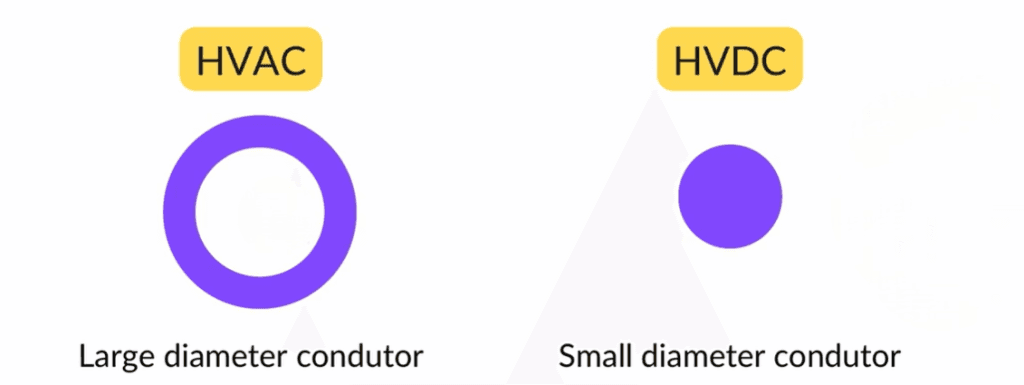
Conductor size | Needs thicker conductors (skin effect) | Thinner conductors (no skin effect) |
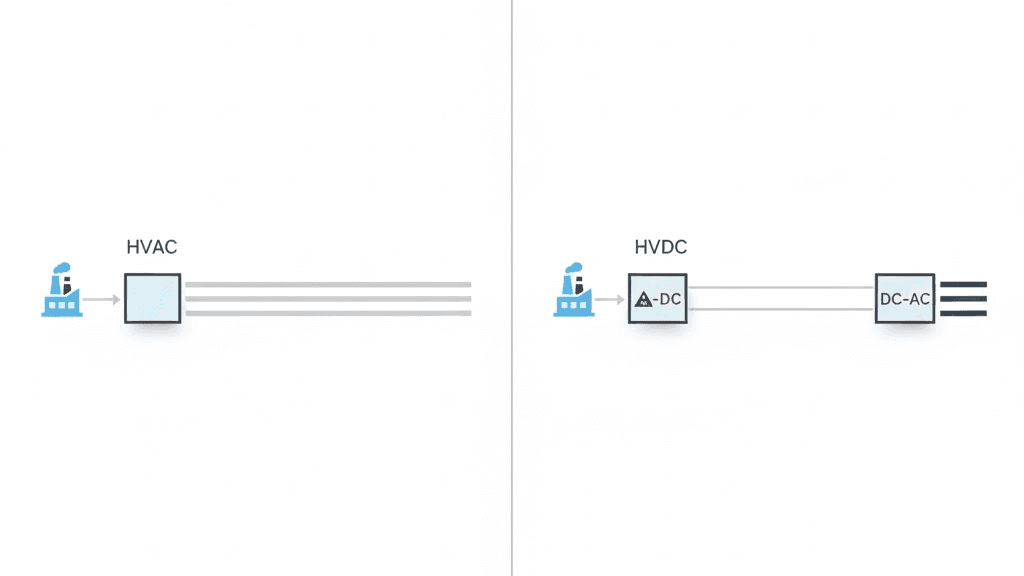
System structure | Simple: generation, step-up, lines | Complex: needs converter stations at both ends |
Initial cost | Lower | Higher (converter stations, filters) |
Power flow direction | One direction | Bidirectional on the same link |
Transmission losses | Higher, rise with distance | Lower, nearly constant with distance |
Tower and land | Three conductors, bulkier towers | Two conductors, smaller footprint |
Best suited for | Shorter lines, same-frequency grids | Long distances, subsea cables, frequency links |
Can HVAC and HVDC Connect Grids of Different Frequencies?
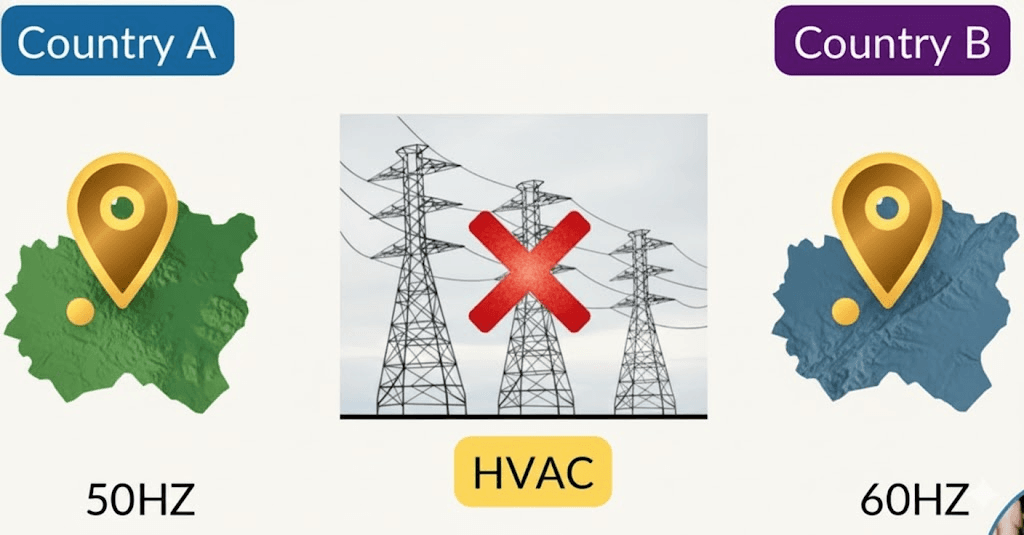
HVAC cannot connect grids of different frequencies, but HVDC can. For two AC systems to link directly, they must run at the same frequency. If one country runs at 50 Hz and a neighbour runs at 60 Hz, HVAC cannot join them.
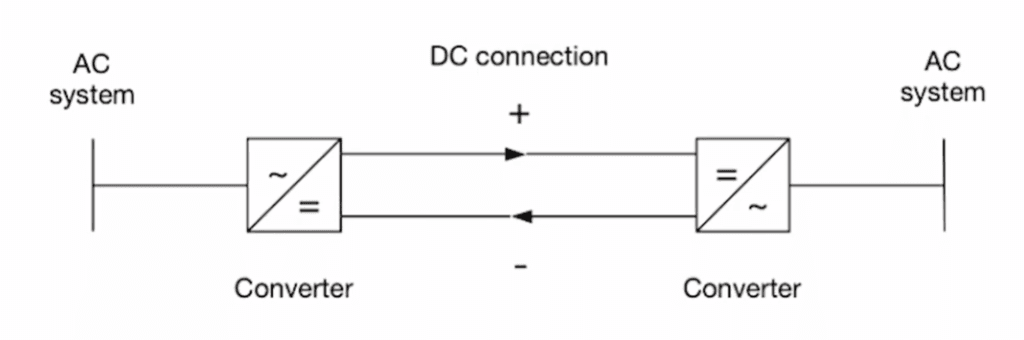
HVDC removes that barrier. It converts the AC to DC, which has no frequency, transmits the DC, then converts it back to AC at the required frequency at the receiving end. This makes HVDC the only option for connecting systems that run at different frequencies.
Which Handles Long Distances and High Capacity Better?
HVDC handles long distances and high capacity far better than HVAC. AC lines carry unavoidable inductance and capacitance, which limit both how far and how much power a line can transmit. As distance grows, losses and heating rise, which is why very long AC lines are impractical.
HVDC does not face this. With only resistance in play, there is no strict limit on distance or capacity, and long HVDC links already carry large blocks of power over great distances. The gap is even wider for cables: AC underground and subsea cables suffer strong capacitive effects, while HVDC avoids that problem, so HVDC is the preferred choice for long cable routes.
Why Does HVAC Need Thicker Conductors?
HVAC needs thicker conductors because of the skin effect, while HVDC can use thinner ones. In an AC line, current concentrates near the conductor surface rather than flowing evenly, and this effect grows with frequency. A large part of the conductor goes unused, so a thicker conductor is needed to carry the same power, which raises material and cost.
HVDC has no frequency, so there is no skin effect. Current flows through the full conductor cross-section, which means a thinner conductor can carry the same power. That directly lowers conductor cost and improves efficiency.
How Do Their System Structures Differ?
HVAC has a simple structure, while HVDC is more complex because it needs converter stations. In HVAC, generators produce power at a lower voltage, step-up transformers raise it for transmission, and it flows over the lines. That is the whole chain.
HVDC adds conversion at both ends. The AC first enters a converter station that turns it into DC, the DC travels over the line, and a second converter station turns it back into AC before connecting to the grid. Those extra components make HVDC more complex to design and operate.
Which Is Cheaper, and What Is the Break-Even Distance?
HVAC is cheaper to build, but HVDC becomes cheaper beyond the break-even distance. HVAC needs a lower initial investment because substations, transformers, and related equipment cost less. HVDC carries a high upfront cost, mainly from the converter stations, and sometimes extra reactive-power compensation and AC harmonic filters.
The break-even distance is the point where the total cost of the two systems is equal. Below it, HVAC is the more economical choice. Beyond it, HVDC becomes the better financial option because its lower losses outweigh the converter-station cost. Engineers run this analysis before selecting a transmission method.
Which Allows Bidirectional Power Flow?
HVDC allows bidirectional power flow on the same link; HVAC generally flows in one direction from source to load. In HVAC, power moves from the source to the destination.
HVDC, and especially back-to-back HVDC configurations, can send power from one system to another and reverse the direction using the same infrastructure. That flexibility supports load balancing between regions and is not available in a standard HVAC line.
Which Has Lower Transmission Losses?
HVDC has lower transmission losses, and they stay nearly constant with distance. HVAC losses are higher because of inductance and capacitance, and they rise as the line gets longer.
In HVDC, losses depend only on resistance, so they remain nearly constant even over long lines. The converter stations add some loss, but the overall losses in an HVDC link are still lower than in an equivalent HVAC line over long distances.
How Do Tower Design and Environmental Impact Compare?
HVAC towers carry three conductors and need more steel and land; HVDC towers carry two conductors with a smaller footprint. The three-conductor HVAC tower is bulkier and needs more material and land.
HVDC towers use only two conductors, which simplifies the design, reduces steel, and shrinks the land footprint. For an equivalent transfer, that generally makes HVDC the more environmentally efficient option.
HVAC vs HVDC: Which Should You Choose?
Choose HVAC for shorter lines and same-frequency grids; choose HVDC for long distances, subsea cables, and links between grids of different frequencies. Neither is universally better. The right method depends on distance, cost, frequency requirements, and the specific transmission need, which is exactly what the break-even analysis is designed to settle.
Frequently Asked Questions
What is the main difference between HVAC and HVDC?
Distance and control. HVAC is cheaper and simpler for shorter lines, while HVDC carries bulk power over long distances with lower losses, links grids of different frequencies, and supports bidirectional flow. The trade-off is HVDC's high upfront converter-station cost.
Why is HVDC used for long distances instead of HVAC?
AC lines are limited by inductance and capacitance, so losses and heating rise with distance. DC lines are limited only by resistance, so there is no strict distance limit and losses stay nearly constant, which makes HVDC better for long routes.
Is HVDC cheaper than HVAC?
Only beyond the break-even distance. HVAC has a lower initial cost, but past the break-even point HVDC's lower losses make it the cheaper option overall. Below that distance, HVAC stays more economical.
Why can't HVAC connect two grids at different frequencies?
Two AC systems must share the same frequency to connect directly. HVDC converts to DC in the middle, which has no frequency, so it can join a 50 Hz grid and a 60 Hz grid that HVAC cannot.
Which is better for submarine cables, HVAC or HVDC?
HVDC. Long AC subsea cables suffer strong capacitive effects that limit their length, while DC cables do not, so most long submarine links use HVDC.
Conclusion
HVAC and HVDC are not rivals so much as tools for different jobs. HVAC remains the simpler, cheaper backbone of most grids, while HVDC earns its place on the long, undersea, and cross-frequency links where AC runs out of room. Learn the break-even distance and the parameters in the table above, and the choice becomes a straightforward engineering decision.
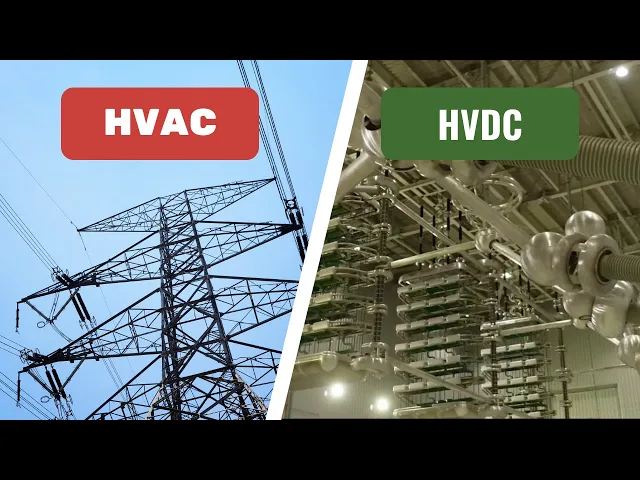
For the full visual comparison, watch the video below.
Watch the Youtube Video

About Author
Gaurav Joshi
Gaurav started his career on the floor of the electrical industry — not in a classroom. Working across Siemens and Schneider Electric, he saw firsthand how wide the gap was between what colleges teach and what the industry actually needs.
So he did something about it.
Today, he's built a global community of 300,000+ engineers and professionals across YouTube and beyond — and TheElectricalGuy Academy is where that knowledge lives in its most structured, practical form.