
Have you ever wondered why power quality matters so much? The answer is simple. It directly affects money, performance, and reliability. Poor power quality in power systems causes industries and utilities to lose millions of dollars every year.
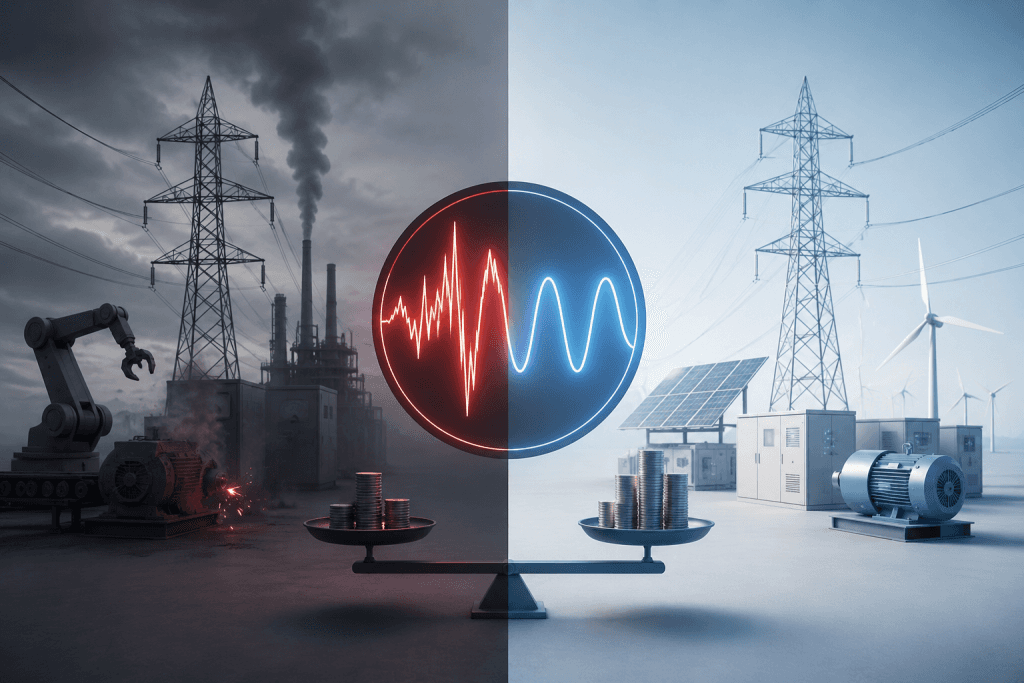
Even a small disturbance can stop machines, damage equipment, and interrupt operations. That is why power quality has become a major concern in modern electrical systems.
Why Power Quality Matters for Industries
Modern industries now depend heavily on automation and advanced technology. These systems improve productivity and reduce operational costs. However, they also become more sensitive to voltage disturbances.
Older electromechanical systems were more robust. In contrast, modern electronic equipment reacts quickly to supply fluctuations. Even a brief disturbance can create major problems.
Imagine a momentary power disturbance caused by a utility breaker operation. That small event can stop an entire production line. Restarting the process may cost around $10,000 in some industries.
In certain cases, restarting the complete line can take up to 4 hours. That means production loss, delayed delivery, and financial stress.
Semiconductor industries face even bigger risks. Small voltage sags can create huge losses. Because of this issue, the SEMI F47 standard was developed. This standard defines voltage sag immunity requirements for semiconductor equipment.
So, industries now focus heavily on maintaining proper power quality in power systems.
Common Industrial Problems Due to Poor Power Quality
Poor power quality creates many operational issues inside industries. One major problem is overheating of three-phase motors. Continuous stress may finally lead to mechanical failure.
Equipment lifetime also reduces because of overheating. As stress increases, the overall system reliability decreases. Another important issue is poor power factor. Utilities may directly apply penalties for maintaining low power factor.
Power quality problems also increase CO2 emissions. Inefficient operation consumes more energy and reduces system efficiency. Sometimes contractors and control relays trip unnecessarily. This creates unwanted interruptions and misoperation.
Production stoppages are another serious issue. Industries may also experience data corruption during disturbances. Non-compliance with grid codes creates additional complications. Maintenance and servicing costs also rise significantly.
All these issues prove that power quality in power systems is not a small topic. It directly impacts productivity and profitability.
Why Power Quality Matters for Utilities
Utilities also face major challenges due to poor power quality. Their biggest priority is customer satisfaction and reliability. Earlier, customers had limited utility options. However, competition has increased significantly today. Private utilities are entering the market rapidly.
If customers face repeated power quality issues, they may switch providers. This creates financial losses for utilities. Utilities must therefore maintain stable and reliable supply. Good power quality helps them retain customers and improve trust.
Residential users also feel the impact. Even if financial loss is small, poor service creates frustration. Today, many homes depend on computers and internet services. Even short interruptions create complaints and dissatisfaction.
Utilities must spend additional resources handling customer complaints, legal issues, and regulatory actions.
So, from the utility perspective, power quality in power systems is extremely important.
Utility Issues Caused by Poor Power Quality
Poor power quality creates technical problems for utilities as well. One major issue is high stress on generators. Generator stress may lead to premature failure and higher operational cost. If a generator fails, electricity production also gets affected.
Transformers may overheat due to harmonics. Over time, this reduces transformer life significantly. Overvoltage conditions can also cause insulation breakdown. This damages equipment and increases maintenance cost.
Grid efficiency reduces because of higher losses. Utilities may also face reduced network capacity and grid instability.
Increased downtime is another major challenge. Every interruption affects reliability and operational performance. All these issues show why utilities strongly focus on improving power quality in power systems.
Challenges Faced by Equipment Manufacturers
Equipment suppliers also face challenges related to power quality. Modern markets are highly competitive. Most customers demand lower prices. Because of this, manufacturers often reduce quality to lower costs.
As a result, some equipment cannot handle common power disturbances properly. Unless customers request it, manufacturers may not design for higher immunity. Therefore, users must ensure equipment meets required power performance standards.
However, many users remain unaware of these risks. In such situations, utilities can help by guiding customers properly. Utilities can provide useful information about power quality and equipment selection. This improves long-term reliability and performance.
Common Power Quality Problems
Power systems experience several types of power quality issues. These problems affect equipment performance and reliability.
Some common issues include:
Transients
Long duration voltage variations
Short duration voltage variations
Voltage imbalance
Waveform distortion
Voltage fluctuations
Power frequency variations
Each issue affects the system differently. Therefore, understanding these problems becomes very important for engineers and industries.
Conclusion
Power quality affects industries, utilities, and residential users alike. Even small disturbances can create major operational and financial losses. Modern equipment has become more sensitive than before. Because of this, maintaining stable supply is now more important than ever.
Understanding power quality helps improve reliability, efficiency, and equipment life. It also reduces downtime and unnecessary costs. For a clearer and more practical understanding, it is recommended to watch the full video explanation.
Watch the Youtube Video

About Author
Gaurav Joshi
Gaurav started his career on the floor of the electrical industry — not in a classroom. Working across Siemens and Schneider Electric, he saw firsthand how wide the gap was between what colleges teach and what the industry actually needs.
So he did something about it.
Today, he's built a global community of 300,000+ engineers and professionals across YouTube and beyond — and TheElectricalGuy Academy is where that knowledge lives in its most structured, practical form.